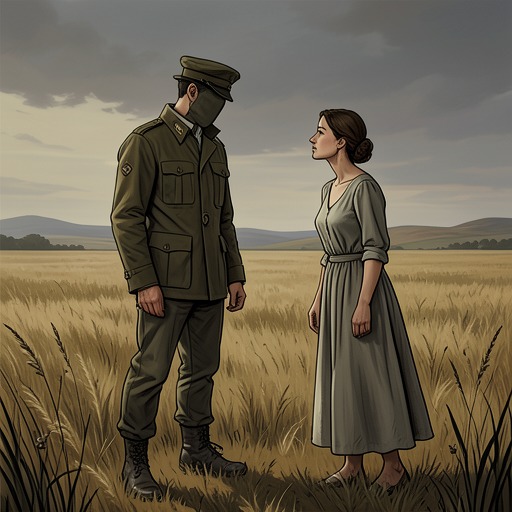
Frank “Darky” Gardiner
The Narrow Road to the Deep NorthFrank “Darky” Gardiner is an Australian prisoner of war in Dorrigo Evans’s J Force, remembered both for the comradeship that binds the prisoners and for a death that makes the railway’s violence personal. Beaten in the camp for a crime he did not commit, he is later found dead after apparently losing his balance in the communal latrine. His story also turns, unexpectedly, on an imagined act of release: returning to Australia and freeing the fish in a shop tank.
Identity and the railway
Gardiner is one of the Australian prisoners compelled to work on the Death Railway in the Siamese jungle. The railway is an imperial project built under conditions of extreme deprivation, with prisoners treated as labour and material rather than as people whose lives impose limits on the work. Japan had captured some 22,000 Australian POWs, and 9,000 were sent to the railway. The first train travelled the completed line on 25 October 1943; the achievement was measured against the human cost borne by the men made to build it.
Gardiner belongs to the thousand prisoners who left Changi as Evans’s J Force. They came from different parts of Australia and from varied military experiences, but the force remained a community in the prisoners’ understanding, even as death reduced its numbers. Its identity rested on mutual attachment: the living held to the dead as well as to one another, because abandoning the memory of those who had died threatened the meaning of survival itself. Gardiner’s fate is therefore both individual and part of a collective history that the railway’s official commemoration does not fully preserve.
Survival and the imagined fish
Life on the line contracts around necessities. Prisoners clear jungle, break rock, move earth, and carry the railway’s sleepers and rails with primitive tools; they are starved, beaten, and worked past exhaustion. Small reprieves—a duck egg, a little palm sugar, or a familiar joke repeated among the men—help make continued survival possible. Against this narrowing world, Gardiner’s attention to fish gives him a private image of life beyond the camp.
While ill and being taken toward the hospital, Gardiner speaks about the fish swimming in the tank at Nikitaris’s Fish Shop. He regards their confinement as resembling the prisoners’ own and imagines that, once he is back home, he will take them to the docks and release them into the sea. His plan is fanciful in its circumstances, but its impulse is plain: he imagines freedom not only for himself but for other captive creatures. In the camp, where so much effort is dictated by the railway, the thought preserves a small space for choice and care.
The fish also connect the jungle camp to a remembered life elsewhere. Gardiner’s talk moves between the tank and the possibility of returning home, while the men listening cannot be certain how much of his imagined scene he is consciously following. That uncertainty belongs to their account of him in this moment; it does not erase the force of the image. The fish become a measure of what captivity has made recognizable to him, and of the release he hopes someday to offer.
Beating, death, and aftermath
During the monsoon rain, roughly a hundred prisoners are assembled on the parade ground to witness Gardiner being beaten by the Goanna, Choi Sang-min, for a crime he had not committed. As prisoners return from work, guards make them join the gathering. When the Goanna tires, two other guards take over. The prisoners are present but have little power to intervene; some retreat into memories of family meals, while others find small ways to occupy their attention. The beating is remembered as something beyond their control, like an event they can only endure as it happens.
Gardiner is taken to the hospital after the beating. Late that night, he is found dead in the communal latrine. The account says he had apparently made his way there from the hospital, then lost his balance and fallen in; too weak to get out, he drowned. Jimmy Bigelow volunteers to be lowered by rope to bring the body out. His action gives the aftermath a practical, collective character: even in death, Gardiner is not left entirely alone, and another prisoner accepts the difficult task of recovering him.
The written account of Choi Sang-min’s later Australian military trial records that the charge concerning the murder of Australian Imperial Force Sergeant Frank Gardiner was dismissed because the written testimonies were contradictory. Other charges, including ill-treatment and the withholding of food and medical supplies, were upheld, and Choi was sentenced to execution. The trial passage thus distinguishes the dismissed murder charge from the convictions that remained; it does not undo the beating witnessed by the prisoners or Gardiner’s death in the camp.
Memory and narrative significance
Gardiner’s own thoughts briefly turn from immediate survival to the prospect of being forgotten. Surrounded by a living world that will continue without him, he imagines that neither the jungle nor the railway will retain any memory of his passing. The fear is not simply of death, but of becoming insignificant within a history that carries on as though he had never been there. His perception echoes the larger problem of remembering the railway’s dead: many of the forced labourers who died there have no names preserved in a shared record, and even the total number of deaths remains uncertain.
The novel places this awareness beside the ordinary gestures of prisoner solidarity: a plan to free fish, a man helping retrieve a body, and a force that continues to understand itself as a community despite its losses. Gardiner’s story does not make suffering redemptive. Instead, it shows how the men’s bonds and acts of care persist within a system designed to consume their labour and disregard their lives. His death stands at once for an individual lost to the railway and for the wider danger that, without remembrance, the loss will seem never to have happened.