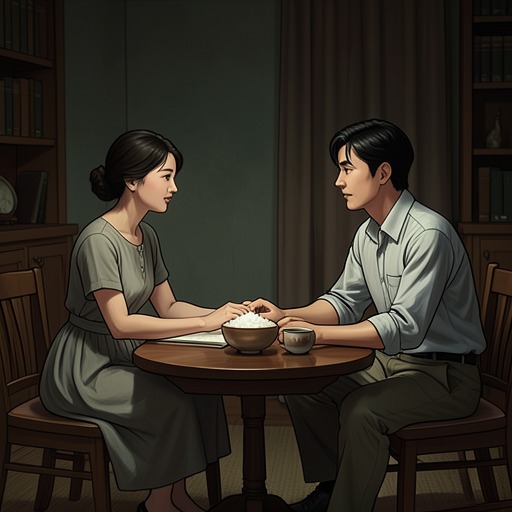
Ikuko Kawabata
The Narrow Road to the Deep NorthIkuko Kawabata is a nurse whose quiet presence shapes Tenji Nakamura’s postwar life. Having survived profound family losses, she keeps her own story largely unspoken; later, through her practical care during Nakamura’s illness, she becomes the person whose presence and touch make his suffering bearable and alter how he understands himself.
Background and Introduction
Ikuko enters the narrative in the years after the war, when Nakamura meets her as a young nurse. Her parents were killed in the firebombing of Kobe in the war’s final months, and after peace her brother died of starvation. The city around her had become a wasteland of rubble and ruins. Her losses are presented as part of a wider postwar devastation: her story was so commonplace that she, like many others, found it better not to speak about it. That silence gives her history weight without making her a public witness or a narrator of her own suffering.
The account first describes her through details that Nakamura notices: a large birthmark on her right cheek, lustrous skin, and a relaxed smile. These impressions do not amount to a full account of her interior life; they reveal instead how closely the narrative’s early portrait is filtered through his responses. Her smile can settle disagreements, which he finds agreeable, but he also interprets it as evidence of weakness. The same gesture attracts and irritates him, exposing his difficulty in receiving another person’s warmth without judging it.
Work and Life with Nakamura
Through Ikuko, Nakamura finds work in a hospital, first as an orderly and then as a storeroom clerk. The new employment lets him leave behind unsafe, unprofitable black-market work and the fear that he might be exposed and handed over to the Americans. He continues to avoid other people, but his reserve belongs to a postwar world in which many seem to understand why others would prefer not to be known. His move into Ikuko’s home is correspondingly mixed: he values the solitude it preserves as much as any human company.
Nakamura appreciates that Ikuko is healthy and a good housekeeper, describing her virtues in practical terms. Yet the relationship is not limited to household convenience. He grows accustomed to her presence even while keeping himself at a distance, and she remains a steady part of the life he is trying to reconstruct. His early judgments of her smile and character contrast with the importance he later gives to her ordinary companionship. The change is not presented as a sudden conversion: it develops through the domestic life they share and, most powerfully, through the care she gives him when he is ill.
Marriage and Family
As the last imprisoned war criminals are released, Nakamura gives up his concealment and returns to his real name. The following year, he marries Ikuko. They have two daughters, both healthy, and the children grow to love their gentle father. The family offers a durable setting for Nakamura’s life after evasion, although the narrative does not suggest that marriage or fatherhood erases his past.
The daughters see a man who can seem almost to belong to another world: he misbuttons his shirts, forgets his belt, and takes care not to harm spiders, carrying them outside rather than killing them. These habits contribute to the image of gentleness that surrounds him at home. Ikuko’s presence belongs to this family life, but the account most distinctly shows her character through action rather than through the children’s descriptions: she works, tends to the household, and later reorganizes her days around Nakamura’s needs.
Care During Nakamura’s Illness
When Nakamura develops throat cancer, surgery and radiotherapy leave him weakened and make eating difficult. As he recovers, he becomes newly attentive to Ikuko’s health and to the goodness he associates with her. She devotes herself to his care while remaining light and pleasant, even as he depends on her through a prolonged illness. The narration describes his recognition of her in contrast to his earlier ambivalence: qualities he once treated as merely agreeable or irritating become signs of a goodness he had failed to value.
Every morning before going to work, Ikuko rises two hours early to attend to his needs. Nakamura admires her practical nature, but what matters most to him is her presence and touch. He longs for her to sit beside him and run the backs of her fingers down his face. Although she considers doing nothing a waste of time, that unoccupied closeness is precious to him: for a while, his fear recedes and his pain becomes bearable. The significance lies in the modest scale of the gesture. Her care is neither a speech nor a cure; it is repeated attention that gives him intervals of comfort.
Character and Narrative Significance
Ikuko’s effect on Nakamura extends beyond nursing. He believes her goodness draws out goodness in him: he bears illness with more humour and stoicism, visits people who are sicker, helps a charity deliver meals to older people, and becomes kinder to family, friends, neighbours, and strangers. His discovery that he can act well brings him comfort as he faces cancer. The novel nevertheless complicates his self-image: his conviction that he is a good man exists alongside his history of overseeing deaths and his limited sense of responsibility for them. Ikuko’s care changes his daily conduct and his understanding of himself, but it does not settle the question of what goodness can mean after violence.
Her role is therefore defined less by explanation than by constancy. Ikuko has endured wartime and postwar bereavement, yet the narrative gives little account of how she privately interprets those losses. Instead, it shows her continuing to work and care for others, and it registers the contrast between Nakamura’s earlier dismissiveness and his later dependence. She becomes central to his experience not because she resolves his past, but because her ordinary, sustained attention makes intimacy possible in a life shaped by concealment, illness, and uneasy self-reckoning.