Impermanence and the “world of dew”
The Narrow Road to the Deep NorthImpermanence and the “world of dew” is the book’s meditation on the evanescence of human power and the difficulty of making suffering endure in public memory. Its central image is the Death Railway: conceived as a strategic instrument of empire, built through coercion and mass death, then abandoned and physically reclaimed by the landscape. Against that history, the brief poem by Issa—“This world of dew / is only a world of dew—and yet.”—holds together the knowledge that all things pass and the insistence that passing does not make them meaningless.
A railway made under the sign of impermanence
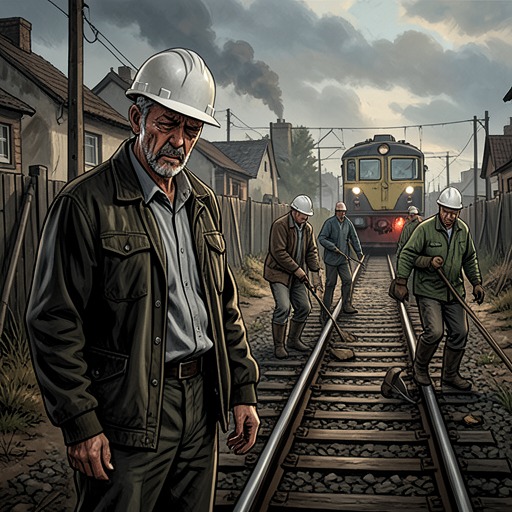
The railway first appears not as a finished monument but as a line of surveyors’ pegs. When Dorrigo Evans reaches Siam in early 1943, Imperial Japanese Army engineers have marked out a route running 415 kilometres from north of Bangkok toward Burma. The prisoners are given blunt axes and rotten hemp rope and ordered to clear a kilometre of giant teak trees. The distance and the pegs give the plan a stark physical precision, even as the book presents it as a project of limited plans, impossible orders, and grand exhortations. Its intended permanence is already shadowed by the unreality of the scheme that produced it.
The larger military purpose makes the contradiction sharper. After the fall of Singapore, Japan is overstretched and under-resourced. The Allies control the seas, while supplies reach Chiang Kai-shek’s Chinese Nationalist Army through Burma; Japanese leaders seek a land route to sustain their forces in Burma and advance their ambitions toward India. They lack the money, machinery, and time to build the railway by ordinary means. The Empire’s belief in victory and the Emperor’s will is joined to the availability of enslaved labour. The grand line through the landscape is therefore not simply an engineering achievement: its apparent solidity depends on lives treated as expendable.
Even its construction is subject to revisions that multiply the demand on those lives. Although a major cutting is already half complete, the Railway Command Group changes Nakamura’s plans and orders it enlarged by a third to address gradients in the next sector. The revision requires another 3,000 cubic metres of rock to be cut and carried away. Prisoners work by hand with hammers and chisels; there are too few tools, and the available chisels cannot reliably be sharpened because the forge lacks coke. The contrast between technical calculations and inadequate equipment shows how a project presented as a line of progress is made through material shortage and bodily labour.
The human cost and the failures of the record
The railway’s completion does not resolve the violence that made it possible. On 25 October 1943, locomotive C 5631 travels the length of the completed line, carrying Japanese and Thai dignitaries in three carriages. By then, its route passes countless human remains. Of the 22,000 Australian prisoners of war, 9,000 are sent to railway work, and one in three of those Australians will die. They are only part of the labour force: about 60,000 Allied prisoners work on the project alongside a quarter of a million Tamils, Chinese, Javanese, Malayans, Thais, and Burmese, or more. Estimates of deaths among these enslaved labourers range from 50,000 to 200,000. The uncertainty is not a minor gap in the accounting; it is part of the history of a mass death for which no agreed total exists.
The book sets the locomotive’s later display against that missing record. C 5631 stands in the museum associated with Yasukuni Shrine in Tokyo, beside the Book of Souls, which lists more than two million people who died in service to the Emperor of Japan between 1867 and 1951. The shrine’s practice of enshrinement confers absolution, and among those listed are 1,068 men convicted of war crimes after the Second World War and executed, including men found guilty of mistreating prisoners on the railway. Yet the locomotive’s plaque makes no mention of the railway’s horror; it names none of the hundreds of thousands who died building it. Against the carefully preserved machine and the named dead of the shrine, the labourers remain largely uncounted and forgotten.
The narrative frames its own account as a fragment offered in response to that absence. Dorrigo Evans has been writing a foreword to a book of Guy Hendricks’s illustrations of the prisoner-of-war camps, a task he has struggled to complete for months. Even when finished, it feels to him like another failed attempt to understand what the railway means. The book’s reflection on remembrance therefore does not claim to repair the missing record or settle the death toll. It acknowledges that the suffering may survive only in these pages and a few others, and gives the forgotten dead this fragment rather than pretending that a fragment can contain the whole.
The Line’s disappearance
The end of the war removes the railway’s purpose and support. Japanese engineers and guards are imprisoned or repatriated, while the enslaved people still assigned to maintain the Line are freed. Within weeks, the railway begins to be dismantled: the Thais abandon it, the English take it apart, and tribespeople pull up and sell its materials. What had been imposed as a continuous route is broken up by successive human decisions, each stripping away another claim to permanence.
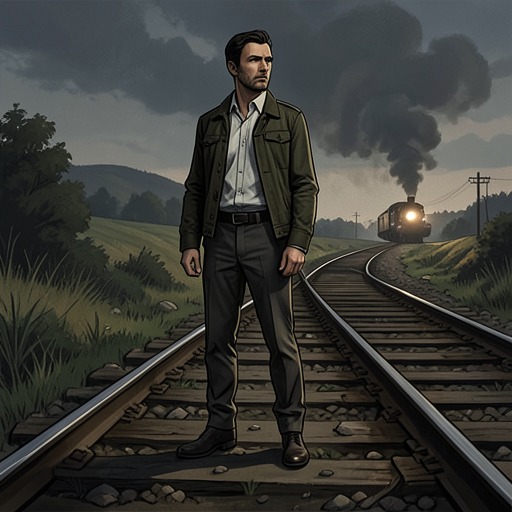
Then the landscape alters what remains. The Line bends and warps; banks break, embankments and bridges wash away, and cuttings fill in. The book describes vegetation growing through the works of forced labour: seeds germinate in mass graves, while weeds enter the embankments, termites consume fallen bridge timbers, and rust and rot spread over the railway iron. These details make the return of life inseparable from the evidence of death. Nature does not restore the victims or undo the labour; it overtakes the structures built with their bodies and tools.
Decades later, a few short stretches are cleared by people who believe memory matters and become tourist, sacred, or national sites. Such preservation is partial: the long railway cannot be restored as a whole, and the commemorated sections stand amid a wider ruin. The Line is broken, its purpose has vanished, and nothing of the imperial dream remains except long grass. The transformation does not make the project harmless in retrospect; it exposes how temporary its apparent mastery of the land was.
“And yet”
The paired lines attributed to Issa give the book’s account of impermanence its unresolved form: “This world of dew” is, indeed, only a world of dew, “and yet.” The ending does not cancel the poem’s recognition of transience, nor does it promise that suffering will be answered by justice or preserved in full. The conjunction leaves a pressure against resignation: even when the railway has disappeared and the dead have no complete roll of names, remembering and bearing witness remain consequential acts.
Another Issa poem, “In this world / we walk on the roof of hell / gazing at flowers,” places fragile beauty beside extreme suffering without making either unreal. The contrast resonates with the railway’s history: flowers and vegetation return among the remains, but their presence is not an explanation for the deaths. In this conception, impermanence is neither a moral ledger in which later growth repays violence nor a reason to dismiss what has vanished. It is the condition in which power and monuments fail, traces survive unevenly, and the living remain responsible for what they choose to remember.