Jack Rainbow
The Narrow Road to the Deep NorthJack Rainbow is an Australian prisoner of war whose story turns on the gap between a doctor’s effort to save an individual and the deprivation that governs the prisoners’ lives. A hop farmer with a soldier’s blunt humour, he is also a performer who helps his companions make a scene out of their suffering. As illness and disability transform his body, the camp’s makeshift medical care offers moments of hope but cannot reliably overcome the conditions around him.
Identity and Introduction
Rainbow appears among the Australian prisoners working on the railway for the Japanese. His first defining feature is his voice: the narration contrasts his austere, anchorite-like face with the rough speech of a wharf worker, although he is a hop farmer. That mismatch gives him a comic edge, but his remarks also register how little the prisoners understand their surroundings. He insists that the camp is far to the north, not east of Australia, and observes that they cannot even work out where the next village is. The joke lands against a serious fact: they are isolated, uncertain of their location, and dependent on others for information about the world beyond their immediate confinement.
His banter with Darky Gardiner makes death part of the prisoners’ ordinary conversation. Darky wagers that he will be dead by breakfast, presenting the prediction as almost fair odds; Rainbow replies that he would rather shoot him then and there. The exchange is darkly playful rather than a stated plan. Its casualness shows how danger has entered the men’s everyday speech: death is not an abstract possibility, but a subject they can use to tease one another.
Performance and Fellow Prisoners
As the railway labour takes a physical toll, Rainbow loses his sight. He performs with Les Whittle, whose fingers have been lost to pellagra and who plays an accordion held together with stitching and buffalo-hide patches, using bamboo sticks tied to his wrist. Rainbow sings for him. Their partnership makes performance possible through the adaptations each man must make, while their presence onstage refuses to reduce them to passive objects of pity.
The pair also act out a scene from the film Waterloo Bridge. Whittle takes the role of Robert Taylor; the blind Rainbow plays Vivien Leigh. They walk towards each other across a bamboo bridge and deliver the scene’s reunion dialogue in character. Their performance draws laughter from the prisoners before they play the film’s signature song, “Auld Lang Syne.” The scene gives the camp a shared interval of amusement, but its borrowed romance and reunion also sharpen the contrast between the performers’ theatrical meeting and their actual circumstances. Rainbow’s blindness is part of the scene, not an obstacle that prevents him from taking a role, singing, or helping sustain the group’s performance.
Illness and Emergency Treatment
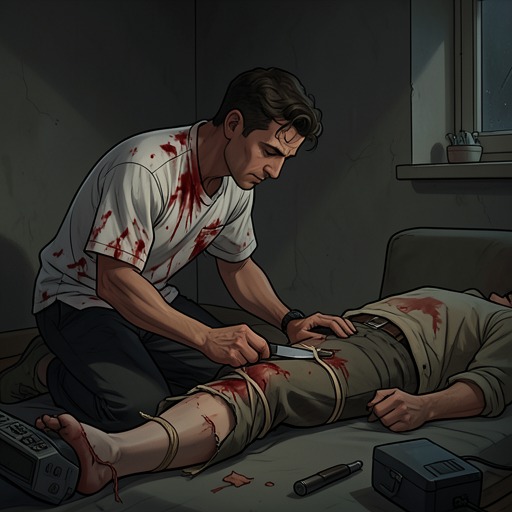
Rainbow later becomes one of the patients in the ulcer hut, where Dorrigo Evans encounters him after two previous operations. Dorrigo had first amputated Rainbow’s leg below the knee after the ulcer there had damaged the shin and ankle bone. When gangrene developed around the stump, Dorrigo amputated higher up the thigh. Three weeks later, the orderlies bring Rainbow back, and Dorrigo must confront further bleeding and infection in the primitive ward.
There is no proper tourniquet. Dorrigo unbuckles his own belt, wraps it around what remains of Rainbow’s thigh, and tightens it until the bleeding slows. Rainbow is too weak to drink from a tin can without spilling the water. The episode establishes the limits of the hut as much as the urgency of Dorrigo’s response: the doctor improvises with what he has, and even a basic piece of equipment is unavailable.
During a later operation, Dorrigo works with Squizzy Taylor, who uses a spoon at his direction while Dorrigo tries to repair the damage. At first Dorrigo believes he has succeeded. He thinks Rainbow will live, though infection and recovery remain risks, and imagines him as a middle-aged man with children, his amputated leg resting on a cushion. That imagined future lets Dorrigo feel, briefly, that his work has meaning and that he has not failed. The hope is provisional, grounded in the operation’s apparent result rather than any guarantee of recovery.
Death and Aftermath
The apparent success does not last. Dorrigo continues working carefully, trying to find the artery and secure the repair, but Rainbow has already been dead for several minutes before anyone knows how to tell him. The change from expected survival to death makes the operation’s outcome more than a medical reversal: it exposes the helplessness concealed by Dorrigo’s concentration. His skill and care are real, but they cannot undo the accumulated effects of illness, repeated surgery, and the camp’s inadequate resources.
A later account also links Rainbow’s name to the prisoners’ uncertain postwar fate. Dorrigo is handed a shoebox of ribbons and medals bearing the name and address of Mrs Jack Rainbow. In the same conversation, a prisoner recounts Les Whittle’s death in a coal mine in Japan: after the war, a supply drum dropped for the starving prisoners crashed through a roof and killed him. The account does not establish the box’s contents or explain precisely how it came to bear Rainbow’s wife’s details. Its presence nevertheless connects the wartime companions to lives and losses that outlast the camp, without offering a clean or consoling resolution.
Narrative Significance
Rainbow’s story repeatedly places performance beside physical vulnerability. His comic exchange with Darky, his singing with Whittle, and the prisoners’ laughter during Waterloo Bridge show companionship as something enacted even under coercive conditions. These moments do not make illness or captivity redemptive; they show the prisoners creating occasions for recognition and shared feeling within circumstances they cannot control.
His final operation also complicates Dorrigo’s role as a healer. For a short time, the doctor’s imagined future for Rainbow seems to affirm that care can restore a life. Rainbow’s death reveals how fragile that conviction is when treatment takes place without adequate equipment or dependable conditions for recovery. The contrast between the operation’s brief promise and its actual ending makes Rainbow a central figure in the novel’s account of responsibility: Dorrigo can respond to suffering with ingenuity and attention, yet those efforts do not amount to mastery over it.