Japanese Empire
The Narrow Road to the Deep NorthThe Japanese Empire is presented as a wartime power whose belief in inevitable victory helped drive the construction of the Death Railway at immense human cost. Facing military and material limits, it converted an urgent strategic objective into a 415-kilometre route built by coerced workers; after defeat, the railway was dismantled, and the empire’s legacy remained entangled with selective remembrance and uncertain accounting for the dead.
Imperial ambition and strategic crisis
The narrative places the project in the aftermath of the fall of Singapore on 15 February 1942, when one empire ended and another rose. By 1943, however, the Japanese Empire was overstretched, under-resourced, and losing. The Allies supplied Chiang Kai-shek’s Nationalist army through Burma, while American control of the seas made land transport increasingly important to the empire’s plans. Its leaders sought to supply forces in Burma and pursue the further ambition of taking India, but the empire lacked the money, machinery, and time to build the railway it required.
The account sets this practical crisis against the empire’s conviction that it would prevail through the Japanese spirit, understood as the Emperor’s will. Belief in that spirit did not remove the shortage of equipment or the urgency of the military timetable. Instead, the empire’s access to enslaved labor—Asian and European—made a project that otherwise seemed impossible appear achievable. The contrast between limited resources and vast confidence helps explain how a railway could be issued as a command before its physical and human costs had been reckoned with.
The railway as an imperial undertaking
In early 1943, Imperial Japanese Army engineers marked the projected route with surveyors’ pegs. The line ran 415 kilometres from north of Bangkok toward Burma. At that stage it existed as a route on the ground and a set of limited plans, orders, and exhortations from the Japanese High Command; its completion depended on transforming that abstraction into cuttings, track, and transport infrastructure through the labor of prisoners and other enslaved people.
Twenty-two thousand Australian prisoners of war were among the empire’s captives, most of them surrendered at the fall of Singapore before the fighting had properly begun. Nine thousand were sent to work on the railway. The project’s strategic purpose became visible in its first full-length train: on 25 October 1943, locomotive C 5631 travelled the completed route, towing three carriages of Japanese and Thai dignitaries. By then, the line passed countless graves, including the remains of one in three of the Australians sent to work on it.
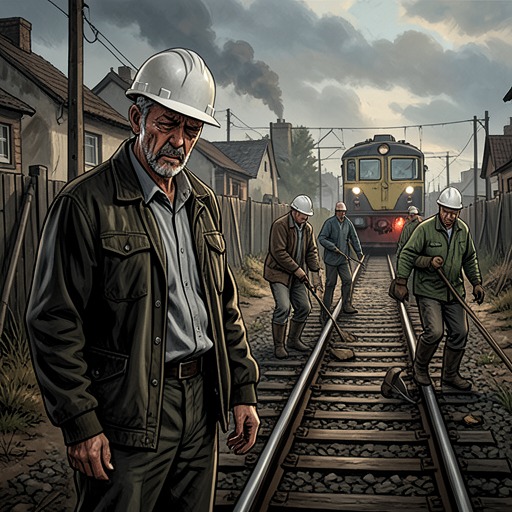
The railway’s engineering demands continued to change even as it was being built. When a major cutting was already half-complete, the Railway Command Group altered the plans and ordered it enlarged by a third to address gradient problems in the next sector. The revision required another 3,000 cubic metres of rock to be cut and removed. Prisoners worked with hammers and chisels; the available tools were inadequate, and there was not enough coke to keep the forge sharpening blunted chisels. The changing specification and the missing equipment show how decisions made within the command structure became additional physical labor at the worksite.
Forced labor and the human cost
The Australians were only a fraction of the workforce. The account estimates that roughly 60,000 Allied prisoners of war labored on the railway alongside a quarter of a million Tamils, Chinese, Javanese, Malayans, Thais, and Burmese, or more. Estimates of deaths among these other laborers vary dramatically: some historians give 50,000, others 100,000 or 200,000. There is no agreed total. The uncertainty is not a minor qualification to the railway’s history; it means that the scale of the loss cannot be fully counted, and that many of those who died cannot be individually named.
The completed railway thus embodies a mismatch between an imperial plan and the bodies used to realize it. A route measured in kilometres and earthworks could be revised by command, while the deprivation and deaths accompanying its construction resist any definitive tally. The empire’s ability to draw on coerced labor helped overcome its lack of machinery and time, but did not make the undertaking costless: the missing resources were answered by workers’ lives and suffering.
Defeat and postwar accountability
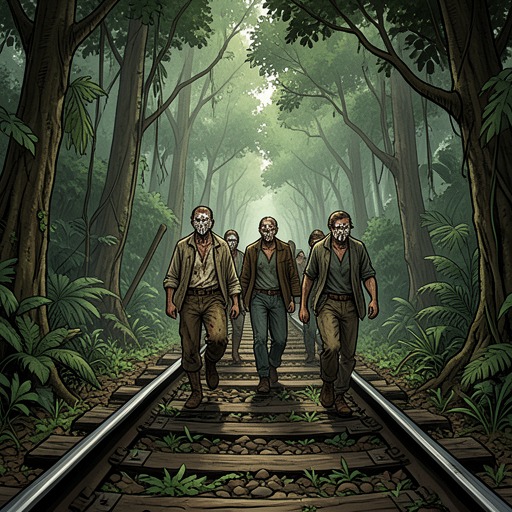
With the Japanese Empire’s defeat, the railway lost its military purpose and support. Japanese engineers and guards responsible for it were imprisoned or repatriated, while the laborers who remained to maintain the line were freed. The Thais abandoned the railway, the English dismantled it, and tribespeople pulled up and sold sections. Its banks and bridges later gave way, its cuttings filled in, and vegetation returned to ground marked by graves and discarded tools.
The postwar record of responsibility is presented as uneven. An Australian military court tried Choi Sang-min, a Korean sergeant, for war crimes. The court dismissed the charge that he had participated in the murder of Australian Imperial Force Sergeant Frank Gardiner, but upheld the charge that he had ordered the murder of Private Wat Cooney, along with lesser charges of ill-treatment, including withholding food and medical supplies. He was sentenced to death. His account of the proceedings also points to the contested quality of the evidence: Colonel Kota’s statements had helped convict Korean and Formosan guards, although Choi believed Kota had been released without charge. The novel does not use this disparity to erase the charges against Choi; it shows how confused camp records, disputed testimony, and unequal outcomes shaped the postwar reckoning.
Another account of postwar justice describes a professor who hanged himself in prison, others whose death sentences were commuted and who were later freed, and a lingering preference among both the Americans and Japanese for forgetting. Together, these outcomes complicate any simple picture of punishment as a complete accounting for the empire’s wartime conduct.
Memorials, erasure, and the Line’s afterlife
Locomotive C 5631 is displayed at the museum associated with Yasukuni Shrine in Tokyo, an unofficial national war memorial. The shrine also holds the Book of Souls, which lists more than two million people who died in service to the Emperor of Japan in wars between 1867 and 1951. Enshrinement at the site is associated with absolution. Among the names are 1,068 men convicted of war crimes after the Second World War and executed, including men found guilty of mistreating prisoners on the Death Railway.
Yet the plaque before the locomotive says nothing of the railway’s construction or its dead. Nor does it name the hundreds of thousands who worked on the line. The contrast between the displayed machine and the absent laborers makes commemoration itself part of the empire’s aftermath: the object that completed the journey is preserved, while the people who made that journey possible remain largely unrecorded. No book gathers the names of many of the laborers who died, and no agreed count can restore what the records do not preserve.
After its abandonment, the railway was dismantled, warped, washed away, and gradually reclaimed by vegetation. Decades later, short stretches were cleared and turned into tourist, sacred, or national sites by people who believed memory mattered. But the surviving fragments could not make the original project whole again. The Line was broken, and the imperial purpose for which it had been built had vanished; in the landscape’s final image, long grass covers the remnants of imperial dreams and dead men.