Japanese High Command
The Narrow Road to the Deep NorthThe Japanese High Command is the strategic authority behind the Death Railway, a military project conceived to sustain Japanese forces in Burma when the war was turning against the Japanese Empire. Its order to build the line in the shortest possible time set imperial ambition against the limits of terrain, supplies, and human endurance. The railway’s completion was presented as an engineering achievement; the labor and deaths that made it possible, and the later silencing of those costs, reveal the project’s deeper history.
Strategic Purpose and Imperial Confidence
The railway’s strategic rationale emerged from the changing fortunes of the war. After the fall of Singapore on 15 February 1942, the Japanese Empire sought a land route to supply its forces in Burma. The Allies were sending armaments to the Chinese Nationalist Army through Burma, while American control of the seas restricted Japan’s movement by water. Japanese leaders also imagined taking India through Burma. A railway promised to carry men and matériel overland, but the Japanese Empire lacked the money, machinery, and time to build one by conventional means.
The Japanese High Command nevertheless decreed that a railway joining Siam and Burma be built in the shortest time possible. Its confidence rested on the belief that the Japanese spirit, understood as the Emperor’s will, could prevail until final victory. The order therefore represented more than a transport plan: it joined military necessity to an imperial conviction that resolve could overcome practical impossibility.
From Decree to Construction
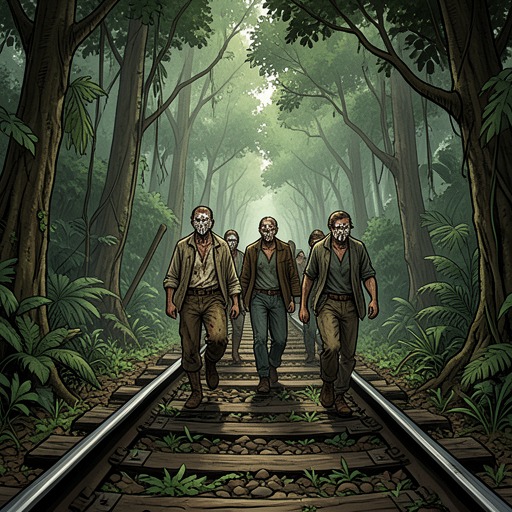
The scale of the project was visible in the surveyors’ pegs driven into the ground by Imperial Japanese Army engineers. They marked a route of 415 kilometres from north of Bangkok through to Burma. In early 1943, the line still existed in limited plans, orders, and exhortations, but the prisoners assigned to its construction were already being put to work. Their first task was to clear a kilometre of giant teak trees with blunt axes and rotten hemp rope.
Before the war, English and American investigators had considered a railway on this route impossible. For Tenji Nakamura, an officer in the Imperial Japanese Army’s Fifth Railway Regiment, the order initially carried the exhilaration of taking part in a historic national mission. Yet the engineering ambition quickly encountered the conditions the decree could not change. A later revision from the Railway Command Group required Nakamura’s existing cutting to be enlarged by a third to address gradients in the next sector, adding 3,000 cubic metres of rock to remove. Prisoners worked the rock by hand with hammers and chisels; tools were inadequate, and the available forge lacked enough coke to resharpen blunted chisels. These material failures show how a command for accelerated construction became labor imposed under conditions unable to support the demanded pace.
The Human Cost of the Project
The Japanese Empire’s reliance on enslaved labor made the railway possible on paper while transferring its impossible demands onto prisoners and Asian laborers. Of 22,000 Australian prisoners of war, most captured at the fall of Singapore, 9,000 were sent to work on the railway. They were only a fraction of the workforce: approximately 60,000 Allied prisoners and a quarter of a million or more Tamil, Chinese, Javanese, Malayan, Thai, and Burmese laborers worked on the project. Estimates of deaths among the Asian laborers range from 50,000 to 200,000, and the total was never agreed. The uncertainty is itself part of the history: many of the dead were left without names or a settled count.
On 25 October 1943, the steam locomotive C 5631 travelled the completed railway with three carriages carrying Japanese and Thai dignitaries. Its passage came after the deaths of vast numbers of laborers; the remains of one in three of the Australian prisoners sent to the line lay along its route. The railway’s inauguration thus joined a visible measure of completion to a human cost that the official achievement could not acknowledge.
Defeat, Ruin, and Public Memory
The railway lost its military purpose when the dream of a global Japanese Empire ended. Within weeks of the war’s end, the line was being abandoned: the Thais left it, the English dismantled it, and tribespeople pulled it up and sold it. Its banks broke, bridges and embankments washed away, and cuttings filled in. The physical system built to make imperial power move across the landscape did not endure; vegetation returned among the graves, bones, and railway materials.
The afterlife of C 5631 sharpens the contrast between commemoration and omission. The locomotive is displayed at the museum associated with Yasukuni Shrine in Tokyo, alongside the Book of Souls, which lists more than two million people who died in service to the Emperor of Japan between 1867 and 1951. The shrine’s enshrinement is associated with absolution, and the names include 1,068 men convicted of war crimes after the Second World War and executed, among them men found guilty of mistreating prisoners on the railway. Yet the locomotive’s plaque says nothing about the railway’s construction, and the display does not name the hundreds of thousands who died building it. The Japanese High Command’s railway therefore persists not only in the ruined route but in a divided public memory: a surviving machine commemorates the project while leaving its laborers and their suffering largely unrecorded.