Jimmy Bigelow
The Narrow Road to the Deep NorthJimmy Bigelow is an Australian soldier, prisoner of war, and bugler whose service carries him from the Middle East to a Japanese-run camp in the jungle. There he plays for daily funerals, helps fellow prisoners in small but consequential ways, and is selected for a march he understands may be fatal. After the war, his memory of captivity gradually recedes; what remains is less a record of violence than an enduring conviction that people can be good to one another.
Identity and Early Service
Before the jungle camp, Bigelow serves with Australian forces in the Middle East. During a pause in the fighting, he taps the dull edge of an axe and recalls his father’s complaint that the young never carry their share. The remembered words are mixed with a wish that his father were present now: an intimate measure of how the work and danger have changed the meaning of that old reproach.
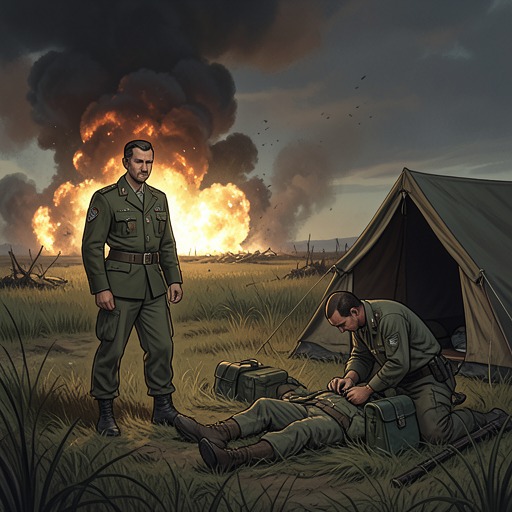
In a village under attack, Bigelow asks why Australians are fighting for the English against African soldiers serving the French, when both sides are trying to kill them. His question registers the bewilderment of a soldier caught in a conflict whose local stakes are difficult for him to understand. The shelling interrupts an uneasy breakfast with coffee and food obtained by his companions. When a shell arrives, Darky Gardiner pulls Dorrigo Evans down beside him, and the explosion passes through the group. Bigelow’s recollection of the scene belongs to a world where companionship and danger arrive together, without warning.
Bigelow also joins Dorrigo Evans in betting that Gardiner will survive the war. He backs that confidence with a simple declaration of faith in Gardiner as a survivor. Gardiner answers with a reflection on repeated coin tosses: even after the same result has appeared several times, the next toss remains statistically independent. The exchange gives their early comradeship a characteristic balance of affection, humor, and an awareness that neither confidence nor probability can guarantee what happens next.
The Bugler in the Prison Camp
In the camp, Bigelow’s bugle becomes part of the routine by which prisoners mark time and death. Its morning Reveille sounds over a landscape of tents, mud, and rainforest. Once cholera spreads, he is assigned camp duties that allow him to perform at the increasingly frequent funerals. He follows the stretchers with his bugle slung over his shoulder on a knotted rag, after its leather strap has rotted. Among the dead is Rabbit Hendricks. Bigelow is surprised by how little he feels, a response that anticipates the emotional distance he describes in other moments of the war.
The instrument appears unusually resistant to the decay around it: while materials and bodies deteriorate, the brass bugle continues to serve. Bigelow invests it with a sense of endurance, but playing is not effortless. At one funeral, illness has left his mouth and tongue painful and swollen. He must work around the physical difficulty to play the familiar Last Post, concentrating on breath and notes until he has completed the tune. His tears afterward come from the physical ordeal rather than an emotion he can identify. The scene makes the bugle’s ceremonial steadiness a hard-won act of labor, repeated for men who will remain in the jungle and may never return home.
Bigelow’s service as a bugler does not mean that he is untouched by what he witnesses. While accompanying Dorrigo Evans on rounds outside the cholera compound, he sometimes has to leave the ulcer hut because the conditions overwhelm him. At the same time, he continues to perform the work assigned to him. The contrast between this bodily limit and his repeated return to funeral duties shows how camp service depends less on invulnerability than on continuing when a task must be done.
Gardiner, Death, and the Outward Fold
Bigelow remains close to Gardiner after Gardiner is beaten by guards. When Gardiner tries to minimize what happened, Bigelow identifies the significance of the episode through the displaced detail of a fold. Later he offers Gardiner a cigarette and urges him to take it, insisting that death is not the only thing catching in the camp. Gardiner accepts the cigarette without touching it to his lips. Bigelow’s gestures do not undo the violence or promise recovery; they offer company and a small refusal to let the camp’s atmosphere of death define every exchange.
After Gardiner is found dead in the communal latrine, Bigelow volunteers to be lowered on a rope to bring the body out. He calls instructions to the men holding the rope and speaks to Gardiner while securing a second rope. His darkly comic remarks about the latrine and a blanket folded the wrong way combine familiar banter with grief. The task makes the bond between the men physical and practical: Bigelow risks entering the foul trench to recover his friend, then addresses him in the language they shared.
The fold becomes a rule Bigelow carries home. Decades later, he checks how his children have folded their clothes and insists that the fold face outward. He does not strike them, but pleads, orders, and eventually refolds the garments himself. The family experiences his insistence as an inexplicable mixture of love and fear. For Bigelow, a fold can change, as can a mood or a decision; the domestic ritual preserves a fragment of a camp experience he cannot easily explain. The rule is therefore both care and an afterlife of apprehension, passed on to children who do not know its source.
Selection, Comradeship, and Postwar Life
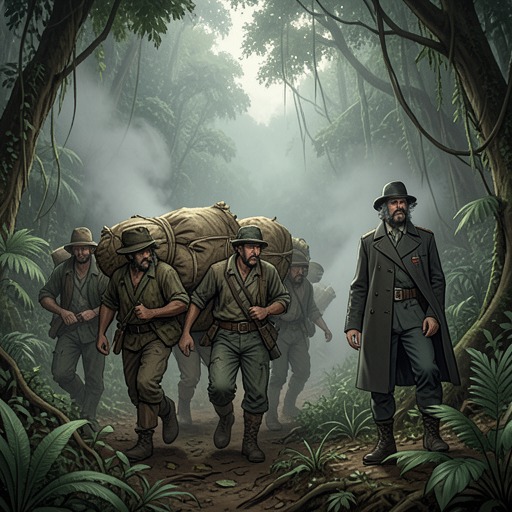
When Dorrigo Evans chooses one hundred prisoners for the march to Three Pagoda Pass, Bigelow is among the men he selects. Dorrigo expects them to condemn him because the march is understood to be a death march. Instead, Bigelow steps forward, tells Dorrigo to look after himself, and thanks him. The other selected men follow, each shaking Dorrigo’s hand. Bigelow’s response does not erase the danger of the selection; it acknowledges the care Dorrigo has given while both men face the consequences of an order neither can make safe.
After demobilization, Bigelow is reunited with a marriage that is no longer the one he left. The war initially seems to recede into an interruption of ordinary life, among jobs, family, children, and the deaths and changes that follow. In Hobart, he works as a mail sorter and does not appear to seek promotion. At a gathering of former prisoners at the Hope and Anchor, the men remember the dead, and Bigelow sings a refrain about things getting a little better. The reunion briefly makes the absent comrades present in the group’s shared memories, but he says little. The marriage, like the reunion, exposes the distance between returning home and returning unchanged.
At another gathering, Bigelow feels empty and unable to summon the feelings he thinks he ought to have. He picks up a rock and throws it through the painted window of Nikitaris’s Fish Shop. The others join him; once the glass is broken, they use a chip fryer to scoop fish into two mop buckets and carry them toward the docks. The episode turns a numbed gathering into collective action. Its improvised, disorderly character contrasts with Bigelow’s later domestic insistence on order, while showing how an act shared with comrades can briefly release him from passivity.
Memory, Family, and Human Goodness
Bigelow’s daughter Jodie asks him about the war for a school project on Anzac Day. At first he says there is little to tell. He brings out his old bugle, plays a few comic noises to make her laugh, then raises his head and performs the Last Post. Asked whether that is all, he says that it is all he knows and about all anyone needs to know. When Jodie asks what the music means, he answers that it is a mystery, and that the greater the mystery, the more it means. His small demonstration gives her access to an experience he will not narrate as a sequence of events.
His account of the war remains partial and unstable. He recalls jokes, stories, the taste of a duck egg Gardiner gave him, and the hope and goodness he associates with the camp. He remembers Wat Cooney as a man who waited at the cookhouse for the last prisoner and made sure everyone received some food, however little there was. He does not retain the circumstances of Cooney’s death on the march, or the surrounding cruelties. As his sons correct inconsistencies in his stories, Bigelow resists being treated as an authoritative record. His point is not that details do not matter, but that his experience cannot be reduced to a perfectly consistent account.
Over time, his mind relinquishes successive parts of captivity: first its humiliation and violence, then sickness and death, mud, and hunger. Eventually he remembers that he was a prisoner of war but can recall nothing of what the experience contained. The loss is not presented as a recovered historical record; it leaves instead what he regards as an irrevocable knowledge of human goodness. In old age he takes pleasure in wind, rain, dawn, and the birds that visit the food and water in his yard, finding in their arrivals and departures an image of life.
Bigelow’s relationship to the war nevertheless changes again at the end of his life. After years without playing the Last Post, at ninety-two, as he lies dying in hospital after his third stroke, he raises the bugle with his good arm. The sight and smell of the camp’s funeral pyres return, and he suddenly understands the war as the event that has most fully shaped his life. Earlier he had told Jodie that the music was a mystery; now the instrument brings back what memory had shed. His arc does not resolve trauma into a complete recollection. Instead, the bugle holds together public duty, private loss, forgetting, and the final return of an experience that had never entirely ceased to matter.