Love as harmony and attunement
The Narrow Road to the Deep NorthLove as harmony and attunement is an account of love as a correspondence between different people: one presence meets another and returns as a resonance that feels right. The image emerges in a quiet conversation between Dorrigo Evans and a woman who has lost Jack Rainbow. Her description of their bond as a note finding a room gives shape to intimacy without making it perfect or permanent. The novel sets her account against Dorrigo’s memories of Amy Mulvaney and, later, a truck driver’s suggestion that love may be received by chance rather than made.
A question and an answer
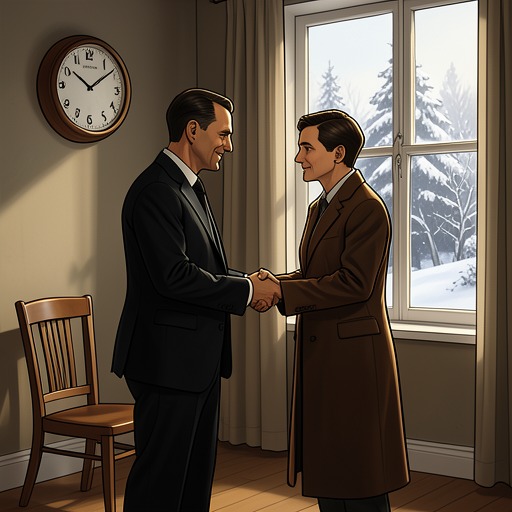
On a snowy day, with the woman’s younger children away at Jack’s sister’s and the older ones at school, she asks Dorrigo whether he believes in love. Before he can answer, she says she thinks people make it rather than receive it as a gift. Her certainty is provisional: when she asks whether he believes in it, she answers her own question by saying that she does not. Love, she suggests, is too small a word for what she wants to describe.
That hesitation matters. She is not offering a neat rule for how people form relationships. Instead, she searches for an image capacious enough to hold both the bond she shared with Jack and the silence left by his death. Her account begins with making, but turns toward a kind of recognition that cannot be reduced to deliberate effort: two unlike things encounter one another and produce a sound neither could make alone.
The room and the returning note
The image comes from a story about a friend in Fern Tree who teaches piano. The friend explained that every room has a note; when she sang through the rooms of her house, one note returned from the walls, rose from the floor, and filled the space with a hum. The woman compares the unexpected harmony to throwing a plum and receiving an orchard in return. A note and a room remain different things, yet their meeting sounds right. Love, in this account, is the answer that comes back and finds a person, even when that person does not want to be found.
She applies the analogy to Jack without pretending that their relationship was effortless. They did not really know each other, she says; she may not have liked everything about him, and some things about her may have annoyed him. The image therefore does not depend on idealizing either partner or claiming that affection erases difference. Its force lies in the fit that can arise amid difference and irritation. Jack was the note, she the room; now that he is gone, the house is silent. The loss is not only of a person but of the answering sound their shared life made.
Memory, touch, and silence
As she describes a sound that has vanished, Dorrigo’s thoughts turn to Amy. He recalls the King of Cornwall Hotel room that he and Amy had thought of as theirs: its peeling white paint, rusty French-door lock, afternoon breezes, and the waves breaking at night. In memory, that room too had seemed like the centre of a universe. The parallel links two distinct intimacies through the feeling of a place becoming charged by the people who share it; it does not make their relationships identical. For Dorrigo, the recollection arrives while another person is speaking about love and loss, bringing his own past into the conversation without resolving it.
He tells the woman that he was with Jack at the end, and that Jack had been keen for a Pall Mall. Later, on a lumpy mattress padded at its centre with an old North Hobart football jumper, Dorrigo and the woman hold one another. Their bodies adjust to the mattress and to each other; they speak of troubling things without forcing them into words or confusing one thing with another. The scene gives a bodily counterpart to her analogy: closeness can be made in the moment, but it cannot restore the lost sound. Perhaps they lie together for warmth or to hold each other against silence. The text leaves their exact purpose open, while making their shared knowledge of Jack’s absence unmistakable. For Dorrigo, it is enough to be warm with her.
Love made and love received
After Dorrigo leaves, the woman throws Jack’s medals into the range fire. Days later she rakes out the ash and discards the melted slag in the chicken yard, momentarily unsure what it is. Nineteen years on, the 1967 fire consumes the hop farm, her timber home, her son’s newer brick home, and the photographs of her and Jack. The old medal slag, once half-buried in the former chicken pen, is covered by another layer of ash; in time, ferns, dogwood, and myrtles grow there, and the forest overtakes the dream of Jack’s life. The sequence gives material form to change: keepsakes melt, homes burn, and living growth covers what remains. It neither restores Jack nor preserves their former world intact.
On the brewery truck, Dorrigo answers a driver’s reflection on love by conceding that many people may never know it. The driver proposes a different account from the woman’s: people receive faces, lives, fates, happiness, and unhappiness in unequal measure, and love may be among those allotments. It can be caught like a cold, make people miserable, and then pass; the claim that people make it may be a comforting fiction. The novel does not settle the disagreement. The woman’s note and room describe love as a singular harmony formed between people; the driver’s beer-glass comparison emphasizes unequal fortune and lack of control. Together, the images preserve love as both intimate and unstable: a resonance that can feel made for two people, yet cannot guarantee that it will remain.