Major Nakamura
The Narrow Road to the Deep NorthMajor Nakamura is an officer of the Imperial Japanese Army’s Fifth Railway Regiment whose work on the Siam–Burma Railway brings him into repeated conflict with Dorrigo Evans, the Australian prisoners’ commander and senior medical officer. Initially exhilarated by the railway as a national undertaking, Major Nakamura becomes its local enforcer as the project’s conditions deteriorate. His technical ambition, isolation, drug dependence, and appeals to imperial duty converge in a role that turns prisoners into labor figures and suffering into a problem to be managed rather than a reason to stop.
Identity and Imperial Mission
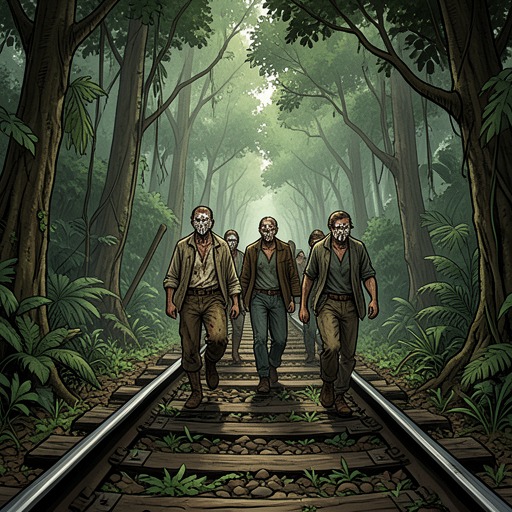
Before the war, English and American investigators had judged a railway linking Siam and Burma impossible. The Japanese High Command nevertheless ordered it built in the shortest time possible, and Major Nakamura welcomed his assignment as a small but significant part of a historic mission. He took pride in joining his life to what he understood as a national and imperial destiny. In the early conception of the work, engineering achievement and service to the country appeared to him to be inseparable.
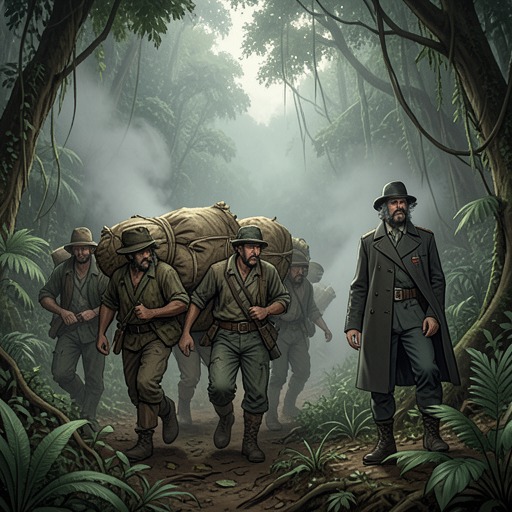
That conviction changes in the jungle, where the abstractions of plans meet a shortage of tools, food, supplies, and people capable of working. In March 1943, Major Nakamura entered a landscape far removed from the crowds and cities that had formed his previous life. He and the other Japanese officers and soldiers represented army discipline, the Emperor’s wishes, and what they called the Japanese spirit; they were also few beside the many laborers and prisoners, while the jungle increasingly constrained their efforts. Major Nakamura responded to the widening gap between ambition and reality by working harder, but the more intensely he pursued the project, the more it became an irrational equation with no workable solution.
Command Under Deteriorating Conditions
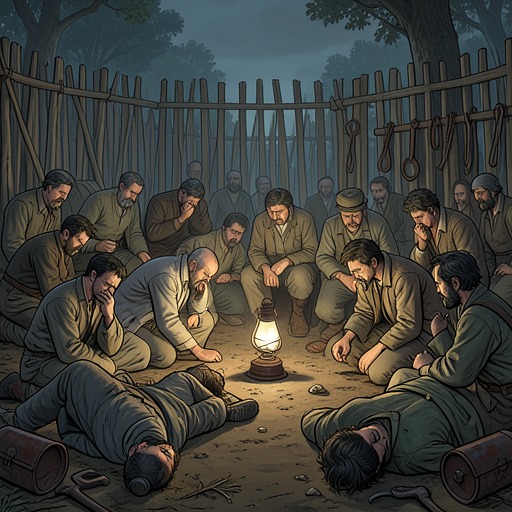
The railway’s construction was shaped by material obstacles as well as orders. With the monsoon, the river ran high and fast, carrying trees and making the movement of heavy loads dangerous. The road was largely impassable, supplies had dwindled, and machinery was unavailable; the available hand tools were poor. There had never been enough prisoners for the task, and the surviving workforce was increasingly sick. Cholera added another crisis, while the disposal of the dead itself became difficult. Major Nakamura tried to impose order on these circumstances through maps, plans, charts, and technical drawings, but paperwork could not supply the missing equipment or restore the laborers’ health.
The prisoners had been transported in cramped, closed railway wagons before being transferred to trucks for the journey onward through the jungle. By the time the Speedo began, the workforce faced rising quotas, longer shifts, and the loss of rest days. Prisoners could be ordered to work two shifts, by day and night. For Major Nakamura, the schedule remained the railway’s governing demand; for the prisoners, it narrowed the distinction between illness and death. The contrast between his technical system and their bodily limits exposes the project’s central contradiction: the railway was treated as an objective that had to be completed even as the labor required to build it was being destroyed.
Isolation and Dependence
Major Nakamura’s authority does not protect him from solitude. The occasional Japanese officer who visits the camp brings news, drink, and reassuring accounts of Japanese honor, spirit, and imminent victory, but these visitors eventually leave for other sections of the railway. Major Nakamura remains with the work and the growing crisis. He throws himself into construction partly to suppress the unsettling isolation, yet the labor intensifies rather than resolves his sense of separation.
His reliance on methamphetamine grows within that cycle. After a second bout of malaria left him exhausted while work continued, he used shabu to keep going. By the time Corporal Tomokawa brought a bottle to the field table, the drug had become more necessary to him than food. Major Nakamura swallowed four pills and soon felt his fatigue give way to renewed alertness and energy. He explained the pills to the men present as help for his fever and a way to stop the ticks biting, but the narration makes clear that they also enabled him to return to the railway day after day with renewed fervor. His apparent command of the task thus depends in part on a private means of overriding his own physical limits.
After an evening of cards with Australian officers and prisoners, Major Nakamura falls into an alcoholic sleep and dreams of being trapped in a dark room, surrounded by life he cannot understand. The dream renders the jungle and the prisoners alien and threatening to him, and his attempt to find an exit becomes a feeling of suffocation. The scene gives a form to the disorientation that his waking system of plans and orders cannot master. On waking, he returns to the work rather than finding a way beyond it.
Negotiation with Dorrigo Evans
Major Nakamura’s exchanges with Dorrigo Evans make their opposed responsibilities visible. At a card game, the Australian officers and prisoners understand that it is better for Major Nakamura not to lose; he wins the final hand, thanks his guests through Lieutenant Fukuhara, and nearly stumbles as he stands. Dorrigo Evans has held back from raising the railway schedule, but, seeing an opportunity, tells him that the Speedo has run for thirty-seven days without a break. Dorrigo Evans argues that rest would preserve the workers and thereby help build the railway. He frames the appeal in terms of the Emperor’s wishes and the project’s practical success, adapting his language to the authority Major Nakamura recognizes. The evidence records the appeal, not whether Major Nakamura grants the requested day of rest.
The conflict becomes sharper during a labor count in the rain. Dorrigo Evans reports that 838 prisoners remain: 67 are in the cholera compound, 179 are seriously ill in hospital, and 167 can perform only light duties; 62 more have reported sick that morning. He calculates that 363 men are available for railway work. Major Nakamura demands 500. As the two sides bargain, Dorrigo Evans argues from the medical condition of the prisoners and the risk that men forced back to work will die before they can recover. He eventually offers 400, judging that number the limit of what can be mustered without sacrificing men who might later be useful.
When Major Nakamura encounters a severely ill prisoner during the dispute, Dorrigo Evans lifts the man and insists that he is too sick to work. Major Nakamura strikes Dorrigo Evans while the doctor keeps hold of the prisoner. The scene makes the power imbalance physical without resolving the argument: Dorrigo Evans must negotiate for the sick within a system that can punish him for refusing its demands. The bargaining resumes, and Major Nakamura names 430 as the number he will accept, invoking the Emperor’s will through Lieutenant Fukuhara. His position is not simply a calculation about available labor; it is the conversion of an order into a non-negotiable measure of human capacity.
Violence, Responsibility, and Narrative Role
Major Nakamura’s part in Darky Gardiner’s beating further exposes the distance between practical authority and moral responsibility. Dorrigo Evans understands that Major Nakamura has ordered the punishment and believes the Japanese officer cannot stop it once it is underway. As Darky is beaten, the watching prisoners do not intervene; Dorrigo Evans recognizes himself as first among those who have arrived too late and done too little. The narration briefly opens onto his perception of violence as a force transmitted through human history, then shows that insight slipping away.
Major Nakamura, too, turns from what he has witnessed. He walks away and returns to the thoughts that make the railway manageable: duty, the Emperor, the nation, and the next day’s work. Within ten minutes he has forgotten the beating. An hour later, when he passes the parade ground and sees that the punishment is still continuing, he recognizes that it has not ended. This sequence does not absolve him; it shows how routine and obedience permit him to resume his assigned role even when the violence exceeds the moment he has tried to leave behind.
The character’s decisive tension is between engineering purpose and moral recognition. Major Nakamura can understand shortages, schedules, and the railway’s physical difficulties, and he can make practical decisions within them. Yet he repeatedly treats the imperial order as the boundary of what can be questioned. Dorrigo Evans’s attempts to reason in terms of preserving workers meet that boundary, while the sick and punished prisoners bear its consequences. Major Nakamura is therefore neither presented only as a distant symbol of Japanese authority nor separated from the harm his command enables: the narrative shows his professional pride and exhaustion alongside his choices, and shows how a language of necessity allows violence to continue.