Nikitaris’s Fish Shop
The Narrow Road to the Deep NorthNikitaris’s Fish Shop is a small Hobart, Tasmania business whose bright front-window aquarium becomes inseparable from Darky Gardiner’s memories of home and his experience as a prisoner of war. Before the war, it had been a place for fish and chips with his wife, Edie; in the jungle, its fish become fellow captives in his imagination. After the war, former prisoners go there together, finding the shop both less like the place Darky had carried in memory and more difficult to leave alone than a simple meal would suggest.
A Shop Remembered from Before the War
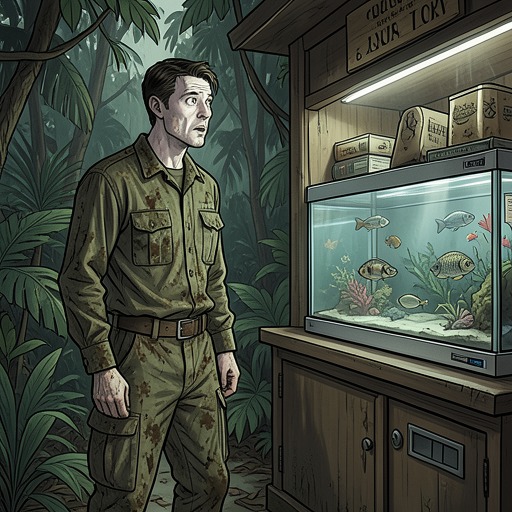
Darky recalls Nikitaris’s Fish Shop while gravely ill and being helped under a bamboo shower by Shugs. His words wander between the present and the familiar routine of taking Edie to North Hobart for fish and chips. The shop’s glass tank stands out in that recollection: Darky remembers flathead, mullet, and blackback salmon swimming behind the window, while Squizzy Taylor examines him and tries to get him to follow simple instructions.
His memory does not preserve the shop only as an image. It brings back the meal in particular, item by item: two couta, chips, battered scallops, and buttered bread. He also recalls going to the Avalon for a matinee before eating there, and that Edie loved this outing. The repeated return to the shop, even as his speech becomes confused, makes an ordinary domestic pleasure a vivid counterpoint to his condition in the camp.
The Aquarium and the Promise of Freedom
Darky’s attention shifts from the food and Edie to the fish enclosed in the window tank. He pities them as creatures locked behind glass and looking out, and recognizes in their confinement an image of prisoners of war. He says he will get the fish out when he returns: he will buy them, rob the shop, or do whatever is necessary to take them to the docks and set them free in the sea. The promise is at once practical in its imagined details and desperate in its scale; the freedom he can picture for the fish is the freedom he cannot secure for himself in the jungle.
Shugs cannot tell whether Darky fully understands where he is or is imagining a meal with Edie. His account leaves open whether Darky is thinking clearly about the tank, recalling the shop, or moving between those memories and his present as a naked, sick prisoner. That uncertainty matters: the fish are not merely a symbol Darky explains from a safe distance. His illness and captivity blur the boundary between the creatures behind the glass and the man who imagines himself among them.
The Former Prisoners at the Window
After their demobilization, the former prisoners’ recollection of the shop resurfaces at the Hope and Anchor. Gallipoli von Kessler mentions Nikitaris’s, and Sheephead Morton remembers how often Darky talked about its fish. One cold, wet night, the men leave the pub and walk up Elizabeth Street. They are drunk, have been thrown out, and have no better plan; the narrative explicitly distinguishes their aimless trip from a deliberate attempt to repair the past.
They find the shop locked and dark, except for the lights illuminating the long aquarium at the front. The fish swim in the window while the rain-slicked street around the men is empty. This is not the busy, warm shop of their imagined camp memories, with people inside and Edie waiting for Darky. The actual tank holds a couple of flatheads, a trumpeter, two silver trevally, and a leatherjacket. Sheephead remarks that the fish do not look unhappy. Jimmy Bigelow answers that the men in the camps may not have looked unhappy at every moment either. The exchange resists an easy division between visible appearance and inward experience: a fish, or a prisoner, may seem content without being free.
An Apology and an Unfinished Reckoning
The fish shop remains in the men’s thoughts the next night, when they gather again at the Hope and Anchor and tell the story with gusto and growing shame. Jimmy says they should visit Nikitaris and make amends for the shop window. This time it is still early and the lights are on; the window has already been replaced but not yet painted. Inside, older women work at the fryers while a boy scrubs the display stand.
Sheephead asks for Mr Nikitaris, and a worker brings out the elderly proprietor, whose earlier life as a stonemason is recalled in the quiet resolve of his bearing. Jimmy apologizes. Sheephead begins to explain that they had a mate, and Jimmy offers to pay for the broken window, the fish, and any other damage. Their return changes the shop from a remembered destination into a place where the survivors must address what they have done. The account ends with the apology and offer of compensation, not with a reported settlement. The aquarium’s significance thus rests less on a confirmed act of release than on the repeated encounter between Darky’s promise, the men’s captivity, and their later attempt to face the consequences of their actions.