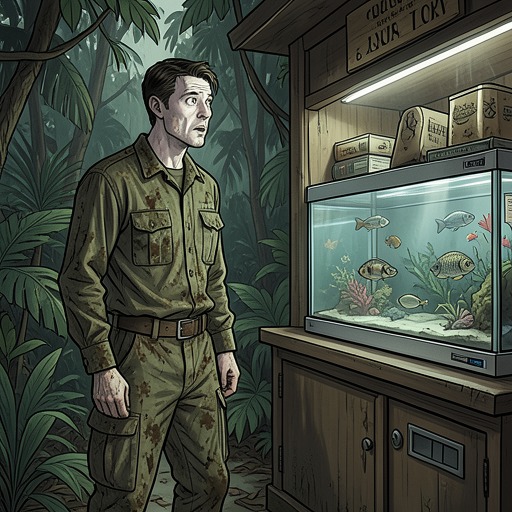
Nikitaris’s fish tank
The Narrow Road to the Deep NorthNikitaris’s fish tank is a brightly lit display aquarium whose fish become, first in Darky Gardiner’s fevered talk and later in his comrades’ actions, prisoners awaiting release. The aquarium links the confinement of the fish to the men’s own captivity, then gives their postwar gathering a concrete task: break the glass, carry the fish away, and return them to the water.
Appearance and First Meaning
While Darky is gravely ill and being taken toward hospital, he keeps speaking about the fish in the tank at Nikitaris’s shop. As Shugs reports it, Darky cannot stop thinking about them: captivity is “not natural,” he insists, because the fish are prisoners of war too. He vows that once he gets back he will go to the shop, acquire the fish by whatever means necessary, and put them into the sea where they belong. The tank matters to him not simply as an aquarium but as a visible version of the condition the men have endured.
That declaration arrives amid uncertainty about Darky’s state. Shugs describes him swaying and cannot tell what he is thinking or how fully he understands where he is. The scene’s possibilities remain unresolved: Darky may be imagining a meal with Edie, thinking of the fish, or confusing his own imprisonment with theirs. In Shugs’s account, even the image of Darky as a naked prisoner in the jungle, with an arm around him, sits beside ordinary memories of Edie and the aquarium. The fish tank gathers these unstable thoughts without confirming which one is actually in Darky’s mind.
Squizzy Taylor answers Darky’s promise with the immediate facts of illness: he has numerous diseases and will remain in hospital as long as necessary. Squizzy also warns that after Darky gets out, neither the fish nor Edie will be safe. His response punctures the certainty of Darky’s plan, but it does not erase its force. The aquarium has become a measure of how captivity persists in Darky’s imagination, extending beyond the camp to creatures behind glass.
The Shop Window
When the former prisoners eventually reach Nikitaris’s Fish Shop, the setting sharply differs from the scene they had imagined. They had pictured a lively shop, people and cooking, and Darky’s girlfriend waiting inside. Instead, they find the doors locked, the interior lifeless, and the night street empty. Only the lights illuminating the long tank at the front remain on. Inside are a couple of flatheads, a trumpeter, two silver trevally, and a leatherjacket, circling in the display window.
The men pause outside, cold and uncertain, shifting from foot to foot as if waiting for a train. Sheephead Morton observes that the fish do not look unhappy; Jimmy Bigelow answers that in the camps the prisoners may not have looked unhappy at any given moment either. Their exchange makes appearance an unreliable measure of freedom. The fish are visible and moving, but the glass keeps them contained; the comparison recalls a captivity that could be overlooked from the outside.
Breaking the Glass and Releasing the Fish
Jimmy’s response begins as an action without warning. He feels like an appearance with nothing inside and wishes he could feel, but wishing does not bring feeling back. He picks up a rock, rolls it in his palm, looks at the shop window, and throws it hard. The plate glass bears the painted name NIKITARIS’S FISH SHOP. Its fracture opens gradually rather than all at once; Jimmy smiles as the break spreads. The display window, previously a boundary that made the fish visible but unreachable, becomes the immediate obstacle the men can destroy.
The others then throw rocks too, and the window breaks apart. Gallipoli von Kessler improvises with a chip fryer, using it to scoop the fish from the tank. After several mishaps, they have them in two mop buckets. Their rescue is practical and precarious: they walk toward the docks trying not to spill the water. The aquarium’s contained world has been disrupted, but the fish still depend on the men to carry them safely to another one.
At Constitution Dock, with boats rocking in the swell and a cruel wind beyond the cove, Sheephead Morton puts his head into a bucket and shouts, “You’re fucking free!” He then tips the bucket. The fish fall into the sound of water. The act fulfills the release Darky had imagined, though the available account does not establish whether the men are consciously carrying out a promise made by him. What it does show is the tank’s transformation from a symbol of confinement into the starting point of a collective, material gesture: the glass is broken, the fish are carried, and the buckets are emptied into the dock.
Significance
The tank’s meaning develops through a contrast between looking and acting. At first, the prisoners can only imagine the fish moving behind glass and compare their condition with the fish’s. Later, the former prisoners face the actual locked shop and aquarium; their recognition of the parallel leads them to break the window and intervene. Jimmy’s numbness is not cured by the act, but his throw initiates movement among the group, whose improvised labor carries the fish from the shop to the water.
The release remains modest in scale: a few fish, two mop buckets, and one brief cry at the dock. Its significance lies in its concrete reversal of the tank’s arrangement. Where the aquarium kept living creatures in view but confined, the men make the barrier give way and return them to open water. In a narrative shaped by captivity, the fish tank makes freedom both an image and an action—not an abstract assurance, but something the men must lift, carry, and release.