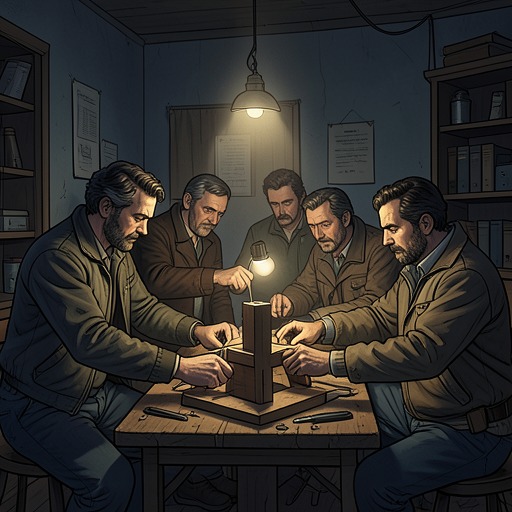
No I or me, only we and us
The Narrow Road to the Deep North“No I or me, only we and us” is the language of collective survival in the POW camp: a conviction that the prisoners’ lives and identities are bound to one another, especially when each day makes individual survival uncertain. The phrase grows out of mutual reliance, grief, and remembrance, and contrasts with the railway regime that reduces people to laboring bodies and counts them as resources.
Meaning in the camp
The expression comes into focus after Darky Gardiner’s death. His comrades feel the fear and relief of having survived another day, but neither feeling can settle the question of who will die next. The answer they can give is that they have each other; from then on, the narration describes their bond as a refusal of the isolated “I” in favor of “we and us.” The words are not a claim that each prisoner’s experience is identical. They register a shared condition in which danger, loss, and dependence make individual life inseparable from the group.
That collective identity is also evident in the name Evans’ J Force. A thousand prisoners leave Changi for the railway, and, despite deaths along the way and in the camp, they remain Evans’ J Force in the account’s telling. Their number and composition change, but the group’s identity persists: even if only one man remains to march out, he carries the force’s shared history. The phrase thus links solidarity among the living to an obligation not to let the dead become meaningless or disappear from memory.
Solidarity in daily life
The bond is sustained not only in moments of bereavement but through small acts that make continued life possible. Under the increasing work quotas and loss of rest days of the Speedo, prisoners share occasional food, repeat jokes, and keep hope alive. Such gestures do not undo the coercion or make suffering virtuous; they offer practical and emotional support within circumstances imposed on them.
Wat Cooney’s care for the others gives that mutual responsibility a particular form. He waits at the cookhouse until the last man arrives and tries to ensure that everyone receives something to eat, however little there is. When the prisoners later gather at his grave, none wants to be the first to throw a sod. Jimmy Bigelow remembers Wat’s generosity as part of the group’s history, preserving the care that defined him even as other details of the march and its hardships fade from Jimmy’s recollection.
Against the logic of the railway
The phrase also has force against the railway’s instrumental view of human beings. Japan’s need to build a railway with limited machinery and time leads to the use of POWs and Asian laborers on an enormous scale. In the camp, more deaths and illness shrink the number of men available for work; Major Nakamura confronts the practical problem of how to build with fewer tools and fewer prisoners, while Colonel Kota insists that the work must be completed even if most—or all—die. In that system, a prisoner is treated as material for construction. “We and us” asserts a human relationship where the railway’s logic recognizes only labor and output.
The expression does not resolve the injustice or restore those who die. The book sets the railway’s completion and its public commemoration beside the absence of names for the many laborers who died building it; even the number of Asian laborers killed remains disputed. Against that silence, the prisoners’ shared memory offers a fragment of recognition. It cannot stand in for every lost life, but it resists the idea that those lives were merely part of the cost of construction.
Memory after the war
The phrase’s communal meaning persists in Jimmy Bigelow’s later recollections, though memory proves partial and unreliable. He remembers the taste of a duck egg Darky gave him, the hope, and the goodness; he also remembers Wat’s habit of feeding the men and the reluctance to begin the burial. He does not remember some of the march’s cruelties, and his sons and others correct errors and contradictions in his accounts. His memories do not form a complete record, but the ties and acts of care remain among the details that endure.
In this way, collective identity is both a form of survival and a fragile act of witness. The men’s bond gives meaning to lives that the machinery of forced labor treats as replaceable, while the gaps in later recollection show how much even a survivor cannot preserve. “No I or me, only we and us” holds together those two truths: the prisoners survive through one another, and remembrance remains incomplete even when the dead are not willingly abandoned.