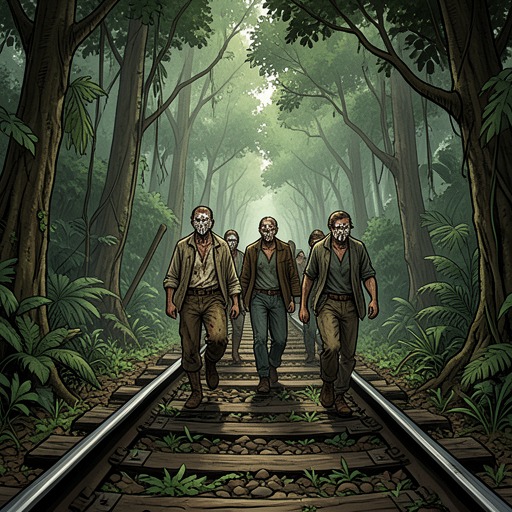
POW captivity and forced labour on the Thai-Burma Railway
The Narrow Road to the Deep NorthPOW captivity and forced labour on the Thai-Burma Railway is presented as both a military engineering project and a system that reduces human lives to labour capacity. The railway’s strategic purpose sets the work in motion; quotas, shortages, disease and command decisions shape life in the camps. Against that machinery, Dorrigo Evans tries to preserve the prisoners as a community, even as the project consumes the people assigned to build it and later leaves their deaths incompletely recorded.
Strategic Purpose and Construction
In early 1943, Dorrigo Evans sees surveyors’ pegs marking a route 415 kilometres long, running from north of Bangkok through to Burma. The railway exists at first as a line on the ground and a set of plans and orders, rather than as a functioning transport route. The prisoners’ first task is to clear a kilometre of giant teak trees along the proposed path, using blunt axes and rope. The distance and the tools make the gap between the project’s scale and the workers’ means plain from the outset.
The urgency comes from Japan’s wartime position. The Allies supply China through Burma, while control of the seas limits Japan’s options for moving men and matériel. Japanese leaders also envisage taking India through Burma. The railway is intended to serve these aims, but Japan lacks the money, machinery and time to build it by ordinary means. The Japanese High Command’s need for rapid construction therefore meets an available captive workforce: of 22,000 Australian POWs, nine thousand are sent to work on the railway. The project’s engineering requirements are not abstract. When a major cutting is already half complete, the Railway Command Group changes Nakamura’s original plans and orders it enlarged by a third to address gradients in the next sector, requiring another 3,000 cubic metres of rock to be removed.
Captivity, Transport, and the Labour Regime
Before reaching the railway, the men designated Evans’ J Force endure a journey that foreshadows their loss of control over daily life. In closed steel rice wagons, 27 men are crowded into each compartment without room to sit. Their journey lasts five days; they travel about a thousand miles, make six stops, and three men die before the group reaches Ban Pong. The prisoners are then packed into trucks for the onward journey. Transport itself is organized around moving people as cargo, not accommodating them as individuals.
At first, the work is hard but has not yet become the sustained emergency it will be. That changes with the monsoon and the onset of the Speedo. Rest days disappear, quotas rise, and shifts lengthen until some men are required to work both day and night. The distinction between those fit for work and those who are sick becomes increasingly difficult to maintain. Prisoners clear jungle, break rock and move earth with basic tools and their own physical labour, while food becomes scarcer. The railway’s schedule is thus enforced not only through orders but through the steady conversion of the prisoners’ time and strength into construction output.
The conditions of work are compounded by shortages of equipment. Prisoners break rock by hand with hammer and chisel; there are too few tools, and the forge lacks enough coke to sharpen blunted chisels. Nakamura asks for drilling machines and compressors, but Colonel Kota makes the priority unmistakable: the railway must be completed even if most of the workers die, or even if all of them die. Nakamura understands that prisoners are being treated as material for the railway, but continues to carry out the work. The order links engineering targets to a command structure in which the lives of the labourers do not constrain the required outcome.
Dorrigo Evans and the Prisoners’ Collective Survival
As the prisoners’ senior medical officer and commanding officer, Dorrigo Evans must account for their condition as well as lead them. At one roll call, he reports that four men died the previous day and two overnight, leaving 838 POWs. Of these, 67 have cholera, 179 are in hospital with severe illness, and 167 are too sick for anything beyond light duties; another 62 are reporting sick. Dorrigo calculates that 363 men can work. When the Japanese demand more, he argues from medical knowledge and eventually offers 400, insisting that sending more would endanger men who could recover and later contribute. His argument is a limited defence of the prisoners’ remaining capacity, made within a negotiation whose terms he does not control.
The account does not present the men as uniformly noble or selfless. They lie, cheat and steal, and exhaustion can make prisoners unwilling to help someone else. Dorrigo has to order two men to assist a sick prisoner who cannot make the last stretch back to camp. Yet his daily work includes carrying, nursing and treating the men, and he repeatedly risks his own standing to secure what help he can. He recognizes that caring for them does not make their suffering virtuous, nor does it guarantee that he can save them. His medical responsibility is therefore inseparable from the knowledge that more prisoners die despite his efforts.
The J Force remains a collective identity even as its numbers fall. Its members come from different Australian states and military experiences, but the account describes their belief in one another as a minimum they hold more tightly when deaths accumulate. Small resources and repeated jokes help make survival possible; the evidence does not turn these into triumphs over captivity, but shows how shared life persists inside the forced labour system. Dorrigo’s leadership is formed in this contradiction: the men’s need for a commanding figure draws him into a role he does not feel he naturally possesses, while the work of caring for them makes their continued losses personal.
Scale of Loss and the Railway’s Afterlife
The railway is completed at immense human cost. On 25 October 1943, locomotive C 5631 travels its length, carrying Japanese and Thai dignitaries. The account places the train’s passage beside the remains of the dead, including one in three of the Australian POWs sent to work on the line. Allied POWs, estimated at about 60,000 among the labourers, were only a fraction of the workforce. Alongside them were roughly a quarter of a million people from across Asia, including Tamils, Chinese, Javanese, Malayans, Thais and Burmese. Estimates of deaths among these labourers vary widely, from 50,000 to 200,000; the novel stresses that no agreed total exists.
The postwar treatment of the railway sharpens the contrast between a visible engineering relic and the obscured history of its construction. Locomotive C 5631 is displayed at Yasukuni Shrine in Tokyo, but its plaque does not mention the suffering involved in building the railway or name the hundreds of thousands who died. The line itself loses its military purpose after Japan’s defeat. Its remaining maintenance workers are freed; the railway is abandoned by the Thais, dismantled by the English and salvaged by local people. Rain and time then undo its banks, bridges and cuttings, and vegetation grows through the ground where the work and deaths took place.
The railway’s physical disappearance does not resolve the problem of remembrance. The dead labourers’ names have largely been forgotten, and even the total number of those who died cannot be established. The line’s return to the landscape counters the imperial ambition that built it, but it also makes the history easier to overlook: what remains is not a complete record but fragments, uncertain numbers and a landscape changed again by natural growth. Captivity on the railway thus encompasses both the prisoners’ forced use in construction and the later struggle to keep their labour, suffering and deaths present in history.