Progress without freedom
The Narrow Road to the Deep NorthProgress without freedom is the doctrine that makes the Siam–Burma Railway seem, to its Japanese builders, both necessary and historically glorious. In the novel, progress is severed from human liberty and recast as a national destiny: prisoners’ labor becomes a resource, suffering a cost to be borne, and the railway a demonstration of imperial power. The project’s eventual abandonment exposes the fragility of that promise and the human consequences it leaves unacknowledged.
The doctrine and its imperial purpose
The idea is articulated most directly by Major Nakamura, who tells Dorrigo Evans that progress does not demand freedom and has no need of it. He contrasts the Japanese language of spirit, nation, and Emperor with the language of cruelty and non-freedom. The distinction does not lessen the railway’s coercion; instead, it presents that coercion as a different, supposedly higher principle. In this reasoning, the project’s future value is made to supersede the immediate freedom and welfare of the people forced to build it.
The doctrine rests on an imperial belief that Japan will prevail through its spirit and the Emperor’s will. The novel places that belief beside a material predicament: Japan is overstretched, lacks the money and machinery to build the railway, and faces pressure to move men and supplies by land. The railway is meant to cut the Allies’ supply route through Burma to the Chinese Nationalist Army and support Japanese ambitions in Burma and India. Political ambition supplies the purpose; a claimed national spirit is made to answer for the inadequate means and urgent timetable.
The railway as an engineered demand
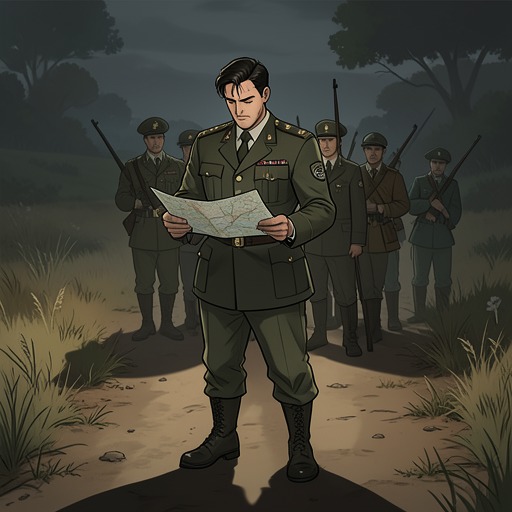
At the planned route, Imperial Japanese Army engineers mark the ground with surveyors’ pegs. The line extends 415 kilometres from north of Bangkok toward Burma, but its scale is initially represented by plans, orders, and exhortations rather than a completed railway. Dorrigo Evans and the prisoners with him are given blunt axes and rotten hemp rope and ordered to clear a kilometre of giant teak trees. The project’s abstract line thus becomes a specific labor demand imposed on bodies with inadequate tools.
The engineering requirements continue to change. After half of a major cutting has already been completed, the Railway Command Group orders it enlarged by a third to address gradient problems in the next sector. The alteration requires a further 3,000 cubic metres of rock to be cut and carried away. Nakamura points to the shortage of saws and axes, the prisoners’ hand work with hammers and chisels, and the lack of coke to sharpen the chisels. The gap between ambitious specifications and the available equipment is not resolved by reducing the demand. Instead, the work is driven forward under conditions in which fewer men remain each day.
Colonel Kota states the governing imperative without qualification: the work must be completed even if most of the prisoners die, or even if everyone dies. Nakamura understands the prisoner as material to be used in making the railway, comparable to sleepers, rails, and dog spikes. The project’s language of progress therefore has a practical operation: it converts a human population into labor inputs while treating the completion target as inviolable.
The cost concealed by progress
The railway is not built by Australian prisoners alone. The novel describes 22,000 Australian POWs in Japanese hands, of whom 9,000 are sent to work on the railway; the Allies on the railway amount to about 60,000 men. Alongside them are a quarter of a million Asian laborers, including Tamils, Chinese, Javanese, Malayans, Thais, and Burmese. Estimates of deaths among these laborers vary widely, and the text emphasizes that no agreed total exists. That uncertainty is itself part of the cost: many of the people who bore the project’s labor are left without a reliable accounting of their deaths or even a place in its public memory.
For the prisoners, the railway becomes the organizing fact of daily life. They clear jungle, break rock, move earth, and carry sleepers and rails with basic tools and their own physical labor. They are starved, beaten, and worked beyond exhaustion; the dead accumulate as the sick and dying fill the camp hospital. Yet the doctrine of progress does not register these consequences as a reason to stop. It absorbs them as sacrifice to the line. The prisoners’ small acts of shared survival—jokes, an occasional duck egg, a little palm sugar—stand in contrast to an imperial project that measures its success by construction rather than by the lives it consumes.
Achievement, memory, and collapse
Colonel Kota presents the Siam–Burma Railway as more than a military undertaking: he describes it as an epoch-making construction that will establish Japan and its outlook as drivers of world progress. He also turns the argument back toward the British Empire, asserting that it too was built through unfree labor. The comparison broadens the novel’s criticism of imperial claims to progress, but it does not make the Japanese railway’s forced labor less real or its victims less particular. The rivalry between empires does not release the prisoners from the work.
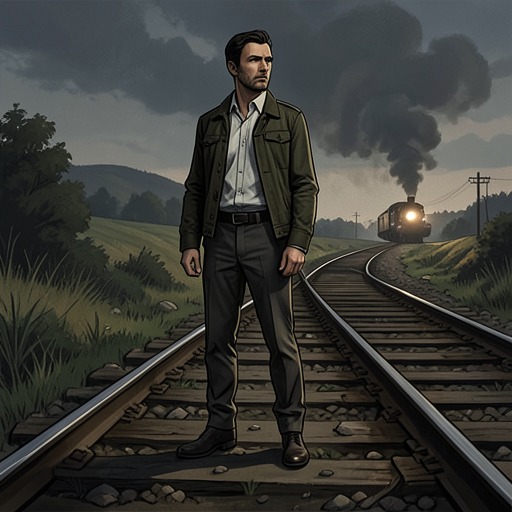
On 25 October 1943, steam locomotive C 5631 travels the completed Death Railway, towing three carriages of Japanese and Thai dignitaries. The achievement is set against the remains of the dead along its route. At Yasukuni Shrine in Tokyo, the locomotive is displayed, but its plaque makes no mention of the railway’s construction horrors or the names of the people who died building it. The disparity between a celebrated machine and an unrecorded workforce reveals how the language of progress can survive by preserving the monument while excluding the labor and loss that made it possible.
After the war, the railway loses its purpose and support. The remaining laborers are freed; the line is abandoned by the Thais, dismantled by the English, and pulled up and sold off by tribespeople. Its banks and bridges break down, its cuttings fill, and vegetation returns. A few sections later become tourist, sacred, or national sites, but the project itself is broken and its remains largely disappear into the landscape. The line’s fate reverses the promise that it would inaugurate a new era: the achievement proves temporary, while the dead and the uncertainty surrounding their numbers persist. In this ending, progress without freedom is not a durable triumph but an imperial demand whose human cost outlasts its usefulness.