Rabbit Hendricks's Sketchbook
The Narrow Road to the Deep NorthRabbit Hendricks's Sketchbook changes from a practical tool and a source of small exchanges into a secret record of camp life, then into the last surviving trace of Rabbit Hendricks. Its passage through the cholera compound and the pyre makes its survival uncertain; when Dorrigo Evans finds it charred but intact, he chooses not to complete its destruction.
Commissioned Work and Hidden Drawings
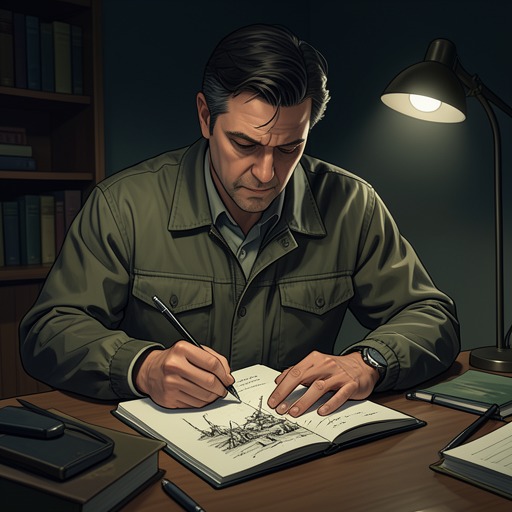
Rabbit’s sketchbook belonged to a working artist whose skill could be useful even to his captors. The Japanese commander gave him two duck eggs in exchange for postcard pictures of the commander and several associates, apparently intended for loved ones and families in Japan. Such commissions made Rabbit’s art a limited point of contact between the prisoner and his captors, while also supplying him with food in a camp where useful goods could be traded.
The commissioned portraits were not the sketchbook’s only purpose. Rabbit also used it, alongside watercolours, to record the camp’s daily reality, including forced labour and mistreatment. He kept these pictures hidden because the Japanese would likely have killed him had they discovered them. The book therefore held two kinds of images with sharply different audiences: flattering or acceptable portraits made at the commander’s request, and private depictions that exposed conditions the authorities would not want shown.
That contrast gives the object its particular significance. In ordinary use, it served Rabbit’s work and helped him obtain necessities; concealed, it became a record he hoped might outlast the circumstances in which it was made. Bonox Baker later reported that Rabbit believed the pictures would survive whatever happened to him and that people beyond the camp would eventually know what they showed. The sketchbook’s importance thus rested not only on the drawings themselves, but on Rabbit’s expectation that they might carry evidence beyond his own life.
Rabbit’s Death and the Order to Burn It
After cholera had spread through the camp, Rabbit became ill while working on The Line. His fellow prisoners carried him back to camp, and he was sent into the cholera compound, from which few returned. The sketchbook and his watercolour set went with him into that compound. The disease therefore separated the pictures from their maker and placed them among the possessions subject to the camp’s rules for controlling contagion.
At a funeral, Rabbit’s body was among those placed on the pyre with his few possessions and blanket. Because anything touched by cholera had to be burned, a pyre maker brought the sketchbook to Dorrigo Evans. Dorrigo told him to burn it and waved it away. The instruction treated the book as contaminated property to be destroyed along with the other belongings; it also threatened the only remaining container for Rabbit’s concealed pictures.
Bonox Baker raised the question of the pictures and explained Rabbit’s faith in their survival. His appeal put the book’s material fate beside its intended purpose: Rabbit had made images in the belief that they could preserve knowledge of camp life, while the funeral procedure required their destruction. The sketchbook was not simply a keepsake being rescued from a fire. It was the record Rabbit had hidden, now exposed to the same process that was consuming the possessions associated with the dead.
The Surviving Page
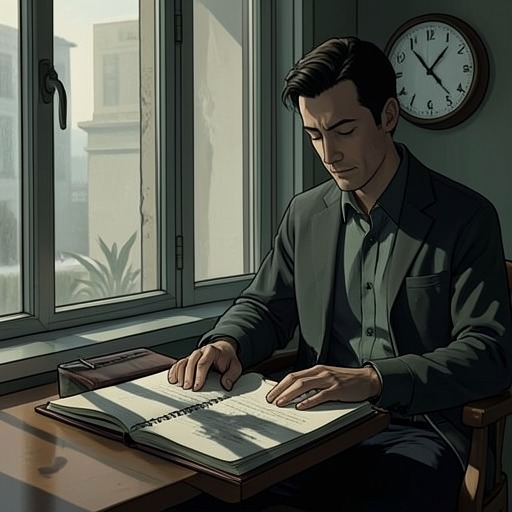
After the pyre had burned, Dorrigo noticed the sketchbook in the mud, slightly charred but otherwise intact. He surmised that a small explosion during the burning had thrown it clear. Its card cover and early pages were gone, so survival had not restored the book in full. What remained was a damaged, incomplete object: enough to retain an image, but no longer the original sequence or outer protection.
The surviving front page showed Darky Gardiner seated in an opulent armchair decorated with little fish, drinking coffee in a ruined Syrian village. Other figures stood behind him, including Yabby Burrows with his hot boxes. Dorrigo realized that Rabbit must have added Yabby to the drawing after Yabby had been blown up. The page consequently joined a scene of earlier comradeship and wartime experience to a later loss, though the surviving evidence does not establish when every part of the image was made. It is both a picture and a fragment whose incomplete history Dorrigo must infer.
Dorrigo picked the sketchbook up intending to throw it back into the fire, then changed his mind at the last moment. That small reversal leaves the object’s fate different from the fate prescribed for Rabbit’s other possessions: the book has passed through the pyre, but Dorrigo does not return it to the flames. Its survival is accidental, its pages are damaged, and its preservation is not presented as a complete recovery of Rabbit’s work. What remains is nevertheless enough to show why the pictures mattered to Rabbit and why the book could not be treated as an ordinary possession.
A Record Against Erasure
The sketchbook’s story turns on the gap between the image-making that was permitted and the image-making Rabbit concealed. The commander’s postcard pictures could travel outward as personal souvenirs; Rabbit’s private drawings risked exposing the camp’s treatment of its prisoners. The same artistic skill could therefore produce an acceptable likeness for the Japanese commander or an unwelcome account of daily life, depending on what it represented and who might see it.
Its near-destruction sharpens that distinction. The camp’s requirement to burn cholera victims’ possessions gave the sketchbook no protected status, despite the record it contained and Rabbit’s hope that the pictures would reach a wider audience. After Rabbit’s death, the book is carried into the funeral process as property to be destroyed; its survival depends on being thrown clear, and then on Dorrigo’s decision not to put it back. Neither action guarantees that the hidden drawings remain intact or that the world will see them. The surviving image and the incomplete book instead make preservation contingent: the record persists, but only in fragments, through accident and a changed decision.