Recessional
The Narrow Road to the Deep NorthRecessional is the poem Dorrigo Evans invokes while a cholera pyre is being prepared in the jungle. Its refrain, “Lest we forget,” appears to command remembrance, but Dorrigo reads the poem as an account of forgetting: empires and their ceremonies disappear, and the dead may vanish from memory with them. The poem’s force in the novel lies in that reversal. It makes a funeral argument about one prisoner’s possessions open outward into a meditation on the unrecorded victims of the railway and the limits of memorials.
The poem at the cholera pyre
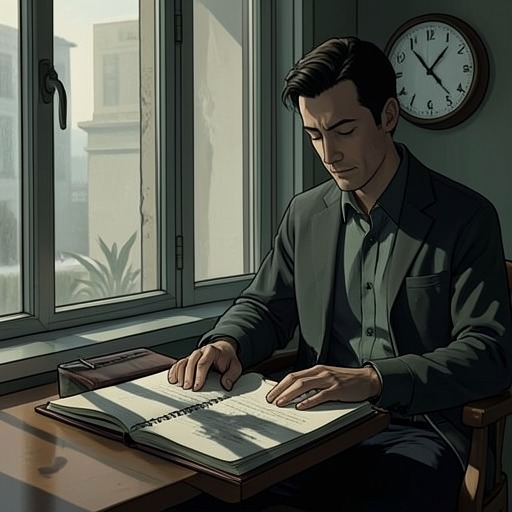
As a cholera corpse is carried to the pyre, Rabbit Hendricks is recognized among the dead. Because everything a cholera victim possessed must be burned to control contagion, a pyre maker brings Rabbit’s sketchbook to Dorrigo. Dorrigo waves it away and orders it burned. Bonox Baker objects to letting the sketchbook be lost, arguing that it should be saved so Rabbit will not be forgotten. Dorrigo counters that everything is forgotten in the end and that the living are better served by living now. Their disagreement gives the poem its immediate setting: remembrance is not an abstract virtue here, but a choice about whether to preserve one dead man’s trace when practical necessity demands its destruction.
When Bonox recalls the customary injunction “Lest we forget,” Dorrigo distinguishes the words from their usual memorial purpose. He tells Bonox that Kipling’s poem is not about remembering but about how everything gets forgotten, then recites its images of naval power melting away, the fire sinking on dune and headland, and yesterday’s pomp becoming one with Nineveh and Tyre. The stanza’s movement is from imperial display to disappearance. Its concluding plea, “Lest we forget—lest we forget!”, does not cancel that movement; in Dorrigo’s reading, the plea is itself shadowed by the certainty that human memory fails.
Dorrigo’s reading and the railway
The scene turns on an apparent contradiction. Dorrigo orders the sketchbook burned, yet pauses to explain a poem about forgetting and asks how anyone can remember anything if the poem’s meaning is missed. The contradiction is not resolved by saving Rabbit’s possession: Dorrigo nods to the pyre maker, and the bamboo is set alight. Instead, his speech makes the burning part of a larger recognition. A poem can name the loss without preventing it. Dorrigo adds Nineveh and Tyre to a “God-forsaken railway in Siam,” joining the vanished cities of imperial history to the railway that has consumed prisoners and forced laborers. He also recognizes, with a shock, that the poem’s account of forgetting functions for him almost as fate: it is not merely a lesson he explains to Bonox, but a pattern he feels himself caught inside.
The poem’s reach extends beyond the funeral through the contrast between the railway’s victims and the forms of public remembrance that survive. Locomotive C 5631, which ran the length of the completed Death Railway, is displayed at the Yasukuni Shrine in Tokyo. Its plaque does not mention the railway’s horror or the hundreds of thousands who died building it. The Book of Souls records more than two million names of people who died in service to the Emperor, including men convicted of war crimes and executed after the war; enshrinement at the shrine is associated with absolution. Yet the people who died as railway laborers have no comparable register. Even their number is unresolved: estimates for Asian forced laborers killed range widely, and no one knows the total. Recessional’s passage from pomp to disappearance therefore resonates with a commemorative landscape in which imperial names and objects remain visible while the laborers’ deaths are uncounted and their names forgotten. The novel offers the fragment of their story as a modest counter to that erasure, not as a restoration of what cannot be known.
The refrain beyond the scene
The novel’s later account of Jimmy Bigelow further complicates the promise contained in “Lest we forget.” Jimmy lives for decades after Jodie’s mother dies, while a growing public industry of memory surrounds him. Yet he recalls less and less. What persists for him includes jokes, stories, the taste of a duck egg given by Darky Gardiner, hope, and goodness. He remembers Wat Cooney’s generosity and the hesitation of the men gathered at his grave, but not that Wat died during the march to Three Pagoda Pass or the cruelties accompanying it. His sons and other commentators correct his inconsistencies, but correction does not make his recollection complete; Jimmy insists on the authority of having been there while resisting the demand to serve as a definitive record.
That later tension does not make Jimmy’s partial memory equivalent to the deliberate omission from a memorial plaque. It does, however, return to the question raised at the pyre: what survives, what is lost, and who gets to define the record. Dorrigo’s reading of Recessional refuses the comfort that a commemorative phrase can guarantee remembrance. The poem’s imperial imagery supplies a scale for that refusal, while the sketchbook, the railway, the shrine, and Jimmy’s fallible recollections show different ways that traces endure or disappear. The poem matters because the novel lets its warning remain unresolved: naming forgetting may resist it, but it cannot by itself recover every name or prevent loss.