Sheephead Morton
The Narrow Road to the Deep NorthSheephead Morton is a Tasmanian miner and Australian prisoner of war whose rough, combative reputation sits beside a capacity for practical care. His childhood poverty in a remote mining town gave him his name; in the camp, the same large, work-hardened hands that suggest violence also help sustain fellow prisoners and tend to the dead. The contrast makes him more than a stock fighter: his place among the men is defined by both volatility and shared survival.
Background and temperament
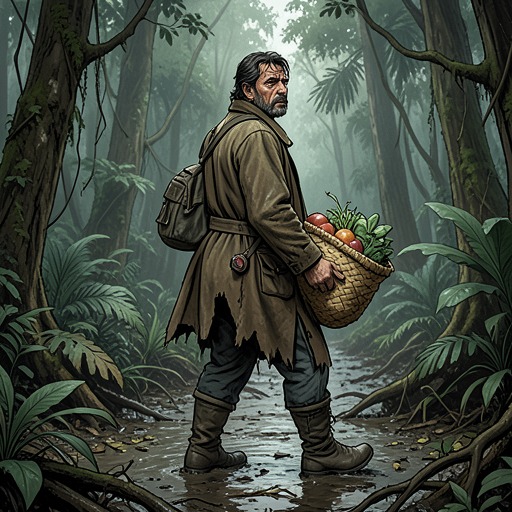
Sheephead grew up in Queenstown, a copper-mining town on Tasmania’s west coast. His nickname came not from his appearance but from a period when his family was so poor that sheep’s heads were what they could afford to eat. He describes Queenstown and nearby Gormanston as isolated settlements divided by a substantial hill. In his account, mining stripped the rainforest from the landscape, leaving ground so bare that it resembles the moon. The description connects his personal origins to a place transformed by extraction and hardship.
His physical presence is striking: he has huge hands and describes his own head as rougher than the road out of Rosebery. Yet the narrative distinguishes his manner according to whether he is sober. Sober, he can be gentle; drunk, he can be violent and eager to fight. On one occasion, after returning from leave in Cairo, he challenges an entire busload of diggers. When told to sit down and be quiet, he turns to Jimmy Bigelow with an expression of disgust. The episode establishes his readiness to provoke, while also showing how quickly his forceful manner can become a performance among companions.
Speech and sense of home
Sheephead speaks about Queenstown with the familiarity of someone shaped by its limited geography and mining life. He remembers the route over the hill to Gormanston and the local routine of drinking on a Saturday night, crossing over, fighting, and returning home. His account is not a detached description of the towns: it conveys how thoroughly their landscape and habits have formed his idea of what makes a place distinctive.
His remarks elsewhere are brief and blunt. He makes a crude dismissal of Tarzan, reminds someone that a fold has been forgotten, and at another point addresses a companion familiarly as mate. When he assesses an unspecified matter, he says it is not much to boast about. These scraps do not supply a continuous account of his views, but they show a voice inclined toward plain speech, mockery, and understatement rather than grand claims.
Work and comradeship in captivity
At the tool depot, where prisoners collect their equipment, Sheephead offers Darky Gardiner a sledgehammer. Later, as the men struggle along, Darky becomes intent on reaching for his food. Sheephead pulls him back to his feet. Lizard Brancussi takes over the sledgehammer Darky had been carrying, not from compassion, but because the men function as a group that survives by redistributing effort. Darky is at once angry to lose the chance to reach his food and relieved that his rice ball will still be there for lunch. Sheephead’s intervention does not erase the strain or resentment of the moment; it helps Darky continue within a fragile arrangement of mutual dependence.
That dependence also appears in a quieter act of labor. While forbidden movement must be kept inconspicuous, Sheephead carefully works mud beneath his toes, returning to the kind of concreting he sometimes did before the war when laying a house foundation. The task draws on a civilian skill in circumstances where even a small movement has to be concealed. His memory of building does not become an escape from captivity; it is a practical resource carried into it.
Care, death, and narrative role
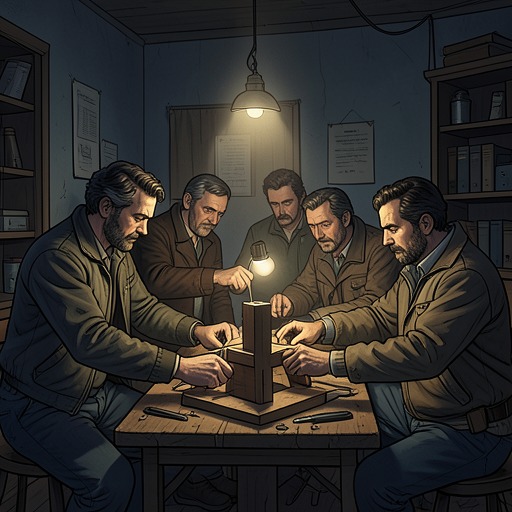
After a body is brought to the hospital, Sheephead cleans it with water from a kerosene tin and prepares it for burial the following day. The narrative places his miner’s hands at the center of the scene, emphasizing their capacity for both violence and gentleness. His care is concrete and unceremonious: he performs the work of tending to the dead rather than turning it into a declaration about himself.
A later scene places him at Constitution Dock, where he puts his head into a bucket and yells. The surviving account does not give the words or explain the purpose of the gesture, so its significance remains limited to the action itself. Taken together, these moments present Sheephead through gestures rather than a fully narrated life: a man formed by poverty and mining, capable of drunken aggression, and repeatedly involved in the unglamorous work through which the prisoners endure. His contradictions are not resolved; they are the terms of his presence among them.