Siam–Burma Railway
The Narrow Road to the Deep NorthThe Siam–Burma Railway, also called the Line, is a military transport project that becomes the organizing fact of the prisoners’ lives and a lasting record of the human cost of imperial ambition. Planned as a route from north of Bangkok through to Burma, it is built under demands that treat laborers as expendable resources. Its story does not end when trains begin to run: the railway is later dismantled, reclaimed by vegetation, and remembered through fragments that cannot restore the names or lives lost in its construction.
Route, Purpose, and Engineering
In early 1943, Imperial Japanese Army engineers marked the proposed route with surveyors’ pegs: a straight line extending 415 kilometres from north of Bangkok towards Burma. When Dorrigo Evans first sees it, the route is still an outline rather than a functioning railway. Its construction depends on plans, orders, and expectations that exceed the available time and resources. The project is driven by Japan’s military position: the Allies supply the Chinese Nationalist Army through Burma, while American control of the seas makes a land route increasingly important to Japanese plans for supplying forces in Burma and advancing towards India.
The railway’s strategic purpose is therefore joined to a practical impossibility. Japan lacks the money and machinery required to build it, and the timetable is urgent. The novel presents the resulting gap between engineering requirements and available means as a political decision rather than a problem solved by adequate investment: the burden falls on the laborers compelled to build the route. They are issued blunt axes and rotten hemp rope to clear a kilometre of giant teak trees. Later, prisoners work with hand tools to cut rock, while shortages of saws, axes, proper chisels, and forge fuel impede the work. When a cutting is already half finished, the Railway Command Group orders it enlarged by a third to address gradient problems in the next sector, adding 3,000 cubic metres of rock to be cut and removed. A technical revision thus becomes another demand on an already depleted workforce.
Forced Labor and the Prisoner Workforce
The railway’s labor system draws on a vast captive population. The book gives the scale as 22,000 Australian prisoners of war, with 9,000 sent to work on the railway; it also describes some 60,000 Allied prisoners among the laborers and approximately a quarter of a million Asian workers, including Tamils, Chinese, Javanese, Malayans, Thais, and Burmese. The recorded totals remain uncertain. Estimates for Asian laborers’ deaths range from 50,000 to 200,000, and the text emphasizes that no agreed count exists. These figures make the railway’s construction a history not only of infrastructure but also of people subjected to a system that leaves many of them unnamed.
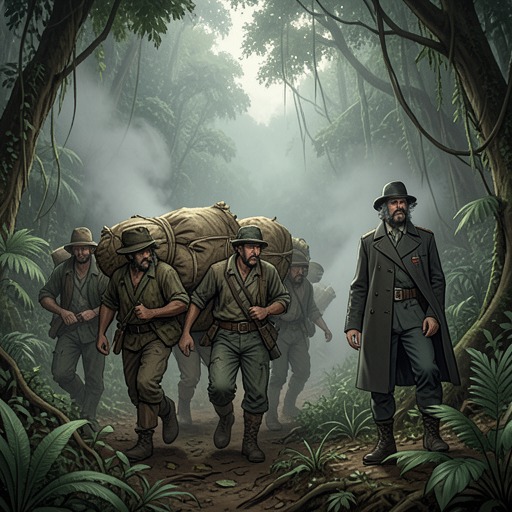
Evans’ J Force reaches the railway after being transported in closed rice wagons, with 27 men confined in each wagon and too little room to sit. The journey lasts five days and covers roughly a thousand miles; the party makes six stops, and three men die before it reaches Ban Pong. Their arrival marks the transition from captivity as transport to captivity as labor. The railway itself determines where they must work and what they must carry: prisoners clear jungle, break rock, move earth, and haul sleepers and rails with ropes, poles, hammers, bars, baskets, and hoes.
As the monsoon sets in, the work intensifies under the Speedo. Rest days disappear, quotas rise, shifts lengthen, and men may be ordered to work both day and night. The distinction between those fit to work and those too sick to work breaks down as the workforce is divided instead into the sick and the dying. When Nakamura faces a revised demand for labor, Evans reports that only 363 of 838 prisoners are available for railway work: 67 have cholera, 179 are seriously ill in hospital, 167 can manage only light duties, and 62 more are reporting sick. After further bargaining, Evans offers 400 men, arguing that taking more would leave men dead or unable to work once recovered. His medical judgment provides a basis for negotiation, but no dependable shield against the railway’s demands.
The Railway as an Imperial Command
For the Japanese officers, the railway is not simply a construction scheme that can be abandoned when costs rise. Colonel Kota tells Nakamura that the work must be completed even if most of the prisoners die, or even if everyone dies. Nakamura understands the order through the Emperor’s wishes and the assumption that prisoners can be used as material for construction. The project’s objective has thus been detached from the survival of the workforce: the railway must be finished, whatever its human consequences.
The novel’s account of this logic gives the railway a double significance. It is a physical line of embankments, cuttings, bridges, sleepers, and rails, but it is also the mechanism by which military priorities become labor quotas and bodily depletion. The prisoners’ continued identity as Evans’ J Force stands in opposition to this reduction. Although their number falls, they remain a force bound by shared survival and by their refusal to let the dead cease to matter. Their collective name persists even when the railway’s system treats each worker as replaceable.
Completion, Ruins, and Memory
On 25 October 1943, steam locomotive C 5631 travels the full length of the completed railway, towing carriages of Japanese and Thai dignitaries. The book sets this public milestone against the deaths that made it possible: among the remains along the route are those of one in three of the Australians sent to work there. The railway’s completion is therefore not presented as a neutral engineering achievement. Its first full journey also marks the distance between official celebration and the suffering left outside the account of progress.
The memorial history sharpens that contrast. C 5631 is displayed at the museum associated with Yasukuni Shrine in Tokyo, while the plaque in front of the locomotive makes no mention of the railway’s construction or the dead workers. The novel notes that the number of deaths is not agreed and that there is no corresponding book listing the names of the many Asian laborers who died. The locomotive and the memorial preserve one version of the past; the missing names and disputed totals expose what that version leaves out.
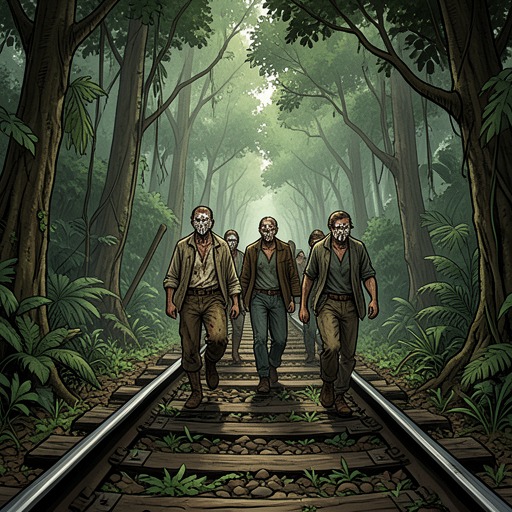
After the war, the railway loses its military purpose and support. Its Japanese engineers and guards are imprisoned or repatriated, and the workers who remain to maintain it are freed. The route is abandoned by the Thais, dismantled by the English, and pulled up and sold by tribespeople. Rain and time then break down embankments and bridges, fill in cuttings, and return vegetation to ground once occupied by the works. Decades later, some short sections are cleared and turned into tourist, sacred, or national sites, but these partial restorations cannot undo the larger disappearance of the line.
A later letter to Tenji Nakamura describes railway engineers returning to Thailand, now called Siam in the novel, to find the rusting remains of the first locomotive to have travelled the full route in 1944; they are restoring it with the intention of displaying it at Yasukuni Shrine. This account sits alongside the earlier description of C 5631’s journey on 25 October 1943, preserving different details of the railway’s remembered completion. In either account, the surviving locomotive stands apart from the route that has been dismantled and overgrown. The novel’s final image of the Line is not a functioning transport system but a broken trace beneath the jungle: the imperial project has passed, while its incomplete record and the lives it consumed remain difficult to gather into a single history.