Squizzy Taylor
The Narrow Road to the Deep NorthSquizzy Taylor is a doctor, a prisoner of war, and Dorrigo Evans’s second-in-command in the camp. His medical training makes him one of the few men able to assist Dorrigo with treatment, but it does not give him power over the conditions that make treatment necessary or over the outcomes those conditions permit. His work with Darky Gardiner and Jack Rainbow shows both the value and the limits of that expertise: he can assess, assist, and care, yet even a painstaking operation cannot guarantee that a patient will live.
Identity and Background
Squizzy’s nickname draws on his surname and the dark charm associated with it; he is named after a Melbourne gangster. In appearance he once seemed sleek, but by the time the narrative describes him in the camp he has become very thin. His professional background is more ordinary than the nickname suggests: he had been a suburban doctor in Adelaide. Outside the medical knowledge he gained by assisting Dorrigo, his surgical experience consisted of his formal training and what he had learned from medical anecdotes.
That distinction matters to his role. Squizzy is not presented as an experienced surgeon with the equipment or support of a modern hospital. He brings a doctor’s training to improvised decisions, while Dorrigo’s work exposes him to practical surgery in circumstances neither man can control. His expertise is useful, but bounded; his confidence is strongest when naming what the available evidence can and cannot justify.
Second-in-Command and Camp Doctor
Squizzy serves as Dorrigo’s second-in-command and participates in the camp’s medical work. The responsibility is inseparable from the camp’s forced-labour system: prisoners must be counted and assessed for railway work even when illness has left few of them fit. When Dorrigo reports 838 prisoners, he specifies that 67 have cholera, 179 are in hospital with severe illness, 167 can manage only light duties, and another 62 have reported sick that morning. His calculation leaves 363 men for work. Squizzy belongs to the small medical team confronting the consequences of such decisions, though the evidence does not assign him Dorrigo’s specific role in negotiating the labour total.
The distinction between medical judgment and the demands imposed on it becomes stark when Dorrigo later argues over how many sick prisoners can be sent to work. He offers 400, reasoning from the men’s conditions, while recognizing that medical knowledge cannot shield him from the camp authorities’ demands. Squizzy’s place beside Dorrigo is part of this shared, constrained work: the doctors can identify illness and estimate risk, but their assessments occur within a system that compels labour from starving, sick prisoners.
Care for Darky Gardiner
After Darky returns in an acutely weakened state, Shugs helps wash and care for him. Squizzy arrives as Dorrigo’s second-in-command and examines Darky, checking his condition through a brief medical assessment. Darky is feverish and disoriented; among the memories he talks about is taking his wife to Nikitaris’s fish shop in North Hobart and watching the fish in its window tank. Squizzy’s examination takes place amid this fragmentary account, as he tests Darky’s responsiveness and looks him over.
The scene makes Squizzy’s professional attention part of a larger act of camp care. He cannot reverse Darky’s condition merely by examining him, but he treats the man as a patient while Shugs undertakes the intimate work of cleaning him. The contrast is between the severe circumstances of the camp and the practical, individual gestures that remain possible within them. Squizzy’s role is neither heroic rescue nor detached diagnosis: he attends to Darky and tries to understand what state he is in.
Jack Rainbow’s Operation and Its Outcome
Squizzy’s most sustained medical exchange with Dorrigo concerns Jack Rainbow. When Dorrigo recognizes that an earlier attempt to close Jack’s femoral artery has failed and infection has taken hold, he decides that another amputation may offer a chance of survival. Squizzy challenges the prognosis. He warns that removing the leg at the hip is so dangerous that even modern hospitals rarely succeed, and that under their conditions the attempt may be pointless. His objection is a clinical judgment about risk, not indifference to Jack.
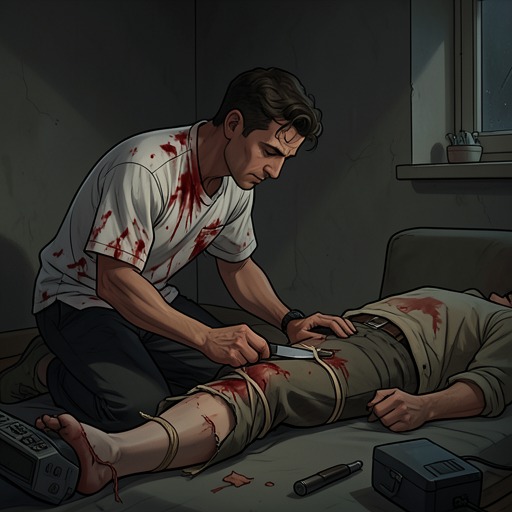
The procedure proceeds with scarce, improvised materials. Dorrigo asks whether there is enough anaesthetic, and the operation uses a kitchen meat saw and gut twine made from pig intestine. Squizzy assists while Dorrigo works to close the artery; when Dorrigo tells him to move the spoon, Squizzy lifts it so the operation can continue. The bleeding stops, and Dorrigo believes Jack will survive, though recovery and infection remain risks. For a moment, the operation appears to have turned toward life: Dorrigo imagines Jack alive and loved, and feels that his effort has not been futile.
That hope is overturned. Dorrigo continues working carefully on Jack’s stump, unaware that Jack has already been dead for several minutes. Squizzy’s earlier warning therefore remains in the scene without becoming a simple verdict on the decision to operate. He identified the danger accurately, yet the possibility of success was real enough for Dorrigo to persist, and the immediate repair of the artery seemed to confirm it. The final outcome exposes the gap between technical success and survival: the operation reaches its intended surgical step, but it cannot save Jack.
Character and Narrative Significance
Squizzy is defined by a tension between medical knowledge and medical power. He can assess Darky, question Dorrigo’s proposed operation, and assist with its execution; he cannot secure the conditions that would make either care or recovery reliable. His medical judgment is most consequential when it resists the impulse to treat effort as a promise of success. At the same time, he does not withdraw from the work after stating the risks. He assists Dorrigo, and his practical participation helps carry the operation forward.
The contrast between the two cases gives his role its shape. Darky’s examination occurs alongside Shugs’s personal care and Darky’s return to memories of ordinary life; Jack’s treatment becomes a desperate technical attempt whose apparent success cannot hold. Across both, Squizzy stands near the boundary between care and helplessness. The camp needs the skills he and Dorrigo possess, but its deprivation and coercive labour demands continually exceed what those skills can repair.