Starvation and Malnutrition Among Death Railway POWs
The Narrow Road to the Deep NorthStarvation and Malnutrition Among Death Railway POWs describes how deprivation shaped the prisoners’ bodies, work, relationships, and ideas of survival. The worsening scarcity was not separate from the railway’s construction: a military project imposed on captive laborers turned their need for food and rest into a daily conflict with the demands of the Imperial Japanese Army. As illness and deaths accumulated, small acts of sharing became both practical support and a measure of responsibility to one another.
Conditions and causes
When Dorrigo Evans first saw the railway route in Siam in early 1943, the conditions had not yet reached their later extremity. The dry-season jungle was open, some food was available, and hunger had not yet become the defining condition of the men’s lives. The surveyed route stretched 415 kilometres from north of Bangkok toward Burma. The prisoners’ first assignment was to clear a kilometre of giant teak trees along its planned path.
The railway was driven by Japan’s military predicament. Japan needed a land route through Burma to supply its forces and advance its wider campaign, while the Allies controlled the seas and supplied the Chinese Nationalist Army through Burma. Japan lacked the money, machinery, and time to build the required railway by ordinary means. Its answer relied on forced labor: of 22,000 Australian POWs, about 9,000 would be sent to the railway. They were part of a much larger labor force that also included hundreds of thousands of Asian workers. The railway’s engineering demands therefore became demands on captive people, with their labor and survival subordinated to the project.
The prisoners’ transfer to the work site made that subordination tangible. The thousand men designated Evans’ J Force travelled in closed rice wagons, 27 to a wagon, without enough room to sit comfortably. The journey lasted five days, covered about a thousand miles, and was made without food; three men died before the group reached Ban Pong. Their arrival marked the beginning of labor under conditions that would steadily worsen.
The Speedo and the deepening crisis
The change came with the monsoon and the Speedo, which raised work quotas, lengthened shifts, and removed rest days. Prisoners could be ordered to work two shifts, by day and by night. The distinction between those fit to work and those who were sick became harder to maintain; the practical division was increasingly between the sick and the dying. At another point in the railway’s construction, Major Nakamura faced an order to enlarge a major cutting by one-third, requiring a further 3,000 cubic metres of rock to be removed. Prisoners had to break rock by hand, while the camp lacked enough tools and the means to keep those tools serviceable. The demand for progress thus persisted even when laborers and equipment were already inadequate.
As the rains continued, Colonel Rexroth died of dysentery and Dorrigo Evans assumed command. He imposed a levy on officers’ pay to buy food and drugs for sick prisoners, and pressed the officers to work. These measures could not undo the conditions imposed on the men, but they addressed needs that had become urgent. Dorrigo Evans also understood that food and rest mattered more than drugs when starvation itself was driving so many illnesses. The dead accumulated from week to week, while the hospital hut filled with men too sick to work. The focus of life narrowed: thoughts of food and rest displaced other concerns.
Illness, hunger, and the body
The camp’s malnutrition appeared in multiple forms. Dorrigo Evans saw prisoners affected by pellagra, beri-beri, and avitaminosis, as well as tropical ulcers. Les Whittle, who had lost his fingers to pellagra, continued performing music with bamboo sticks attached to his wrist. Jack Rainbow, who had lost his sight, performed alongside him. Dorrigo Evans considered whether avitaminosis or several illnesses together had caused Rainbow’s blindness, and recognized that food could address many of the conditions around him. These men were not merely examples of suffering: their continued performance made visible how much of ordinary social life the prisoners tried to preserve amid illness and scarcity.
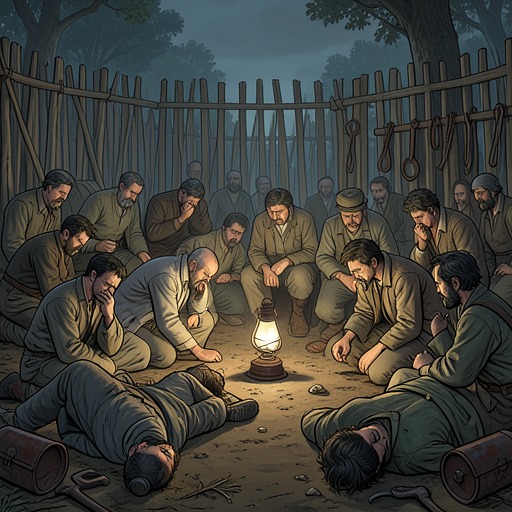
The scale of the crisis defied accurate accounting. One week three men died, the next eight, while the daily total remained uncertain. The hospital was not equipped to restore the sick to health; it was where the worst cases could lie. In the wider camp, there were no longer reliably fit men, only those who were sick, very sick, or dying. Malnutrition also altered the prisoners’ sense of distance and belonging. Australia, once a source of shared identity, seemed to recede beside immediate hunger, disease, and forced labor. A grain of rice could matter more to them than the continent from which they had come.
Food, leadership, and mutual obligation
Scarcity gave food a moral as well as a physical importance. A gang of prisoners stole a cow from Thai traders, and the meat was secretly delivered to the camp kitchen. A steak was set aside for Dorrigo Evans. He recognized that the sick kitchen hand who brought it also had reason to want the food, and that the men intended the meal as a tribute to their leader. Dorrigo Evans ordered the steak taken to the hospital and shared among the sickest prisoners. The choice did not mean that he was free of hunger: he desperately wanted the meal and struggled to hold to his decision. He understood, however, that the men would witness the choice and that it would become a story by which they judged his leadership.
That episode crystallized the pressure of his role. Dorrigo Evans did not consider himself naturally strong, yet he led a thousand men who expected him to act as though he were. Their hope made him responsible for more than issuing orders. The steak’s distribution expressed a camp ethic in which scarce food could not be considered only in terms of individual entitlement. Alongside the levy for food and medicine, it shows how leadership was tested by decisions about who most urgently needed what little the prisoners could obtain.
Survival and aftermath
Deprivation did not eliminate fellowship. An occasional duck egg, a little palm sugar, or a joke repeated among the men could help make survival possible. Such moments were small against the scale of the work and the deaths, but they were part of how Evans’ J Force remained a collective. The unit’s identity endured even as its members died; the survivors understood their continuing bond as inseparable from remembering those who had not survived.
The railway itself did not endure as the purpose for which the prisoners had been made to work. After Japan’s defeat, it lost its military purpose and support. The remaining laborers were freed, the line was abandoned by the Thais, dismantled by the English, and pulled up for sale by local people. Over time, its embankments and bridges broke down and vegetation returned. The railway’s decay contrasts with the lasting human cost of its construction: the project could be dismantled and reclaimed by the landscape, while the prisoners’ lost lives and the uncounted dead could not be restored. In this account, starvation is not simply a condition accompanying hard work; it is one of the means by which an imperial infrastructure project consumed the people forced to build it.