Starvation and disease among the POWs
The Narrow Road to the Deep NorthStarvation and disease among the POWs are not incidental hardships but the conditions through which forced railway labor consumes bodies and narrows the possibility of choice. Food diminishes as work intensifies; illness moves through the camp; and the distinction between those considered fit and those already sick becomes increasingly difficult to sustain. The narrative follows this attrition from the prisoners’ transport to the railway, through the cholera compound and the daily allocation of labor, showing how medical care and survival are constrained by the same system that demands the work.
Conditions of Captivity and Forced Labor
The POWs’ deprivation begins before they reach the railway camps. Evans’ J Force is transported in closed steel wagons used for rice, with twenty-seven men packed into each. They travel for five days without food, with only limited space to sit or sleep. By the time the men are taken off the train at Ban Pong, three have died. The journey makes plain that deprivation is not confined to the worksite: transport itself subjects the prisoners to overcrowding, hunger, and exhaustion.
The wider project magnifies the scale of this coercion. The Japanese Empire holds twenty-two thousand Australian POWs, and nine thousand are sent to work on the railway. They are among a far larger forced workforce that also includes Asian laborers, whose status and circumstances are not identical to those of the POWs. The railway is completed amid enormous human loss, but the number of laborers who died cannot be established with agreement. The uncertainty is part of the book’s account of the conditions: many of those who suffered and died are left without a reliably recorded place in the history of the project.
As the monsoon season approaches, food becomes scarcer. The Speedo removes rest days, raises work quotas, and lengthens shifts, sometimes requiring prisoners to work both day and night. The pressure does not merely make the already sick weaker; it erodes the practical distinction between men who are fit, men who are ill, and men close to death. Prisoners are compelled to work with basic tools and their own strength, even as starvation and disease reduce their capacity. The railway’s demands therefore operate alongside hunger and illness, each worsening the effects of the others.
Unequal Effects and Small Means of Survival
Illness affects individual prisoners differently. Tiny Middleton, despite starvation rations, initially appears to retain his strength through malaria, dysentery, pellagra, and beri-beri. His work drilling holes in the rock is a source of personal pride: he tries to complete his quota before the others. But the Japanese engineers repeatedly increase the required amount, from one metre a day to two and then three. Tiny continues to meet the rising target quickly, while the other prisoners, many of them feverish or weakened, try to conserve energy. His exceptional output consequently raises the pressure on the group, turning a personal contest into an added burden for men with far less strength. The episode shows that apparent resilience does not protect the prisoners collectively when the labor system uses an individual’s output to set expectations for everyone.
The camp’s material scarcity leaves room for only small interruptions in deprivation. A duck egg, a little palm sugar, or a joke repeated among the men can help make survival possible. Such moments do not reverse the conditions or lessen the work demanded of them; their importance lies in the way the prisoners continue to share and value what little is available. They remain a group through mutual recognition even as the railway’s labor regime treats them as a supply of workers.
Medical Care Under Pressure
Dorrigo Evans serves as both the prisoners’ commanding officer and senior medical officer. During a labor count, he reports that four men died the previous day and two more overnight, leaving 838 POWs. Of these, 67 have cholera and are isolated in the cholera compound, 179 are in hospital with severe illness, and 167 are too ill for anything beyond light duties. A further 62 report sick that morning. These figures make the apparent labor pool a matter of medical judgment as well as arithmetic.
The medical work takes place amid severe shortages and continuing danger. The cholera compound consists of open-sided shelters where many patients die. Dorrigo and the orderlies inspect the men, check saline levels, administer drips, and move some patients to a smaller recovery shelter. Forty-eight other men lie on the platform in one scene of rounds. The patients’ conditions vary: one man is judged to be recovering, another is dead, and Ray Hale improves enough to be released from the compound for light duties. Dorrigo and Bonox Baker also prepare bodies for removal. The repeated decisions to treat, isolate, release, or record a death give the medical work a rhythm dictated by scarcity and urgency rather than by any secure prospect of recovery.
Cholera also threatens the people providing care. Bonox Baker reports that two other orderlies have fallen ill, and volunteering for this work is understood as carrying a grave risk. Dorrigo accepts that danger as part of being a doctor, while recognizing that the men who volunteer despite the risk are choosing a form of service from which they might otherwise stay away. The compound thus depends on care that can itself expose its providers to the disease.
Labor Counts and the Limits of Choice
When Major Nakamura and Lieutenant Fukuhara oversee a selection of men for work, Dorrigo argues from the camp’s medical condition. He first identifies 363 men as available for railway labor, based on the numbers of dead, seriously ill, assigned to light duties, and reporting sick. Nakamura rejects the figure and demands more. As the negotiation continues, Dorrigo offers 400, explaining the illnesses and the limits of the men’s capacity. His medical knowledge gives him a basis for making the case, but it cannot protect the prisoners from the labor demand.
Dorrigo recognizes that the figures are not a straightforward measure of fitness. In his judgment, no prisoner is truly able to do the work expected of him: all are suffering from some degree of starvation or illness. Yet he must still identify a number, choosing among men who are least likely to die if sent to work. While Nakamura strikes him, Dorrigo calculates whether a few men recovering in hospital might manage very light duties and whether some of those already on light duties could then join the work parties. He reaches a possible maximum of 406, while knowing that the figure may still fail to satisfy Nakamura. The count is therefore both a medical calculation and a forced compromise: it cannot make the work safe, only attempt to limit who is exposed to it.
The violence of the exchange does not resolve the underlying shortage or restore Dorrigo’s authority over the men’s health. Nakamura and Dorrigo communicate their opposing positions in a pause in the negotiation, but the bargaining resumes. The episode reveals the narrow space in which the doctor acts: he can advocate, calculate, and try to protect some men, but he cannot remove the demand that sick and depleted prisoners be made to work.
Consequences and Significance
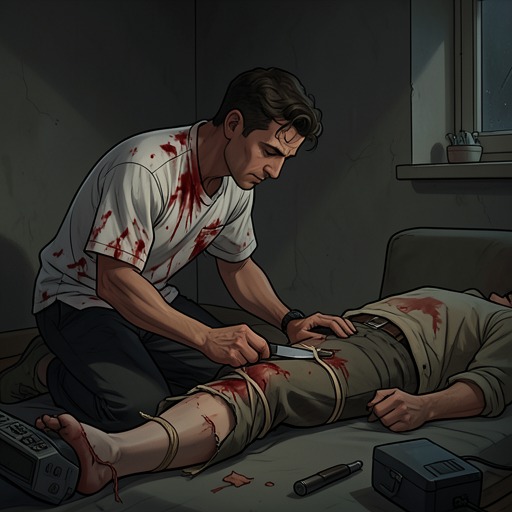
The effects of deprivation are visible not only in the labor counts but also in the care required after injury. When an earlier operation fails and gangrene develops, Dorrigo calls for a tourniquet. Water is too precious to use freely, and he instructs Jimmy Bigelow to use it slowly. Faced with the prospect that the patient will die without intervention, Dorrigo considers amputation at the hip as a chance of survival, while another medical voice warns that the shock could itself prove fatal. The decision is presented as a judgment under extreme limits: an intervention carries serious risk, but doing nothing also leaves the patient in danger. The scene connects the larger condition of the POWs to the immediate ethical pressure of treating one person when equipment, supplies, and certainty are absent.
The prisoners’ condition is also a collective one. Evans’ J Force remains a thousand souls in the group’s understanding of itself even as deaths reduce its numbers. The men’s belief in one another is strengthened by the presence of the dead, whose loss makes continued solidarity matter more, not less. Against the railway’s treatment of prisoners as labor to be counted and expended, that shared identity preserves a measure of human connection. Starvation and disease thus register both physical depletion and an institutional assault on agency; the prisoners’ mutual care and Dorrigo’s repeated efforts to assess, treat, and negotiate are acts of resistance within limits, not escapes from them.