Tenji Nakamura
The Narrow Road to the Deep NorthTenji Nakamura’s life is shaped by a contradiction: he understands himself as a gentle, dutiful man, yet his obedience helps sustain the coercive labour system of the Death Railway. After the war, he tries to live honestly under his own name, but his memories and justifications never resolve the gap between his private idea of goodness and the consequences of his service.
Wartime Authority and the Railway
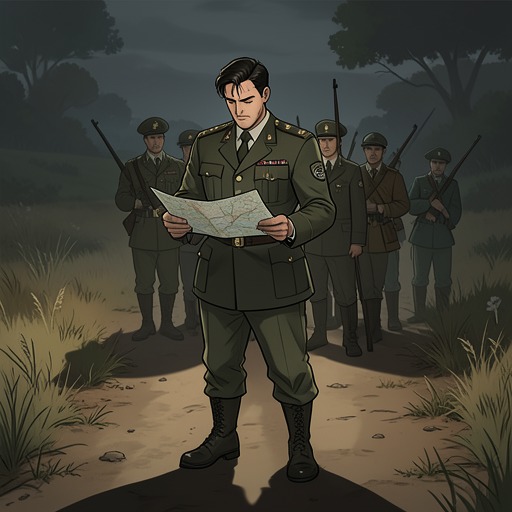
Nakamura serves as an officer in the Imperial Japanese Army 2nd Railway Regiment and becomes one of the authorities responsible for Australian prisoners of war working on the railway in Siam. The prisoners’ transfer into the labour system is marked by confinement and deprivation: Evans’ J Force travels in closed rice wagons, with twenty-seven men crowded into each, before continuing by truck to the camps. As the monsoon arrives, the Death Railway’s Speedo system removes rest days, raises work quotas, and lengthens shifts. Nakamura’s authority operates within a system that makes prisoners’ labour an imperial requirement rather than a matter of individual consent.
A later muster shows the practical stakes of his orders. With prisoners assembled in heavy rain, Dorrigo Evans reports that the camp holds 838 men: 67 are in the cholera compound, 179 are in hospital with serious illness, 167 can manage only light duties, and 62 more are reporting sick. He calculates that 363 can work. Nakamura disputes the figure and presses for a larger labour force. After further argument, Dorrigo offers 400, knowing that medical knowledge cannot protect the men from the demands imposed on them. Nakamura’s position gives him the power to insist; the doctor’s negotiation can only limit, not remove, the danger.
The imbalance appears again when Nakamura orders Dorrigo to select 100 men for a march to a camp near Three Pagoda Pass. Dorrigo argues that no prisoner is capable of making the journey, but Nakamura insists that the hundred must be found. His command turns an administrative requirement into a decision about the bodies of already exhausted men, while leaving Dorrigo to carry out the selection.
Duty as Moral Evasion
Nakamura’s obedience is not presented as a simple absence of feeling. During a punishment he has ordered, he is agitated and distressed, and reasons that his distress proves he is a good man. He treats obedience, reverence, and painful duty as evidence of moral character, allowing compassion to coexist with the decision to authorize punishment. He justifies the act as serving the railway and restoring authority among the guards, and regards the railway as an embodiment of the Emperor’s will. In this reasoning, responsibility is displaced upward to the imperial cause and outward to the machinery of command.
That displacement is reinforced by his response to what he has witnessed. He briefly confronts a disturbing sense of violence as a persistent force, but the thought does not last. Duty, the Emperor, the nation, and the practical work of the railway take its place. He soon forgets the punishment, even though it is still continuing when he later passes the parade ground. His return to routine shows how forgetting functions not merely as a failure of memory but as a means of resuming the role he believes has been assigned to him.
Flight and the Unequal Reckoning
After the war, Nakamura lives in the ruins of Tokyo, sheltering in the Shinjuku Rashomon, an archway made from debris. He has lost his position and his shabu habit, but remains afraid of recognition and arrest. He steals money from a pan pan girl to buy false identity papers, sells her clothes to pay for a train ticket, and travels to Kobe under the name Yoshio Kimura, presenting himself as a former private rather than a former major. There he scrapes by through petty theft and black-market dealings. Fear of a possible Australian officer sighting him keeps him indoors for a week.
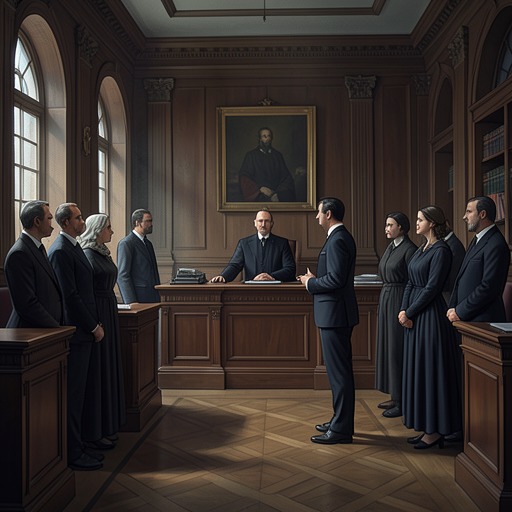
The proceedings against other wartime personnel make his own escape especially visible. He follows the war-crimes trials and cannot understand the conviction of a Japanese soldier for beating a prisoner. At Choi Sang-min’s trial, evidence from Colonel Kota helps secure Choi’s conviction, while Choi believes that Nakamura has not been arrested and may be working for the Americans. The outcome sits within a broader record of selective accountability: the railway’s memorial plaque names neither the people who died building it nor the scale of their deaths, while the Book of Souls at Yasukuni Shrine includes the names of men convicted of war crimes. Nakamura’s survival outside custody is part of a postwar landscape in which responsibility is neither evenly pursued nor fully remembered.
Return to His Name and Family Life
Nakamura’s relationship with Sato, a surgeon, changes after Sato recounts his involvement in wartime operations on airmen and explains that Professor Ishiyama died in prison while other men were sentenced, had their sentences commuted, and were eventually released. Sato says that both the Americans and the Japanese want the matter forgotten. After hearing this, Nakamura and Sato gradually stop meeting to smoke and play go. Their former companionship becomes uncomfortable, and the games end.
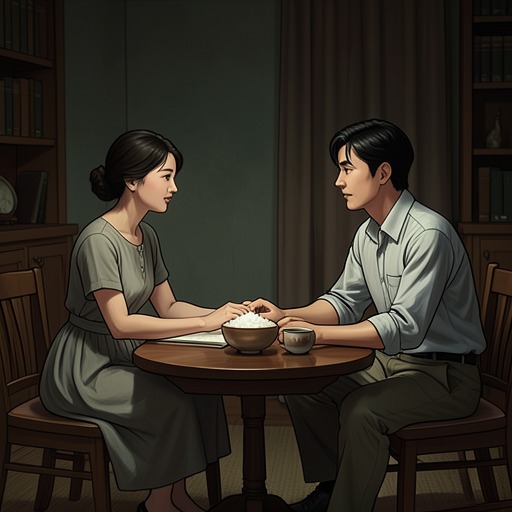
As the remaining imprisoned war criminals are released, Nakamura gives up his false identity and returns to his real name. The change is presented as an attempt to live honourably by acknowledging the truth, but it does not amount to a full reckoning with what he has done. He marries Ikuko the following year, and they have two daughters. His daughters experience him as gentle and absent-minded; when the younger one is seriously hurt in a school-bus accident, he stays beside her. He also takes spiders outdoors rather than killing them and refuses to swat mosquitoes. Yet the story distinguishes this everyday tenderness from the wartime goodness Nakamura attached to imperial service. He has overseen many deaths, but feels little responsibility for them; as time passes, memory gives more room to stories of goodness and extenuating circumstances than to his crimes.
Illness, Memory, and Death
As an adult, Nakamura is busy in a personnel department and in line for a senior management position when persistent hoarseness and a swelling in his neck lead to a diagnosis of throat cancer. Surgery changes his voice. When the cancer returns, further surgery and radiotherapy leave him weak and unable to swallow ordinary food easily. Ikuko devotes herself to his care, and her patience makes the difference between her goodness and his own increasingly difficult to ignore.
During his illness, Nakamura returns mentally to the Japan he had believed he served: beautiful, noble, and spiritually strong. He also recalls the railway as a triumph achieved through effort, despite disease, starvation, air raids, inadequate machinery, and a shortage of healthy labourers. He acknowledges that he might have been responsible for the deaths of hundreds of prisoners and labourers, but cannot say how many. He continues to defend the railway as necessary for the Emperor, even as memories of suffering unsettle that account. His thoughts turn toward the possibility that the goodness he served was a mask for evil; he cannot sustain the possibility for long, and resolves instead to understand his life’s work as that of a good man.
Nakamura’s final days intensify rather than settle this conflict. His family’s later account omits his ravings and anger toward those caring for him. In the card sent to the Tomokawas after his death, Ikuko describes him writing a death poem, then deciding that he could not improve on a poem by Hyakka. She remembers him as humble, kind, and unable to bear the suffering of animals. This loving portrait preserves a real part of Nakamura’s character, but it also demonstrates how the familiar stories of gentleness can outlast his responsibility for wartime deaths. His ending offers no clean conversion or absolution: the tender man his family knew and the officer who served the railway remain parts of the same life.