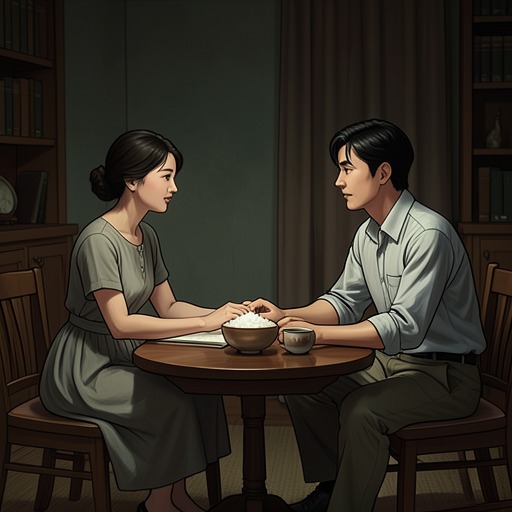
Tenji Nakamura—Ikuko Nakamura
The Narrow Road to the Deep NorthTenji Nakamura’s relationship with Ikuko Nakamura is a late, intimate measure of the goodness he has spent his life trying to define. As Ikuko nurses him through his final illness, her ordinary acts of care—rising early for work, touching his cheek, and smiling at him—confront him with a form of goodness he cannot claim as his own. Their bond persists through his anger and approaching death, but its final account also reveals a divide between the man his family remembers and the man his illness made difficult to care for.
Marriage and the Meaning of Care
Ikuko is Nakamura’s wife, and their marriage is seen most clearly in the practical labor of his care. She gets up two hours before work to tend to him; the touch of her fingers on his cheek and her smile become details he recalls when his thoughts turn to the life he has led. These gestures are modest and repeated rather than ceremonial. Their significance lies in the attention they give to one vulnerable person, not in service to an abstraction or institution.
Nakamura’s memories of Ikuko’s voice and smile provoke shame as well as recognition. He sees in her care a goodness unlike the ideal that had authorized his devotion to the Empire. He had understood himself as serving a universal good, and had used that conviction to justify acts that otherwise might have seemed evil to him. Ikuko’s goodness offers a different measure: patient, personal, and expressed through care for the person before her. The contrast unsettles his self-understanding because it cannot be absorbed into the moral system on which he had relied.
Caregiving and Conflict in His Illness
The tenderness Nakamura recognizes in Ikuko does not make their final period together serene. As his illness advances, he becomes bad-tempered and vicious toward Ikuko and their daughters, who are nursing him. The account specifies that even simple gestures—stroking his cheek or smiling—can draw his attacks. This conduct stands in stark contrast with the small acts of care he remembers and with the kind husband his family believes him to be.
The contrast is central to the relationship’s painful complexity. Ikuko continues to nurse him, while Nakamura is at once dependent on her care and unable to receive it without anger. His recognition that her goodness is not within him does not amount to a reconciliation that overcomes his behavior. Instead, the narrative places her patient attention beside his hostility, showing how intimate care can persist without erasing the harm that takes place within the relationship. The available account does not explain Ikuko’s private response to his attacks; it records both her care and the difficulty of caring for him.
Recognition Near Death
As he approaches death, Nakamura tries to recall forms of goodness in his life that are separate from the Emperor’s will, orders, and authority. He remembers offering quinine to an Australian doctor and despairing at violence, but these recollections do not give him a secure alternative to his old conception of goodness. Ikuko’s touch brings the distinction into focus: her kindness is something he recognizes and values, yet understands as fundamentally unlike his own.
That recognition is not presented as a complete transformation. Nakamura continues to struggle to hold on to the idea that he is a good man, while memories of the dead and the violence of his past overwhelm him. Ikuko’s care becomes a test of his moral self-image, not proof that he has resolved the contradictions of his life. Their closeness at the end therefore carries both attachment and distance: she is physically present in his illness, while he confronts the possibility that the goodness he admired in her was never the goodness by which he had lived.
Death and the Family’s Account
The following spring, the Tomokawas receive a card from Mrs Nakamura reporting her husband’s death. She does not mention his final ravings, his petty temper, or his attacks on the daughters and herself as they cared for him. Instead, she recounts his last attempt to write a death poem. Weakened by illness, he concluded that he could not improve on a poem by Hyakka that expressed his feelings more beautifully than he could. Ikuko also says that the family was with him when he died.
Her account presents Nakamura as a humble, kind man who could not bear to see even animals suffer, and as someone who believed he had led a blessed and fortunate life. Set beside the omitted details of his final illness, that portrait is not a full record of the marriage’s last days. It preserves the family’s understanding of him while leaving his cruelty toward his caregivers outside the story she sends. The ending holds these versions together without making them equivalent: Ikuko’s sustained care is part of his final life, while the card’s remembrance of kindness cannot undo the anger with which he sometimes met it.