Tenji Nakamura's Death
The Narrow Road to the Deep NorthTenji Nakamura's death is presented in two sharply contrasting forms: an intimate, disordered moment of approaching death, and the composed account of it that Ikuko Nakamura sends afterward. In the first, snow seems to erase the world while memories of wartime suffering return. In the second, his final hours become a story of humility, kindness, and a death poem whose image of ice melting into clear water gives his life a carefully shaped conclusion.
The vision of approaching death
As snow sweeps through the world, Nakamura imagines that he will soon die and that good and evil will become nothing. The landscape's erasure is joined to a fleeting sequence of remembered images: Kameya Sato looking up from a go board, lice fleeing a dead boy's body, and a man crumpling in the mud of a jungle clearing. The fragments bring different forms of wartime suffering into the same final field of vision, without arranging them into a settled account. Nakamura also smells DDT, an abrupt sensory detail amid the snow and the memories.
The passage gives Nakamura a momentary sense that he has cheated destiny and lived a fulfilling life. That sense does not resolve into a calm farewell: his body jolts, he wakes, and he cannot tell how long he has been asleep. The transition from imagined extinction to waking is abrupt, leaving the reader with an unsettled gap between his vision and the death that will follow. The scene does not depict the precise moment of his death; it makes the approach to it felt through anticipation, bodily disturbance, and memory.
The card and the last hours
The following spring, the Tomokawas learn of Nakamura's death through a card from Ikuko Nakamura. Her message does not include the final ravings, petty temper, or vicious attacks on her and their daughters as they care for him. Even simple gestures, such as stroking his cheeks or smiling, had provoked him. The omission is consequential: the account offered to the Tomokawas presents a gentler final image than the family experienced during his illness. The card records his family's understanding of him, but it does not erase the strain of nursing him.
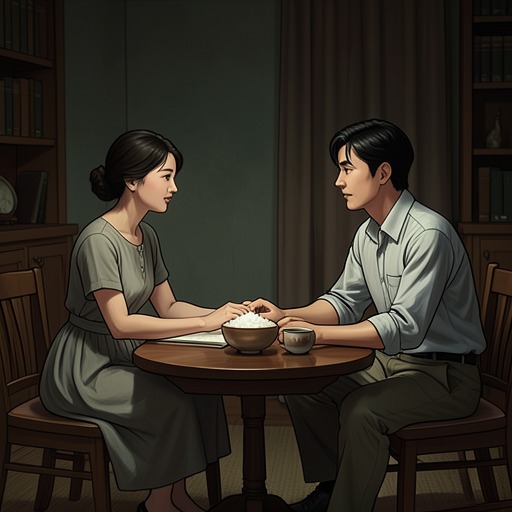
In Ikuko Nakamura's account, the night before his death brings a deliberate, traditional act. Knowing that his time is nearly over, Nakamura tries to compose a death poem. He struggles for hours, weakened by illness, but concludes that he cannot improve on a poem by Hyakka. He believes that poem expresses everything he feels more beautifully than he could. Rather than claiming a final work of his own, he chooses an existing poem as the truest expression of his state.
The poem and the portrait of Nakamura
Ikuko Nakamura connects his choice to a visit the previous year to wintry Sapporo and forwards the Tomokawas a copy. The poem describes winter ice melting into clean water and a heart made clear. Its movement from frozen material to clarity offers a compact image of transformation, but the account does not claim that illness has simply purified Nakamura. Instead, the poem is the one he recognizes as adequate to his feelings when his own effort fails.
The card also describes the family gathered around him when he died. In Ikuko Nakamura's remembrance, they knew him as a kind man who could not bear to see animals suffer, and as someone who believed himself blessed and lucky to have led a good life. This portrait stands beside the earlier disclosure of his anger toward the people caring for him. The contrast makes the death account less a single, definitive judgment than two forms of testimony held together: the intimate burden of his last illness and the family's sustaining image of the man they believed they knew.
Narrative significance
After the card reaches the Tomokawas, Mrs Tomokawa reads the copied poem aloud to her husband. The poem thus passes from Nakamura's failed attempt at authorship, through Ikuko Nakamura's account, into another household's act of reading. That sequence gives the death a small afterlife in language without suggesting that the poem removes the painful facts of his final illness.
The contrast between the snow vision and the card's memorial portrait is central to the event's meaning. In the vision, wartime memories appear as scattered images beneath an erasing snowfall; in the letter, death is narrated through family presence, an act of poetic selection, and a remembered character. Neither version fully contains Nakamura. Together they preserve the instability of the ending: he faces death with a sense of having lived well, yet those closest to him also endured his viciousness; he cannot write the poem he wants, yet finds his feelings in another poet's lines.