The Death Railway “Complete at Any Cost” Order
The Narrow Road to the Deep NorthThe Death Railway “Complete at Any Cost” Order turns a military railway timetable into a mechanism for treating prisoners and other forced laborers as expendable construction resources. Issued amid shortages of machinery, tools, and workers, its demands intensified even as the railway’s deadline moved closer. For Nakamura, the orders made the work practically impossible; for the prisoners, they translated imperial ambition into a daily demand for labor under conditions that brought exhaustion, illness, and death.
Purpose and construction crisis
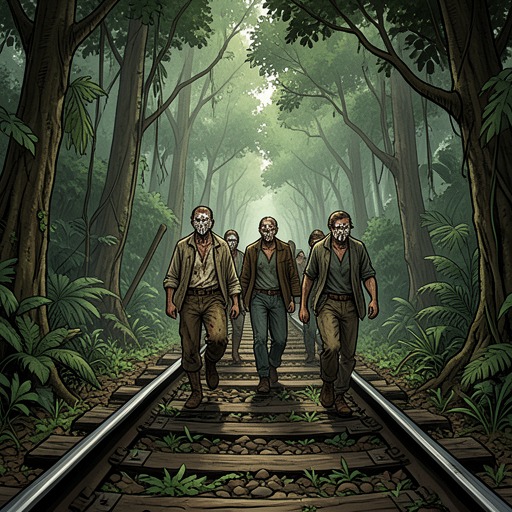
The railway was intended to carry men and matériel to Japanese forces in Burma, helping cut the Allies’ supply route through Burma to the Chinese Nationalist Army and supporting Japan’s ambitions toward India. The Japanese Empire lacked the money, machinery, and time to build the needed route by conventional means. Its plans instead relied on an enormous labor force, including prisoners of war and Asian civilian laborers. Surveyors’ pegs marked a planned 415-kilometre route running from north of Bangkok toward Burma; the scale of that line made its construction depend on the bodies and effort of the people compelled to build it.
The orders reached Nakamura through Colonel Kota, who arrived with a typed sheet and technical drawings. The Railway Command Group had altered Nakamura’s original plans even though the major cutting was already half-completed: it was to be enlarged by a third to address gradient problems in the next sector. The revision required a further 3,000 cubic metres of rock to be cut and carried away. It was not a modest adjustment to a functioning engineering operation. The prisoners were breaking rock by hand with hammers and chisels, and there were too few proper chisels; when the tools blunted, the camp lacked enough coke to sharpen them. Nakamura asked for drilling machines and compressors, but the requests exposed the gap between the work demanded and the resources provided.
Accelerated deadline and forced transfer
The second order brought the railway’s completion deadline forward from December to October. Nakamura received it in August and understood that his task had become impossible. Kota said that machinery and tools were unlikely to increase, and could not promise additional workers. His account of the wider labor force made the contradiction explicit: more than a quarter of a million civilian laborers and 60,000 prisoners were already working on the railway, yet manpower remained insufficient as people fled or died, including from cholera. The order did not respond to that attrition by reducing the work or extending the schedule.
A third directive removed another hundred prisoners from Nakamura’s camp for work near Three Pagoda Pass camp, about 150 kilometres to the north on the Burmese border. They were to march there during the monsoon because no other transport was available. Nakamura knew many might die on the journey, perhaps most, and that he did not have enough men to spare. The transfer therefore compounded two pressures: he was expected to complete an enlarged section sooner, while losing workers and receiving no assurance of replacement labor or equipment. The railway’s demand for labor overrode even the practical needs of the camp tasked with building it.
Obedience, labor, and human cost
The order’s governing logic was not simply that the railway had to be built, but that its completion took precedence over the survival of those assigned to build it. Nakamura understood that the Emperor had ordered the railway and that, within the system he served, there was no accepted alternative to carrying out the plan. Kota made that logic unmistakable by insisting that the work must be completed even if the workers died. Nakamura’s own reasoning shows how the command system dehumanized prisoners: he could see them being treated as material for the railway, comparable to sleepers, rails, and spikes, rather than as people whose lives could limit the project.
The conditions described elsewhere in the novel give the order’s consequences their human measure. The prisoners cleared jungle, broke rock, moved earth, and carried sleepers and rails with rudimentary tools; they were starved, beaten, and worked beyond exhaustion. Men died in numbers that could no longer be reliably counted, while the hospital hut filled with the sick and dying. Yet the command structure continued to express labor as a schedule and a quota. This contrast makes the railway’s engineering figures—an enlarged cutting, cubic metres of rock, a deadline, a hundred transferred prisoners—more than administrative details: each is a demand imposed on people already deprived of adequate food, rest, and equipment.
The scale extended well beyond Nakamura’s camp. Of 22,000 Australian prisoners of war, 9,000 were sent to work on the railway; the Allied prisoners were only part of a labor force that also included a quarter of a million or more Asian laborers. Estimates of deaths among those civilian laborers vary widely, and no agreed total exists. The first train ran the length of the completed railway on 25 October 1943, towing Japanese and Thai dignitaries past the remains of the dead. The completion that the orders treated as their overriding objective was thus inseparable from an immense and poorly recorded human cost.
Aftermath and significance
The railway’s later history reverses the order’s promise of lasting purpose. After the Japanese Empire’s defeat, the railway no longer had its former military use or support. It was abandoned by the Thais, dismantled by the English, and pulled up and sold by local tribespeople. Rain and time weakened its embankments, bridges, and cuttings; vegetation returned over the route and the mass graves. The line built through accelerated labor and death was itself broken and reclaimed, leaving little of the imperial project it had served.
The contrast between this disappearance and the railway’s public commemoration sharpens the question of what the order’s version of completion leaves out. Steam locomotive C 5631 is displayed at Yasukuni Shrine in Tokyo, where the Book of Souls lists those who died in service to the Emperor. The plaque before the locomotive does not name the railway’s dead or describe the horror of its construction. The monument preserves the machine and the achievement while omitting the laborers whose lives made the line possible. In that contrast, the order stands not only for forced labor but also for a system in which the imposed measure of success was the completion of the railway, while the people consumed in achieving it could disappear from both the official account and the count of the dead.