The Emperor’s will
The Narrow Road to the Deep NorthThe Emperor’s will is the imperial doctrine that gives the railway project its moral authority within the Japanese command structure. It recasts strategic ambition as sacred obligation: to serve the Emperor is to build the railway, while failure becomes a source of shame and obedience a substitute for moral judgment. The novel sets this language against the labor and lives consumed by the project, then against the railway’s postwar disappearance, exposing the gap between an empire’s claim to permanence and the impermanence of what it builds.
Ideology and the railway project
The doctrine appears amid Japan’s increasingly desperate military position. After the fall of Singapore in 1942, the Japanese Empire was losing ground, and the Japanese High Command sought a land route through Siam and Burma to supply its forces and disrupt Allied aid to China. The project had to be built without sufficient money, machinery, or time. The belief that the Japanese spirit, understood as the Emperor’s will, would ultimately prevail supplied an ideological answer to these material limits: determination was treated as a force capable of overcoming them.
For the Australian prisoners who arrived in Siam in early 1943, the railway initially existed as surveyors’ pegs and a projected route. Imperial Japanese Army engineers marked a line of 415 kilometres from north of Bangkok toward Burma. The prisoners were given blunt axes and inadequate rope to clear a kilometre of giant teak trees. The distance and the work were physical facts; the railway’s grand purpose and promised inevitability belonged to a larger imperial vision. The novel places the two together from the outset, showing how a political aspiration becomes a demand on bodies and labor.
That demand was part of a much larger system of forced labor. Of 22,000 Australian prisoners, most captured at Singapore, 9,000 were sent to work on the railway. They were only a fraction of the workforce: roughly 60,000 Allied prisoners labored alongside a quarter of a million Asian laborers or more. Estimates of deaths among the Asian laborers range from 50,000 to 200,000, with no agreed total. The uncertain figures and the absence of many names underscore how little the imperial language of duty accounts for those made to bear its costs.
Duty translated into command
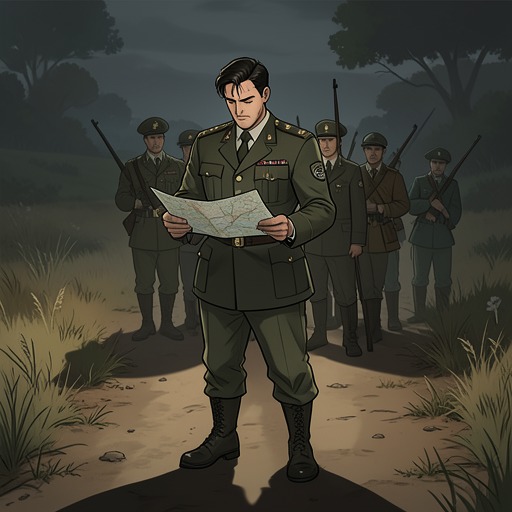
The doctrine operates not only as public ideology but as a practical rule for interpreting orders. When the Railway Command Group changed Major Nakamura’s plan, it required a cutting already half-completed to be enlarged by a third, adding 3,000 cubic metres of rock to the task. The prisoners worked with hammers and chisels; usable tools were scarce, and the forge lacked enough fuel to sharpen the chisels. Nakamura identified drilling machines and compressors as useful, but the order had to be met under conditions that denied him the means to meet it efficiently. The episode shows how an abstract commitment to progress is transmitted through technical specifications, quotas, and labor, even when the necessary equipment is absent.
Nakamura’s understanding of duty makes the doctrine especially revealing. He regards the railway as the embodiment of the Emperor’s will and interprets punishment not as a question of guilt but as a matter of honor and authority. The completion deadline, the guards’ unease, and the discovery of missing prisoners all reinforce his sense that discipline must be restored. He feels distress at the suffering he has ordered, but reads that distress as proof of his own goodness rather than as a reason to reject the order. His moral self-image and his obedience therefore reinforce one another: duty becomes a way to experience himself as good while continuing to serve a violent system.
The same logic shapes his response to the prisoners’ need for medicine. Nakamura knows that central command has sent little food, machinery, or medicine, and fears the disgrace of failing to complete his section. When he offers extra quinine, it is presented as help for sick men to continue working, not as a challenge to the work itself. The gesture can relieve some suffering while leaving the railway’s demand intact. Dorrigo Evans recognizes both Nakamura’s limited attempt to help and his inability to stop the punishment he ordered; each man remains implicated in a system that assigns everyone a part.
The doctrine beyond the railway
The novel presents this reasoning as more than a response to one engineering project. After the war, Sato recounts to Nakamura the operations performed by Professor Ishiyama on American airmen. Nakamura finds the account comprehensible because its reasoning resembles the argument, differently framed for different circumstances, that has governed his adult life. The story does not make the Emperor’s will the stated cause of every act; instead, it shows how a habit of treating institutional purpose and obedience as ethical justification can travel beyond the railway and make extreme conduct seem unremarkable to the person who accepts its premises.
This connection complicates the idea that obedience is merely imposed from above. Orders and shortages constrain what people can do, but Nakamura also interprets them through a moral vocabulary in which duty, reverence, and honor settle questions that might otherwise demand judgment. The doctrine works by joining coercive command to inward assent. Its force lies not only in what officials require, but in the way subordinates learn to regard compliance as evidence of their own virtue.
Defeat, memory, and the railway’s end
The railway’s first full-length train ran on 25 October 1943. Steam locomotive C 5631 carried Japanese and Thai dignitaries along the completed line, while the route passed the remains of workers who had died building it. The contrast between the ceremony of completion and the human cost makes visible what the language of imperial achievement excludes. The railway could be declared finished; the losses that made it possible could not be gathered into one agreed count.
After Japan’s defeat, the project lost both its strategic purpose and its imperial support. Japanese engineers and guards were imprisoned or repatriated, remaining laborers were freed, and the railway was dismantled, sold, or abandoned. Rain and time damaged its banks, bridges, and cuttings; vegetation returned over the route. Decades later, short sections became tourist, sacred, or national sites, but these fragments could not restore the line or recover all the names of those who had worked on it. The novel’s account of the railway’s broken remains reverses the imperial promise of lasting progress: the line itself was temporary, and the grand purpose invoked to justify it did not survive the empire that built it.
The memorial landscape sharpens that reversal. C 5631 is displayed at the Yasukuni Shrine in Tokyo, where the Book of Souls lists more than two million people who died in service to the Emperor between 1867 and 1951. Among those listed are 1,068 men convicted of war crimes and executed after the war, including men found guilty of mistreating prisoners on the railway. Yet the locomotive’s plaque does not mention the railway’s horrors or the people who died constructing it, and the memorial gives no place to the hundreds of thousands of laborers whose names are already forgotten. The doctrine’s afterlife is therefore not only in the language of wartime duty but also in the contest over what the nation commemorates and what it leaves out. Against that monumental display, the ruined route and its uncounted dead expose the cost of treating the Emperor’s will as a moral answer in itself.