The fish as prisoners and the motif of release
The Narrow Road to the Deep NorthThe fish in Nikitaris’s Fish Shop form a recurring image through which the novel connects the confinement of animals in a display tank with the captivity of prisoners of war. Darky Gardiner’s wartime fixation gives that comparison its force; after the war, his comrades enact the release he had imagined. Their gesture is at once a tribute to Darky, an attempt to answer his promise, and an uneasy expression of what the men themselves have endured.
Darky’s memory of the tank
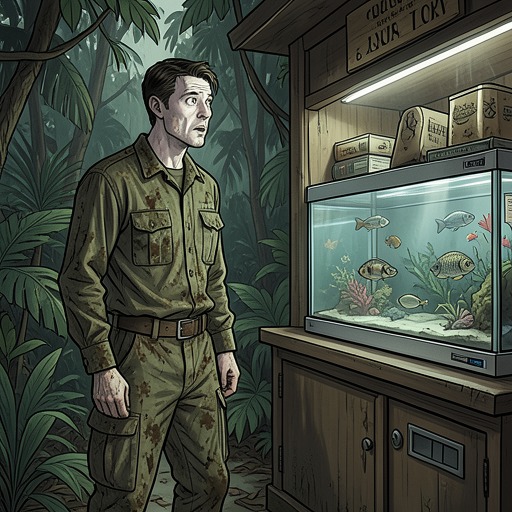
While recovering in the camp, Darky repeatedly recalls the fish tank at Nikitaris’s Fish Shop in North Hobart, where he had gone with his wife, Edie, after visits to the Avalon. His remembered meal is specific: couta, chips, battered scallops, and buttered bread. But the fish in the window become more important than the food. Darky remembers flathead, mullet, and blackback salmon circling inside the glass, and describes them as confined creatures looking out. His comparison makes the tank legible as a small image of captivity, rather than merely a detail of his former civilian routine.
The thought recurs as Darky speaks about the shop and his plans for returning home. He imagines getting the fish out and putting them back in the sea, even if doing so means buying them or taking them by force. His promise is presented amid illness and confused recollection, so it is not certain how steadily he understands his surroundings or how literally he expects to carry it out. Shugs, recounting the episode, considers several possibilities: Darky might be remembering a meal with Edie, or attending to the fish, or imagining himself among the confined creatures. The narrative preserves that uncertainty instead of reducing the episode to a clear, deliberate declaration.
The fish image therefore joins two kinds of memory without making them identical. Darky’s description draws attention to the tank’s enclosure and to the prisoners’ own confinement, while the comrades later recognize that the fish may not appear unhappy. The comparison remains emotionally compelling, but the scene does not claim that the animals’ experience and the men’s experience are the same. That gap matters: the fish offer the survivors a possible object for action when their own past cannot be repaired.
The postwar return to the shop
After demobilization, the former prisoners gather at the Hope and Anchor. Their reunion is marked by distance and difficulty: Jimmy Bigelow says little, and the marriage he returned to is no longer as he had left it. He has four children, yet thinks of himself as a man who has four children rather than as a family man. The group does not dwell on Darky, but Gallipoli von Kessler recalls Nikitaris’s, prompting Sheephead Morton to remember how often Darky had spoken of the fish shop.
The men walk together up Elizabeth Street to find it. The place is not the crowded, warmly imagined scene they had pictured from camp: the shop is closed, its interior dark, and the street nearly empty. Only the lights illuminating the front tank remain on. The fish swim in view behind the glass, including flatheads, a trumpeter, silver trevally, and a leatherjacket. Sheephead observes that they do not look unhappy; Jimmy answers by recalling that the prisoners, too, may not have looked unhappy at any particular moment. The exchange holds open the difference between outward appearance and confinement, without claiming that a glance at the tank can reveal what the fish feel.
Breaking the glass and releasing the fish
The men initially stand outside without a clear plan. Jimmy, who feels himself to be all appearance and nothing inside and wishes he could feel more, picks up a rock and throws it at the shop window. The glass fractures gradually before giving way. His action turns the group’s remembered obligation into a physical decision; the others join him, and together they break the remaining window.
Gallipoli von Kessler improvises with a chip fryer, using it to transfer the fish into two mop buckets. The men carry the buckets to Constitution Dock, taking care not to spill the water. At the dock, Sheephead Morton calls the fish free and tips out a bucket; the fish fall into the water. The release fulfills the central action in Darky’s promise, but it belongs to the group as much as to him: his memory has given the survivors a task they can perform together when recollection alone has offered no easy relief.
Meaning and aftermath
The release does not erase the men’s confinement or restore the lives they left behind. Its significance lies instead in the movement from looking through a barrier to breaking it, and from recalling Darky’s intention to acting upon it. The fish become a focus for comradeship: Gallipoli finds a way to move them, Jimmy initiates the break, and the group carries out the release together. The act is concrete, but what it resolves remains limited.
The next night, the story is retold at the Hope and Anchor with enthusiasm and growing shame. Jimmy says the men must visit Nikitaris and pay for the broken window. When they return, the shop lights are on and the window has already been replaced, though it has not yet been painted. This consequence places the release beside an ordinary responsibility to repair what they damaged. The episode thus resists a simple, triumphant conclusion: the men have carried out Darky’s wish, yet the act leaves them with consequences and with feelings they cannot settle merely by retelling it. The tank’s fish serve both as prisoners in Darky’s wartime imagination and as the recipients of a postwar gesture whose emotional meaning remains more complicated than the act itself.