Tiny Middleton
The Narrow Road to the Deep NorthTiny Middleton is an Australian prisoner of war whose physical strength first appears to defy the conditions of the railway camps, then becomes part of the machinery that worsens them. His transformation—from a vigorous, competitive worker to a man who can no longer resist the camp’s demands—exposes the limits of bodily endurance. His bond with Darky Gardiner gives that decline its hardest contradiction: Darky resents Tiny’s effect on the other prisoners, yet remains with him because abandoning one man would mean abandoning the group.
Identity and Work on the Railway
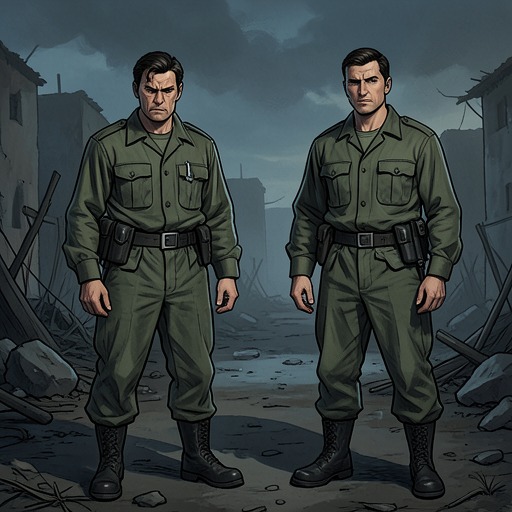
Tiny is remembered as a powerful man whose physique seems almost untouched by the prisoners’ starvation rations. Malaria, dysentery, pellagra, and beri-beri have laid low and begun killing other men, but at first these illnesses appear not to diminish him. Even his weight loss seems to sharpen rather than erase his muscular build. The camps have not yet visibly reduced him, and his apparent resilience takes on the force of a private triumph over the Japanese captors.
His work is physically demanding and organized around drilling the rock. Tiny swings a sledgehammer against a steel bar while Darky holds the bar and turns it after each blow; once the holes reach the required depth, a Japanese engineer fills them with explosive. Tiny works with an energy unusual among the prisoners and prides himself on finishing his quota first. He treats the work as a contest he can win, making effort itself a way to assert that his captors have not broken him.
Strength, Competition, and the Speedo
That resistance carries a cost for the men around him. As the Japanese engineers increase the daily quota from one metre to two and then three, Tiny meets each demand faster than required. The other prisoners try to slow their work and conserve the little energy they have left for survival. But Tiny’s pace becomes the standard they are forced to match. What he experiences as personal achievement therefore helps the Japanese impose greater labor on men already weakened by fever, hunger, and illness.
The arrival of the Speedo intensifies the pressure. Prisoners fall behind the Japanese schedules, face more beatings and less food, and are eventually ordered back to the cutting at night after a day of work. The cutting is a long, deep passage through rock, worked by firelight and crude torches. In this setting, Tiny’s appetite for the quota is no longer simply an expression of strength: it is entangled with a labor system that demands more from the whole group. Darky’s growing hatred reflects this change. Tiny’s energy may be his answer to captivity, but its consequences are shared by men who do not have his strength.
The Breaking of His Endurance
A beating by the Goanna marks a decisive change. Earlier, Tiny had seemed able to absorb blows without yielding; now he cannot hold himself in the same way, and he begins to sob. The response unsettles those present because crying is unfamiliar on the Line. Darky cannot explain it simply as pain, humiliation, despair, or horror: the men live with all of those conditions. Instead, Tiny’s distress appears to register the collapse of the confidence he had placed in his body.
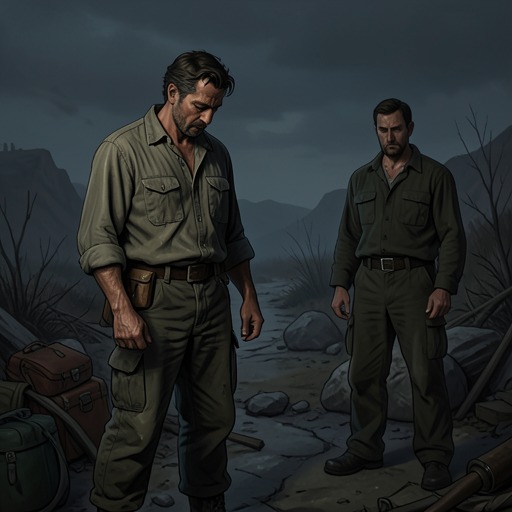
In the weeks that follow, Darky watches Tiny’s once-magnificent physique fade. Tiny no longer seems to care about the beatings or the ordinary acts of washing and keeping himself clean. Lice spread over him, and ringworm follows. These changes make visible a surrender that Darky understands but cannot reverse. The body that had seemed to protect Tiny from the camp’s diseases and hardship is no longer carrying him through them; his earlier certainty that effort could master the conditions around him has given way to a decline he recognizes as irreversible.
Darky Gardiner and the Meaning of Mateship
Darky’s response is divided. He is revolted by what Tiny has become and thinks, at moments, that Tiny has given up through weakness. But Darky also recognizes that this judgment protects his own hope: if Tiny’s fate were only a matter of character, Darky might believe that he could choose a different outcome for himself. He knows he has no such power. Resentment and care therefore coexist without resolving into forgiveness or admiration.
Darky stays with Tiny because he is his mate. The men do not need to ask why Darky helps him; they understand the obligation. In the camp’s logic, courage, survival, and love cannot belong to one man alone. They must be sustained among the men, or all are at risk. Tiny’s earlier work had imposed a burden on the group, but his final dependence reveals another form of shared responsibility: even the man whose choices have harmed others is not to be abandoned when he can no longer help himself.
Death and Narrative Significance
Tiny is dead by the time Dorrigo Evans turns back during the camp’s daily handling of the sick and laboring prisoners. Rain snakes over his corpse among the railway materials, without distinguishing a human body from the logs, sleepers, bamboo, and iron around it. The scene places his death within the landscape of forced labor rather than giving it the shape of a victory or a final contest. The rain continues; the work and its count of bodies continue with it.
Tiny’s arc resists a simple celebration of toughness. His apparent immunity is real enough to distinguish him from the other prisoners, but it cannot make him invulnerable, and his competitive endurance helps expose fellow prisoners to harsher demands. His collapse does not make his earlier resistance meaningless; it shows what that resistance could and could not accomplish. Through Darky’s conflicted loyalty, Tiny’s decline also becomes a measure of how the prisoners understand survival: not as a quality possessed by the strongest individual, but as a responsibility that can only be carried collectively.