the Dolly
The Narrow Road to the Deep NorthThe Dolly is the jungle track between the prisoners’ camp and The Line, the railway work site in Siam. More than a route through the forest, it organized the prisoners’ passage between camp and labor: they walked it under guard, carried sick men along it, and relied on one another to negotiate its difficult terrain.
Name and Setting
Dorrigo Evans connected the track’s name to the prisoners’ own transformation of a classical reference. He called the route to the railway the Via Dolorosa; the prisoners adapted this into Dolly Rose and then shortened it to the Dolly. The name thus arose from the men’s shared language for a route that repeatedly brought them between camp and work.
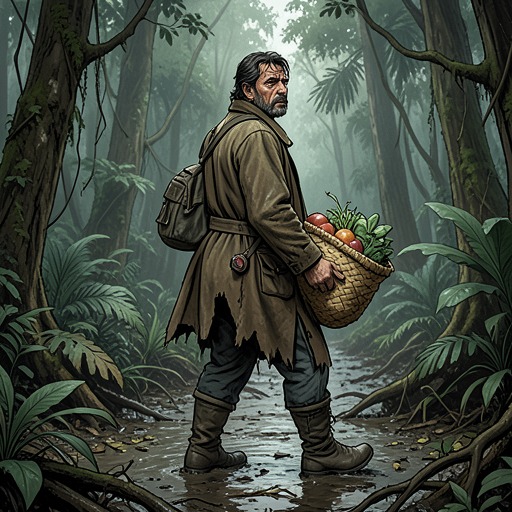
The track ran through dense jungle, where the narrow corridor cut through teak trees and thorny bamboo. The Dolly connected the camp with the Line, which lay three and a half miles away. Its forest setting restricted movement to the cleared passage, making it a necessary link in the railway labor system rather than an incidental path.
A Route of Forced Labor
Prisoners traveled the Dolly in guarded columns on their way to work. During the railway’s increasingly demanding labor regime, rest days disappeared and work quotas and shifts grew. The Dolly consequently carried men whose strength and health had been steadily diminished by the demands of the Line. The journey was part of the imposed workday, not a respite from it.
The track also exposed how the camp’s labor force was sorted and managed. In one march, the least sick prisoners led, followed by men on stretchers who had been judged fit enough to work, then others in varying degrees of weakness; men using makeshift crutches brought up the rear. Guards accompanied the column. At the camp’s edge, the men had to climb a small cliff by a bamboo ladder tied with wire, testing its unstable rungs as they went.
Carrying the Sick and Supporting One Another
The Dolly served as a difficult passage for those who could not make the journey unaided. During the cholera outbreak, Chum Fahey and two other prisoners helped Darky Gardiner carry Rabbit Hendricks on an improvised stretcher from the Line back to camp. The three-and-a-half-mile journey took them through the jungle at night and ended shortly before midnight. Rabbit was then taken into the cholera compound, from which few prisoners returned.
Other marches required similar collective effort. Prisoners passed tools along a human chain, helped weaker men up the cliff, and maneuvered stretchers over the rough route. These acts did not undo the conditions imposed on them, but they made the track a setting for practical mutual aid amid an organized system of forced labor.
Medical Rounds and the Track’s Meaning
The Dolly also belonged to Dorrigo Evans’s medical routine. He crossed the creek and walked down the hill to continue his rounds at the cholera camp, while the track connected that world of illness with the labor site. His classical name for the route gave way in prisoners’ speech to a compact, everyday name: the Dolly. That shift reflects how the men made a shared vocabulary within an environment structured by orders, illness, and work.
The track’s significance lies in this double function. It was infrastructure for moving prisoners to the railway and a repeated setting for the effort to keep one another alive. Its passage linked the camp’s medical crisis to the demands of the Line, making visible how forced labor extended beyond the work site into the routes prisoners were required to travel.