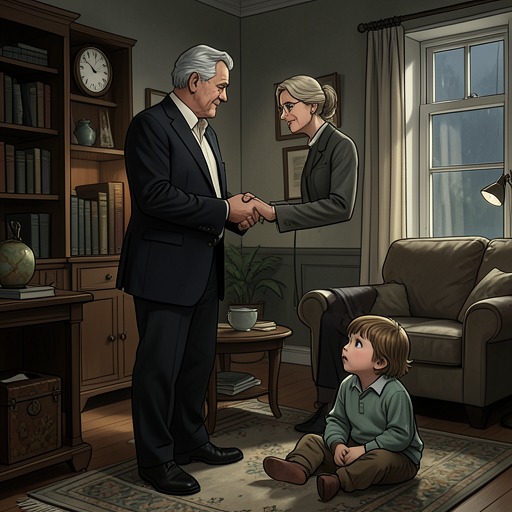
Jackson’s parents announce their reconciliation
The NegotiationGwen Caine and Richard Caine’s announcement that they are seeing each other again turns their children’s family history into an immediate argument. Richard says he moved back to New York City because of Gwen and their children, while Gwen reveals that the two had been secretly talking and meeting for about six months. For Jackson Caine, the news is not simply a happy reunion: it revives the instability he associates with their first marriage and makes him challenge the parents’ account of their shared past in front of Jules Caine, Emily Wade, and Carter.
The Announcement and Its Surprise
The announcement comes while Jackson, Gwen, Richard, Jules, Emily, and Carter are together in a room. Richard clears his throat and tells the group that he and Gwen have something to share: they are seeing each other again, and Gwen, along with the children, is why he moved back to New York City. Jackson is drinking scotch when he hears this; the drink flies out of his mouth. Jules echoes his astonishment, and Jackson sets down his glass to ask when the reconciliation began.
Gwen’s answer sharpens the surprise. She says she and Richard have been secretly talking and seeing each other for about six months. Jules repeats the duration in disbelief, while Jackson stands up. The secrecy means that the parents’ renewed relationship has already been developing beyond their children’s view; the announcement gives them the news as a fait accompli rather than inviting them into the decision as it unfolds.
Richard asks whether Jackson is not happy that his parents are reconciling. Jackson instead asks whether their new relationship explains why both are divorcing their spouses, then rejects the suggestion that the former couple’s history can be put aside so easily. Gwen says that his accusation is not true, but Jackson insists that the divorce made life miserable for the children. The scene’s central conflict is therefore not whether the parents still love one another, but whether their children can accept that love as a reason to resume a relationship after years of family disruption.
The Past Reopened
Jackson describes the consequences he associates with his parents’ earlier separation: being shuffled between houses, name-calling, fights, and the repeated presence of stepmothers and stepfathers. His complaint is directed at the long-term accumulation of instability, not merely at the surprise of this evening’s announcement. He points to the contrast between the parents’ declaration that they have reconnected and the family history he remembers living through.
The scale of that history becomes concrete when Jackson says he has stood by Gwen through four husbands and by Richard through five wives. He presents those marriages as part of the burden the children have already endured, and tells his parents he wants no part of their reunion. Jules is less certain: she says she is not sure about the reconciliation, but also asks Jackson to stay. Her response leaves the siblings divided in the moment, rather than making the announcement a conflict between parents and children who share one settled position.
Gwen and Richard offer a different account of what the past means. Richard says they are putting it behind them and moving forward, adding that he has realized Gwen is the love of his life. Gwen answers that he is the love of hers. Their declarations frame the reunion as a return to enduring love; Jackson’s response insists that such declarations cannot erase what happened to the family. The scene lets both accounts stand in direct opposition without resolving the children’s objections.
Jackson’s Refusal and Departure
When Jackson says that his parents have ruined the children, Richard counters by pointing to Jackson’s position as CEO of the company he built from the ground up and to Jules’s work as a doctor. Richard uses their adult accomplishments to dispute the claim that the parents ruined their lives. Jackson rejects that defense and continues to insist that the harm was real. Their exchange makes the disagreement partly about what counts as evidence: Richard cites the children’s success, while Jackson recalls the cost of growing up amid conflict and changing households.
Jackson then invokes his own arrangement with Emily. He tells his father that he and Emily signed a contract and are companions, not a couple in a relationship, which he associates with the problems relationships cause. Richard asks what he means. Jackson’s appeal to a contract distinguishes his chosen companionship from the kind of romantic relationship his parents are announcing, even as the family confrontation exposes how charged that distinction is for him. He does not stay to explain it further. He says he has stood by each parent through their successive marriages, refuses to take part in the reconciliation, and tells Emily, Jules, and Carter to leave with him.
Jules chooses to remain with her parents, so Jackson tells her that the car will wait and that it can take her and Carter home when they are ready. He then goes outside with Emily and hails a cab for them. The exit does not settle the dispute or bring the family back together; it turns Jackson’s rejection into an immediate separation from the gathering. In the cab, Emily acknowledges that he is plainly not okay and that she will not ask him to pretend otherwise. Jackson apologizes for her having to witness the argument.
Emily as Witness and the Scene’s Significance
Emily’s presence gives the confrontation a second family context. Earlier, a man had asked her whether she knew Karen Wade, and Emily identified Karen as her mother. Gregory Davis later told Emily that he thought she might be his daughter. When Emily met him to ask how he had known Karen and what their relationship had been, he described meeting Karen when both were sixteen; Karen eventually confirmed to Emily that Gregory was her father. Emily therefore enters the family gathering with her own questions about parental history and concealed relationships in view, though the announcement itself concerns Jackson’s parents.
The parallel does not make the two situations identical: Emily’s exchanges concern the disclosure and confirmation of her parentage, while Jackson’s confrontation concerns the return of two parents whose earlier marriage shaped his childhood. But her presence makes her more than a bystander to the announcement. She witnesses Jackson describe the cost of his parents’ past and leaves with him when he withdraws from the room.
As an event, the reconciliation announcement exposes the gap between a couple’s renewed commitment and the family history that commitment cannot automatically repair. Richard and Gwen speak of moving forward and of being each other’s great love; Jackson answers with memories of divided homes, conflict, and a succession of new spouses. His departure keeps that disagreement unresolved, while Jules’s decision to stay preserves a different response within the same family. The reunion is announced as a fresh beginning for the parents, but in the room it first functions as a reckoning with the past.