Charles
The Night CleanerCharles’s story links a private recovery to the public turmoil surrounding Seahill. After Esme secretly heals his spine and restores his use of his legs, he returns to physical therapy and strength training; later, he works with the police during the unrest. In the future glimpsed after the time reversal, he has also reconciled with Leon, a change that helps release Leon from guilt and supports Leon and Lilith’s life together.
Identity and Introduction
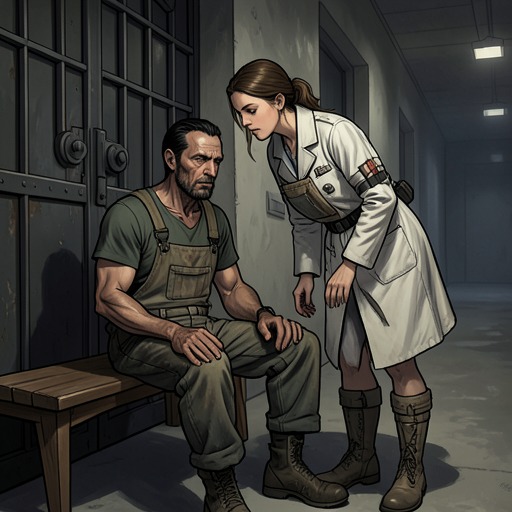
Charles first appears at Seahill Hospital, moving through the emergency department on his way to physical therapy. Esme notices that he now has full use of his legs and has been working out more; his athletic build and longer brown hair mark him as someone whose condition and daily life have changed. His easy manner with Esme makes their brief conversation warm, though she also registers that he seems to have someone close to him.
His recovery is not explained to the medical staff. When Esme asks how therapy is going, Charles says the doctors have no idea how his legs returned to their present condition. He is nearing the end of treatment: this is his final appointment. The scene presents a concrete measure of regained function while leaving the cause hidden from the hospital and its clinicians.
Esme’s Healing and His Recovery
Charles’s restored mobility is the result of Esme’s secret intervention. When he and Leon were brought to the hospital both close to death, Esme healed them. She also healed Charles’s spine so that he could use his legs again. She believes the healing may have taken years from her own life, but says she would do it again; she does not seek recognition, and wants to keep her role unknown to the Hero Society.
That concealed act makes Charles’s physical-therapy scenes carry an additional meaning. For him, the appointments are part of a recovery whose medical explanation is unavailable to the people treating him. For Esme, seeing him walk and regain strength is evidence of what her gift can accomplish, even at a cost she accepts privately. Their conversation does not disclose the secret, preserving the contrast between Charles’s visible progress and the hidden act that made it possible.
Violence and Work During the Unrest
Charles later arrives at Esme’s medical room with Lilith and the injured Leon. Leon had stepped in front of a man trying to hurt Charles, and the assailant was taken to the police station and charged with assault. Charles has been silent since they arrived. The scene places him at the center of the attempted attack while showing Leon bearing its immediate physical consequence; it does not explain Charles’s silence or describe what he says about the incident.
The episode also shows how the escalating disorder reaches ordinary medical and civic spaces. Esme treats Leon’s stab wound, while Lilith rests her head against Leon’s uninjured shoulder and voices concern about people acting out of fear. Charles is present as the person the attacker meant to harm and as a witness to Leon’s intervention, but the account gives no further explanation of his response. The focus remains on the danger surrounding the group and on the care they provide one another.
During the later crisis in Seahill, Charles works with the police in the hope of finding the source of the trouble and determining how to handle the riots. His role is practical rather than prominently heroic: he is trying to help identify what is driving the disorder and how it can be managed. Elsewhere in the same emergency, other members of the group undertake evacuation, political, and electrical-grid tasks, placing Charles’s police work within a broader effort to limit the crisis.
Relationships and Reconciliation
Charles’s connection to Leon is tested by the attack and renewed in the future revealed after the time reversal. In that later vision, Charles has accepted Leon again. The account connects this reconciliation with Leon’s release from guilt, allowing Leon to give himself fully to his wife. It does not specify the earlier breach or explain the terms of their renewed friendship, but it makes Charles’s acceptance a consequential part of Leon’s recovery.
The same future shows Leon and Lilith becoming a prominent Hero Society duo. Leon starts a football team for people with powers, and the two work to help people feel accepted for being different. Charles is not assigned a role in those later activities; his significance in this glimpse is personal, as the friend whose acceptance helps Leon move forward. The relationship thus develops beyond the hospital crisis, where Leon protected Charles, into a later reconciliation that restores trust between them.
Change and Narrative Significance
Charles’s trajectory is shaped by two forms of recovery. His physical recovery follows Esme’s unrecognized healing and becomes visible through his return to walking, exercise, and the completion of therapy. His later reconciliation with Leon belongs to a different kind of repair: the future presents acceptance as something that can free a friend from guilt, even though the original cause of that guilt is left unstated.
Across these scenes, Charles is connected to care without becoming its public emblem. Esme refuses credit for healing him, and the clinicians cannot account for his renewed mobility. During the unrest, he turns toward police work rather than a role in the more conspicuous rescue efforts. His story therefore ties an extraordinary, concealed intervention to ordinary measures of change: walking again, finishing an appointment, trying to understand a riot, and accepting a friend. Those personal consequences give his recovery weight without making him the center of the wider conflict.