Dorian's army
The Night CleanerDorian's army is the force Dorian assembles to challenge the Hero Society and reshape the place of gifted people in the world. Recruited through promises of freedom from fear and trained to wield powers resembling those of the heroes, the army gives Dorian the means to turn a political vision into a military campaign. Its defining contradiction is present from its formation: Dorian speaks of freeing the gifted, yet regards ordinary humans as beneath him and is prepared to make them suffer for the future he wants.
Formation and Recruitment
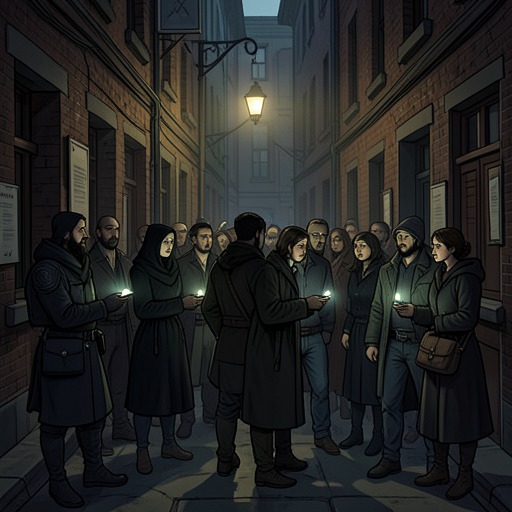
Dorian builds his force by seeking out men and women caught in chaotic circumstances. He offers them a life without fear and the freedom to be themselves without others dictating who they may become. The appeal is personal as well as political: he presents the army as a place where those who have been vulnerable or constrained can claim power and belonging. His recruitment draws strength from the insecurity experienced by gifted people, while directing their grievances toward a confrontation with the existing order.
The army is not yet ready when Dorian begins to consider his larger plans; he estimates that it will take a few more weeks. Its development therefore unfolds as a deliberate buildup, not an already completed force suddenly appearing at the height of the conflict. Dorian treats that preparation as the approach of a victory he believes is nearly within reach.
Powers and Organization
Dorian describes the army as his own version of the Hero Society, but emphasizes that its members are not copies of the heroes. Rather, he has assembled people with corresponding abilities: strength, empathy, and shapeshifting, alongside a computer specialist and a killer. Magic is the notable absence. Dorian considers it unnecessary against what he regards as the power of the gods, a judgment that reveals how confidently he ranks supernatural force above the heroes' particular skills.
The army's powers require practice and control. Dorian instructs its members to keep training as they gain command of their abilities, and he moves among them to assess their progress. His attention to these developments makes the group more than a collection of recruits: it is a force being prepared for coordinated action under his direction. The evidence does not establish a formal hierarchy, but it does show Dorian setting the objective, monitoring training, and treating the members' growing competence as essential to his plan.
Dorian's own abilities shape that plan. His connection to Apollo gives him access to a power also held by Phillip, including the capacity to consult possible futures and choose a path toward the outcome he wants. He has also found a way to attain immortality through the blood of gifted people. These advantages inform his confidence as commander: he can anticipate possibilities, endure a fight, and build an army around abilities that challenge the Hero Society on its own ground.
Aims and Contradictions
Dorian presents the army as an answer to secrecy, fear, and persecution. He wants gifted people to stop hiding and to live openly with the powers they were given, rather than treating those powers as something to diminish. In his account, the Hero Society's protective mission keeps gifted people in the shadows, while his own project promises them the freedom to live as they choose.
That appeal coexists with a harsher ambition. Dorian's plan is not limited to protecting the gifted: he intends to stop Draco from succeeding and to let humanity fall into its own chaos. He sees humans as inferior, and his language of freedom does not extend equally to them. The army's emancipatory promise is therefore bound to a campaign shaped by resentment, hierarchy, and the threat of violence. Dorian rejects a simple division between good and evil, arguing that people may do harm for reasons they consider good; the army itself embodies the danger in that argument, since its liberating purpose does not prevent it from becoming an instrument of coercion.
Campaign and Battle
The army's operations bring Dorian's vision into direct conflict with the Hero Society. In preparation for the assault on Seahill, Ajax and Monica are assigned to destroy the bridge, the route connecting the island to the mainland. Dorian watches from a nearby rooftop as the empty bridge collapses into the water. The operation is followed immediately by a citywide blackout, with electricity failing block by block. These coordinated acts mark the transition from preparation to open conflict and show the army's willingness to target essential infrastructure as part of its campaign.
Before the fighting begins, Dorian appeals to the remaining defenders to join him. He argues that humans have abandoned the gifted and asks why the heroes continue to fight for them. No one accepts. Dorian has expected that refusal, but his attempt to recruit the opposing side underscores the ideological contest within the battle: he wants his cause recognized as liberation, while the defenders regard his terms as unacceptable. He then begins the fight, and the combatants pair off against opponents they consider comparable. Leon faces Ajax, Lilith faces Monica, Phillip faces Ron Presley, and Jesse and Echo fight in animal forms. Asher confronts Trix, whose magic concerns shadows. Dorian reserves his own attention for Draco, whom he regards as the decisive opponent.
Victory and Significance
At the battle's end, Dorian declares victory as Draco falls. The army raises its fists in celebration, making the force's collective presence unmistakable: its members are not merely the background to Dorian's personal rivalry, but participants who share in the claimed triumph. Dorian believes Draco will recover, yet insists that he will never truly live. His account of victory therefore rests not only on physical defeat but on the lasting ruin he expects to impose on his adversary.
The aftermath also exposes the limits of Dorian's promise. He insists that he offered the opposing side the chance to join him and abandon the Hero Society, and that he never sought to become king or take over the world. He frames the army's cause as bringing gifted people into the open, where they can live freely instead of serving as hidden guardians of humanity. But the battle leaves dead among the defeated, and Echo answers Dorian's claim of victory with a declaration that the heroes will not give up. The army has won a major confrontation, but its success does not settle the moral or political struggle that produced it. Its narrative significance lies in that unresolved divide: a genuine demand for freedom is carried by a commander whose methods and contempt for outsiders threaten to make freedom conditional on submission to his cause.