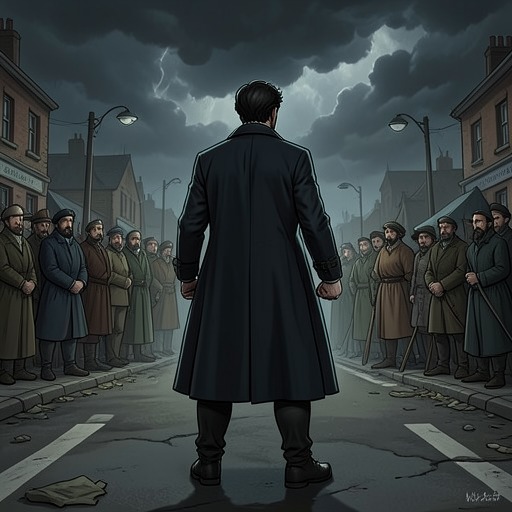
Dorian's public revelation of the gifted
The Night CleanerDorian's public revelation of the gifted is a broadcast that converts concealment into open confrontation. Interrupted dancing gives way to an image of Dorian addressing the world from the capitol: he announces the presence of people with powers, names the next day’s solar eclipse as the beginning of a new era, and threatens the heroes who might resist him. The scene’s decisive change is not only that a secret is spoken aloud; a celebration loses its fragile peace and becomes a preparation for war.
The interruption and its medium
The announcement reaches the assembled characters through an ordinary phone. Phillip asks the room to watch, taps the device, and projects its screen onto a wall. The simple sequence matters: a private, portable object becomes a public-facing display, redirecting everyone’s attention at once. The dancing stops, and the room’s social life is replaced by collective stillness before the broadcast. Rather than receiving news at a distance, those present watch the revelation take over the space in which they had been celebrating.
The timing sharpens that rupture. Just before the interruption, Draco and Rose have exchanged declarations of devotion, imagining one another as sun, moon, stars, and world. Phillip’s announcement cuts across that intimate happiness without warning. The contrast is carried by the scene’s movement: affectionate exchange, dancing, a phone screen on the wall, then a room watching in silence. The broadcast does not erase the preceding joy; it makes that joy newly precarious.
Dorian appears in a room described as resembling the Oval Office, and Phillip confirms that the transmission is on every channel and that Dorian is at the capitol. His setting and the broadcast’s reach give the announcement the form of a public address, not a private message. Its audience is presented as the world, while its impact is also immediate and local: those gathered in the room become witnesses as the screen displaces their celebration.
A secret made into a declaration
Dorian opens by telling his audience to wake up and stating that people with powers are among them and will not leave. The statement makes explicit what had remained concealed: the gifted are not an approaching possibility but already part of the public’s world. His wording also presents their continued presence as settled. He does not ask to be recognized or offer a negotiation; he declares that the hidden condition is over.
The broadcast’s tone reinforces the announcement’s threat. Before speaking, Dorian gives the camera an evil smirk, while the observing narrator reads his expression as that of someone treating the people watching as toys. This is not a neutral disclosure of information. The performance presents Dorian as controlling the encounter, choosing how to address his audience and making the revelation itself an assertion of power.
He then frames visibility as liberation from life in the shadows. His terms leave the public with a stark choice: fear the gifted or join them. The formulation brings exposure and allegiance together; the issue is no longer only whether people with powers exist, but how others will respond to a group that announces it will not retreat. Dorian’s declaration thus changes secrecy from a condition to be maintained into the dividing line of an impending conflict.
The eclipse deadline and the threat to heroes
Dorian attaches a precise deadline to his announcement: the solar eclipse of the century will occur the following day. He predicts that darkness will cover the earth and declares that the age of the gifted will begin then. The eclipse is therefore more than a date marker in the speech. It is the event Dorian names as the threshold between concealment and the new order he claims is coming. The broadcast makes the transition sound imminent rather than distant or hypothetical.
His final warning singles out the heroes. Dorian tells them that they may try to stop his side, but that resistance will cost them everything. The threat closes off any interpretation of the disclosure as a peaceful appeal for acceptance: the same speech that announces the gifted also anticipates opposition and promises consequences. He leans closer to the camera, and the narrator feels that he is staring directly at her. The public address consequently acquires a pointed, personal edge within the room, even as its stated audience remains much wider.
Dorian disappears in a bright flash of light after delivering the warning. The abrupt exit leaves the declaration unanswered and the threatened conflict unresolved. Its structure is compressed but consequential: revelation, deadline, ultimatum, disappearance. No debate or response can soften the terms he has set before the broadcast ends.
The room after the broadcast
The immediate aftermath is registered in the people watching. The narrator looks at Rose and finds Rose looking back; both wish they had more time to be happy together. That exchange places the public crisis against a particular relationship and a happiness that has only just been expressed. Their shared look does not change Dorian’s announcement, but it makes its cost legible as a threat to the lives and future the characters had moments earlier been inhabiting.
The narrator names the arrival of darkness and recognizes that the peace is over. The scene ends not with a battle, but with the decision that it is time to prepare for war. That shift is the broadcast’s immediate consequence for the room: people who had been dancing become witnesses to a threat and understand that action will follow. Dorian’s revelation therefore functions as both public disclosure and a turning point in the surrounding narrative, moving the conflict from hidden existence toward open confrontation on the eve of the eclipse.