Dorian's assault on Seahill
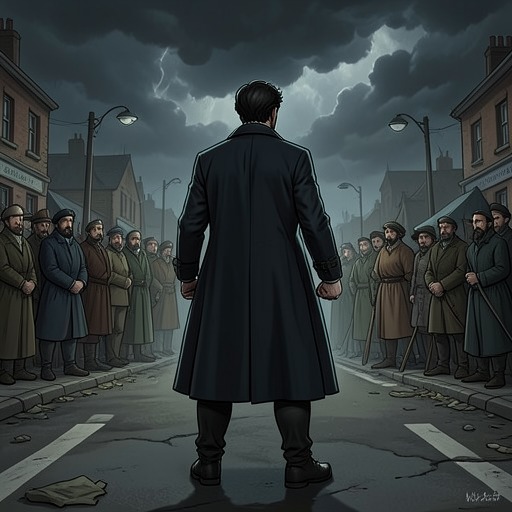
The Night CleanerDorian’s assault on Seahill is a coordinated attack on the island’s access and essential infrastructure, designed to make isolation and civic panic do much of the work for him. The destroyed bridge and spreading blackout expose his strategy and his contempt for ordinary people; the mass evacuation that follows shows that his attempt to unleash chaos does not prevent people from organizing to save one another.
Causes and Preparation
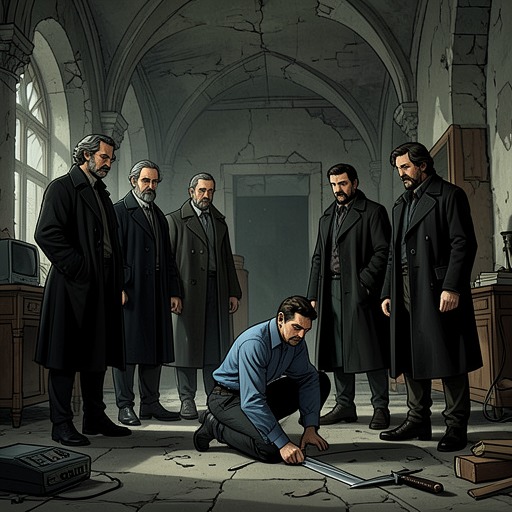
Dorian sets the operation in motion from the training room, where most of his crew are waiting. He sends Ajax and Monica to destroy the bridge, framing the attack as the opening move in a larger plan. Monica approaches him before leaving, but Dorian turns away and knocks her hand aside. His sharp rejection sits within the same scene as his orders: personal contact is refused while the crew is dispatched to carry out the plan.
The assault relies on a sequence rather than a single strike. Ajax and Monica are to bring down the bridge first; Dorian expects the resulting disruption to be followed by greater disorder. Jesse, who hosts Echo’s gift and can shift into animals, is present but is not yet assigned a role. Dorian considers the timing, not Jesse’s potential, decisive: Jesse’s turn has not arrived. The crew’s waiting and the ordered deployment give the attack a staged quality, with the bridge destruction marking the transition from preparation to action.
Bridge Destruction and Blackout
Dorian watches from a nearby rooftop in the very early morning, when the bridge is empty. A large explosion brings it down piece by piece into the freezing water. Because it is the only way onto the island, its destruction makes the assault an act of physical isolation as well as sabotage. The attack does not begin with people caught on the bridge; it removes the route itself before the city’s response can take shape.
The next phase follows immediately. Lights go out across Seahill, block by block, until electricity is gone. The progression turns a citywide system into a visible sequence of failures, while the ruined bridge and the blackout compound one another: the island has lost its sole land connection just as residents lose power. Dorian believes that people accustomed to electricity have not had to learn how to survive without it. He contrasts their dependence with his own past experience of living off the land and intends the disruption to force them back toward harsher conditions.
Police sirens and fire trucks appear as morning begins, but Dorian regards the response as futile. He expects the population to intensify the crisis through its own actions, rather than needing his crew to direct every act. The governor imposes a mandatory curfew, and police patrol slowly through the streets, broadcasting instructions over their radios. Residents do not comply. News that the bridge has been knocked out adds to the panic, while looting, fighting, and fires spread.
Dorian’s View of the Disorder
From his rooftop vantage, Dorian treats the breakdown as confirmation of a settled judgment about humanity. He rejects the idea that evil deeds require a devil or supernatural force: in his account, one nudge is enough for people to do the damage themselves. He names violence and greed as recurring features of human behavior and sees desperation as the condition in which people will do almost anything. The blackout is therefore more than a practical obstacle for Seahill; it is, in his view, a test that exposes what people are already capable of doing.
His judgment also has a specific measure of human failure. Dorian considers kindness less common than self-interest and recalls what he has seen in hospitals: elderly people treated as burdens, alongside doctors and nurses described as perpetrators of abuse and violence. These observations do not establish that every person in Seahill behaves in the same way. They establish the outlook through which Dorian watches the attack: he interprets social breakdown as evidence that people cannot be trusted to protect one another, and sees little reason to protect them from threats posed by their neighbors.
Evacuation and Immediate Outcome
The assault does not end with the city’s descent into disorder. In the response around Griffin Enterprises Tower, Leon reports that boats have been secured, while Lilith works to keep people calm as they board. Residents are directed toward the harbor; a nearby police officer repeats the instructions. Leon is then sent to pull the tower’s fire alarms, bringing people out of the building. The alarms turn the tower into a place to evacuate rather than a place to remain amid the crisis.
Some residents have already left the island, having fled inland after Dorian’s televised warning. Others, including people previously seen rioting and looting in the area, are no longer there. The evacuation effort also uses fear as a practical tool: Echo slithers through the area, and people flee from the giant snake. The immediate threat of the world ending recedes from their attention as escape becomes their priority. Within an hour, most people have been evacuated from the island successfully.
Those remaining form a small and varied group: one person can control water but has not trained in the ability after hiding it for years, and four others are ordinary humans without powers. The narrator admires their willingness to stay, initially doubts whether they can help, and ultimately accepts that they have the right to fight for their lives alongside the powered defenders. The assault thus produces an outcome its instigator’s contemptuous view of humanity does not fully account for: amid panic and destructive behavior, residents and responders also coordinate, guide people to safety, and choose to stand together.