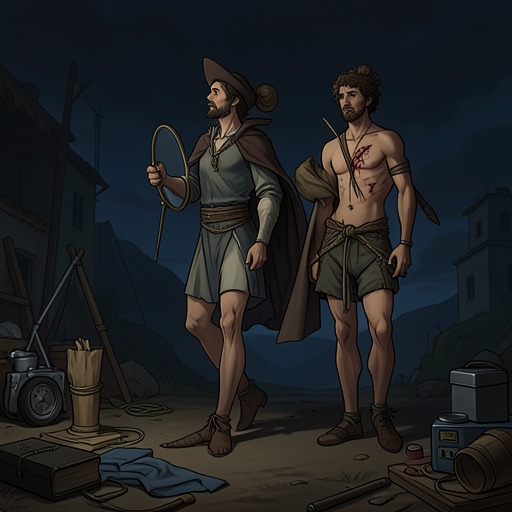
Draco and Dorian’s Final Duel
The Night CleanerDraco and Dorian’s Final Duel is the decisive personal confrontation at the heart of the battle for Seahill. Fought amid a city Dorian has cut off and plunged into darkness, it pits the brothers’ rival claims to protect or liberate the gifted against the consequences of Dorian’s violence—and makes Draco’s victory inseparable from the grief and love that Dorian has spent his life refusing.
Causes and Setting
The duel follows a campaign designed to leave Seahill exposed. In the early morning, Draco watches from a nearby rooftop as Ajax and Monica destroy the empty bridge, the island’s only route in; the city’s electricity then fails block by block. The bridge and blackout are not mere scenery: they are the opening moves in the upheaval that brings Dorian’s forces and the defenders into the same city, with civilian safety and the fate of the Hero Society caught in the conflict.
Dorian presents his cause as liberation. Facing the remaining defenders, he urges them to abandon the Hero Society and join him, arguing that humans have persecuted the gifted and that the gods’ fate shows the danger of trusting them. He insists that freedom lies beyond the defenders’ righteous cause, while privately recognizing that people and moral choices do not divide neatly into good and evil. His offer does not persuade them. The silence that answers it gives way to open combat, and the confrontation with Draco becomes the battle’s central personal contest.
The brothers have already defined their opposition as a conflict between competing visions of a better world. When Draco confronts him, he demands that Dorian end his plans so no more people are hurt. His anger is contained rather than uncontrolled; Dorian has always maintained control, except around Rose. Dorian answers that both brothers seek to improve the world, though each has a different vision of what that means. The exchange makes their fight more than a simple clash between a hero and a villain: they share a stated end, but Dorian’s methods have made that shared language hollow.
The Fight in the City
The battle spreads across Seahill as fighters pair off against opponents they judge to be their equals. Draco and Dorian move toward one another as the two true warriors in the conflict, while other defenders engage Dorian’s allies. Their duel unfolds amid a wider war, so its turning points are repeatedly interrupted by sounds and sights from the surrounding violence.
At first, the physical contest is strikingly uneven in its terms. Dorian has the advantage of immortality and is replenished quickly when weariness catches him; he has also absorbed sunlight, which can sustain him for days unless he gives it back to the earth. Draco, watching Dorian’s energy and precision, understands that they could continue fighting for days. Dorian is faster and more focused than in their previous fight, when he nearly died, and he appears able to anticipate Draco’s movements either through observation or future sight.
Dorian first lets Draco land painful blows without using the sword at his side, as though he welcomes the pain. He then changes the terms of the encounter: stepping away, he flashes out of sight and returns by throwing his sword straight at Draco’s chest. Draco evades its path and catches the weapon. The movement turns the duel from a punishing exchange of fists into a contest of steel. The swords evoke an ancient Greek mode of combat, but the advantage is not simply Dorian’s later training: Draco has been raised to fight since he could stand, and trusts his long experience against Dorian’s practiced skill.
The sound of a woman crying out in agony and a man’s answering roar briefly draws Draco’s attention away. Dorian attacks in that instant. Draco hears Rose’s cry of sadness but knows she is alive; someone on their side has been hurt. When the swords meet, the fight becomes explicitly personal. Dorian abandons his earlier willingness to absorb blows, and rage drives him into a precise, forceful attack. The surrounding street has become a war zone, and the duel can no longer be separated from what is happening to the people around them.
Grief and Reversal
Draco sees Leon and Lilith lying dead together in the grass. The sight fills him with undiluted anger, while Dorian sees the fallen pair and smirks. That expression becomes the duel’s sharpest reversal: Dorian’s contemptuous reaction to the deaths gives Draco the emotional force to press the attack. Draco moves quickly, forcing Dorian to dodge and block. Dorian has years of practice, but Draco has years of experience; the difference matters as Draco taunts him with his technique and turns skill into a weapon of provocation.
The battle’s losses reach their most intimate point when Dorian says goodbye to Rose, his wife, and keeps his eyes on her. Draco has known that a future in which they marry was probable, though he has questioned what such a marriage could mean when Dorian would outlive her. He recognizes the expression on Dorian’s face because he saw the same one on his own after Esme died. But recognition does not make the two losses equivalent: Draco insists to himself that he did not love Esme. The moment exposes a distinction he has tried to hold between bereavement and love, even as Dorian’s grief forces him to confront it.
Dorian takes up the sword he had thrown to the ground and turns back to Draco. With tears on his cheeks, he declares that he would live and suffer for another thousand years for even one minute of Rose’s love, that he cherished and loved her, and that he would change nothing. He accuses Draco of having had love and discarded it, claiming that Draco is the one who truly suffers. The speech is both a confession of what Rose meant to Dorian and a judgment on the brothers’ different relationships to loss. Instead of making him retreat, the confession renews his focus on killing Draco; he attacks harder and faster, apparently wanting both of them to leave the earth that night.
Outcome and Significance
Dorian’s renewed determination is undermined by the agony of Rose’s loss. His concentration falters, and Draco drives his sword into Dorian’s chest. The movement is easy, almost as if Dorian wants Draco to do it, yet the blow cannot kill him: Dorian’s immortality persists even when he wishes to die. The duel therefore ends its immediate exchange of violence without resolving the deeper contradiction at its center. Draco can defeat Dorian in combat, but cannot make him mortal simply by piercing his heart.
After striking the blow, Draco’s mind races to catch up with the feelings the moment has produced. He recognizes that the result is not how he expected to feel and that something is wrong. He looks into the future again and sees it as clearly as before. That final return to future sight leaves the duel poised between apparent victory and an unanticipated consequence: the sword has entered Dorian’s chest, but the future remains open to Draco’s view, and the meaning of what he has done has not yet settled.
The duel gathers the wider conflict into a single relationship. The destroyed bridge and extinguished lights show the scale of Dorian’s assault; the dead defenders and the living grief for Rose show its cost; the brothers’ competing claims show how a shared desire to improve the world can lead to radically different acts. Its most consequential reversal is not merely that Draco lands the decisive blow, but that Dorian’s love and grief become visible at the moment Draco seems to have won. His immortal body survives the sword, while the meaning of their struggle changes in its aftermath.