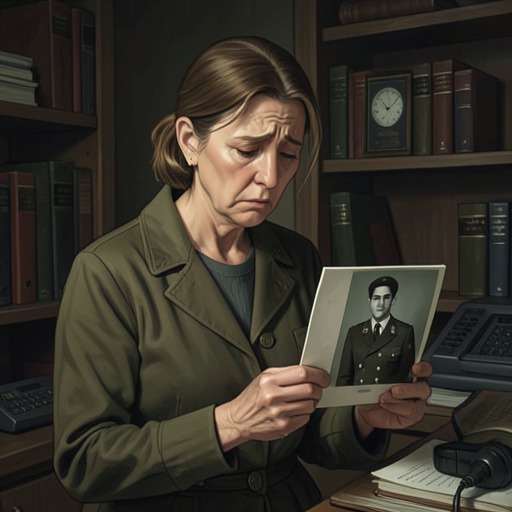
Eli refuses treatment and dies
The Night CleanerEli refuses treatment and dies in 2007 after declining Esme’s offer to use her healing power on his leukemia. The loss establishes the central cost of her ability: she can save another life only by shortening her own, and the person she most wants to save is the first to insist that she must not pay that price for him.
Background and the cost of healing
Eli and Esme are fraternal twins, close enough to recognize one another’s fear without needing it explained. They share reddish-brown hair and hazel-green eyes, but the golden line running down Esme’s left arm marks a difference between them. It appeared on her sixteenth birthday. After she healed an injured squirrel, she and Eli discovered that the line shortened whenever she used her power.
The twins tried to understand what the mark meant by researching the accounts they could find. Their reading about the Three Fates offered a possible framework: one spun a person’s life thread, another set its length, and the third cut it. They also learned that the gods’ ichor was associated with threads that could not be cut. The explanation did not make Esme’s future certain, but it gave the shortening line a frightening possible meaning. Each act of healing might bring her nearer to death, perhaps by taking years from the life she had left.
By the time Eli became gravely ill with leukemia, the twins had already faced the question of whether Esme would heal him. They had gone over it repeatedly during his illness. In the hospital, with tubes and wires attached to him, Esme begged to use her ability, while Eli refused. His condition made the stakes immediate, but their shared knowledge made the choice harder: healing might preserve his life at a cost to hers, and she feared that acting without his consent would permanently damage their bond.
Eli’s refusal and final choice
Eli does not frame his refusal as indifference to living. He tells Esme that he would accept a shorter life if it meant continuing to have her as his sister, but he also believes that her life must not be reduced to rescuing him. He imagines a future for her that he will not share: love, meaningful experiences, and a life in which she can decide her own direction. He worries that allowing her to heal him could take that future away.
His appeal is personal rather than abstract. He asks Esme to tell her future nieces about their uncle, making room in his last conversation for a family life he will not see. Even as he is dying, he tries to redirect her attention toward what may come after him. The lightness of that gesture belongs to the way Esme remembers her brother: he tried to bring light into darkness, even when the darkness was his own approaching death.
The twins’ physical closeness makes the refusal painful without settling the disagreement. Eli grips Esme’s arm where the faint gold line is visible, and she lies beside him as he puts an arm around her and holds her hand. Their bond is both the reason she wants to heal him and the reason his decision matters. He finally tells her that he is choosing to let her live. Esme understands through their connection that his life thread is about to be cut; soon after, his arm falls away and the bond between them is gone.
Consequences for Esme
Eli’s death changes the meaning of Esme’s gift. Until then, healing could be understood as a power with a frightening cost; in this scene, that cost becomes inseparable from the person she could not save. Esme’s grief includes the knowledge that she had the ability to intervene, but Eli had refused, and she believed that overriding him would violate the trust between them. The event therefore leaves no easy distinction between healing as an act of care and healing as a decision made at another person’s expense.
Her later work as a nurse keeps her among people who need care. She helps deliver two babies and supports new parents in the postpartum rooms, while the prospect of having children herself remains painful: she fears she may not live long enough to see them grow up. These later details echo Eli’s insistence that she retain a future beyond the immediate act of saving someone. They also show that his death does not remove her from care; it changes the burden and uncertainty she carries into it.
The cost becomes explicit again when Esme later uses her power on Dorian, who is near death. She recognizes that healing him will consume what remains of her life and proceeds anyway. The contrast does not erase Eli’s refusal or settle the moral tension it raised. Instead, his death supplies the history against which Esme’s later choice is measured: she once held back because the person she loved most asked her to live, and later accepts the price of healing someone she loves rather than lose him.
Significance of the event
Eli’s refusal is both an act of love and a claim to make his own decision about his life. He does not ask Esme to prove her devotion by sacrificing herself; he tries to protect her right to have a future of her own. Esme’s wish to heal him arises from the same attachment, yet it conflicts with his expressed choice. Their final exchange makes that conflict intimate rather than theoretical: the power that could preserve him is also the power that may shorten her life.
The scene also establishes the novel’s recurring imagery of threads, light, and darkness through concrete details. Esme’s life thread is visible as a golden line in her vein; Eli’s approaching death is understood as the cutting of a thread; and his final reassurance imagines himself as a light she can carry after the bond between them is severed. The scene gives those images a personal origin. For Esme, the rules of healing are not merely mythology or mechanics: they are first learned through the loss of her twin, and thereafter every choice to heal carries the memory of the life she could not save.