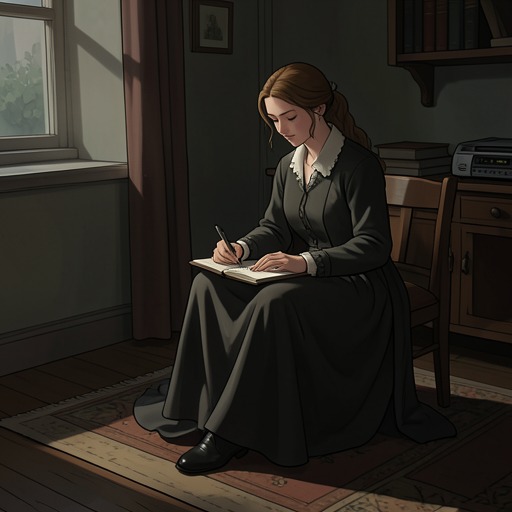
Esme and Dorian’s Love Relationship
The Night CleanerEsme and Dorian’s love relationship is shaped by a persistent contradiction: a bond that both characters come to recognize as love unfolds amid mistrust, possessiveness, and a conflict that neither can simply leave behind. Their story moves from a hostile first impression and a guarded physical affair toward explicit declarations of feeling, then reaches its defining cost when Esme uses her remaining life to save Dorian. Her sacrifice preserves him, but it does not resolve the conflict that helped bring them together; in Dorian’s account, her death becomes the loss against which his earlier choices are measured.
Identity and Beginning
When Esme first moved to Seahill, she was seeking a fresh start and hoping to spend what she expected to be a short life freely and in love. At first, she imagined Dorian might help her come out of her shell and experience life more fully. That possibility ended abruptly when he dismissed her as too innocent and not worth a casual encounter. Esme kept her hurt from him, and the two settled into a cold war: he provoked her, while she ignored him. The relationship begins, then, not as a mutual courtship but as a thwarted hope converted into antagonism.
That early rejection establishes an important imbalance. Esme’s interest initially carries the promise of emotional discovery, while Dorian treats intimacy as something he can dismiss or approach on his own terms. Yet their hostility does not extinguish attraction. It gives the relationship its recurring pattern: an attempt to hold distance, followed by a moment of contact that makes the distance harder to maintain.
Attraction and the Push-Pull Pattern
Their attraction becomes unmistakable during an encounter at the hospital. After Esme leaves a birthday gathering and returns to work, someone pulls her into a room and kisses her; she recognizes Dorian. The suddenness of the encounter turns their previous antagonism into physical closeness, without establishing that their deeper conflict has been settled. Instead, the kiss marks the start of a relationship in which desire repeatedly outruns clarity.
Dorian’s possessiveness later surfaces when he stops Esme from leaving and tells her that she will not have sex with another man, insisting that if she is with anyone, it will be him. The statement makes his claim on her explicit, and Esme registers that it quickens her heart even though she thinks it should not. The scene captures the tension between her response to him and the controlling force of his words; attraction is present, but it does not make the terms of their relationship uncomplicated.
In another encounter, as rain falls, Esme anticipates that Dorian will initiate one of his familiar kisses and chooses to act first. She turns toward him and kisses him before he can make the first move. His response convinces her that his desire is real: she had been frustrated and self-conscious, interpreting his earlier distance as evidence that he did not want her, but the kiss suggests otherwise. The reversal matters because Esme takes the initiative, while Dorian’s reaction gives her a concrete answer to a doubt that had been shaping her conduct.
Naming the Relationship—and Trying to End It
For a long time, Dorian refuses to call what exists between them love. When confronted with the possibility of Esme’s capacity for deep love, he declares that there is no love between them, only lust. He also says he has not been capable of love since the days of the gods, placing his emotional detachment in a distant past. This denial is more than a description of the relationship: it is Dorian’s account of himself, one that makes intimacy seem impossible before Esme can test it.
Esme eventually names her own feelings and tries to end the relationship before they deepen further. During a trip, she tells Dorian that she likes him and that they should stop seeing each other once they return home. She explains that she needs to end things before she falls harder and cannot recover. The choice is an attempt at self-protection, not a claim that her feelings have vanished. Dorian answers that he will not let her go. Esme pleads with him to release her, convinced that continuing will break her, while his refusal keeps the relationship caught between her expressed boundary and his determination to retain it.
The conflict intensifies when Esme slaps Dorian as he comes closer. He catches her hand and reminds her that he had warned her he was bad for her, but also insists that she fell for him and that she is his. Esme considers striking him again; even in anger, she recognizes that she loves him more than she hates him. Their attachment is therefore not presented as a simple cure for their antagonism. Love and anger coexist, while Dorian’s possessive language makes the difference between passionate attachment and mutual freedom difficult to ignore.
Love, Darkness, and the Final Choice
Esme ultimately says plainly that she loves Dorian. He answers that he is too lost in darkness to feel her love, echoing his earlier claim that he is no longer capable of loving anyone. Her confession does not instantly persuade him to accept a future with her. Rather, it exposes the distance between her willingness to risk an honest declaration and his belief that his own darkness places him beyond its reach.
That distance is tested when Dorian is near death. Esme tells herself she will not lose another person she loves if she can act, removes the metal lodged in his chest, and uses her healing power to save him. As she heals him, she realizes that his survival will consume what remains of her life. She continues anyway. Her power and years of life are gone; Dorian recovers and cradles her. The resolution of their romance is thus also its irreversible loss: the person who had feared being broken by loving him gives up her remaining life so that he can live.
A week later, Dorian remembers the rain on the night he first took Esme to her bed and finds it fitting that rain also marks the end. He wishes he could restore life, if only to tell her that her decision to save him was foolish. At her funeral, he watches the black casket and blames the so-called heroes, while also accusing Phillip of having seen the danger and allowed her to die. He frames the outcome as the consequence of a mistaken gamble: a future in which he might have fallen for Esme and abandoned his fight against them, even joined their side. In his telling, that imagined change in allegiance did not come in time to save her; Esme paid for it with her life.
Significance of Their Bond
The relationship turns on repeated reversals between refusal and attachment. Esme first hopes Dorian will help her embrace life, then answers his rejection with silence; Dorian initially insists that what binds them is only lust, yet later resists the separation Esme proposes. She tries to leave because she fears loving him will destroy her, but finally acts to prevent his death even at the cost of her own remaining years. Each change makes the relationship more consequential without erasing the harm and conflict that preceded it.
Their love also becomes part of the larger struggle between Dorian and those he opposes. Dorian imagines that loving Esme might have changed his position in that struggle, but the imagined future remains just that in his funeral account: a possibility he did not reach before she died. Esme’s sacrifice saves him physically, while her death deepens his sense of grievance and loss. The relationship therefore joins intimacy to political consequence, without presenting love as an uncomplicated reconciliation or a guaranteed escape from violence.