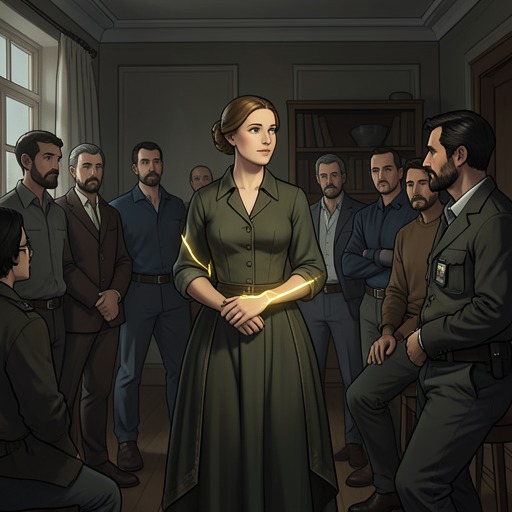
Esme's death
The Night CleanerEsme’s death in Dorian’s arms is both a literal loss and a delayed recognition: he sees her die before he can acknowledge what she means to him, and only later understands his shock and grief as signs of love. The scene’s force lies in that divide between Esme’s final faith in him and Dorian’s belated ability to name what he feels.
The Death and Dorian’s Immediate Response
In the memory that returns to Dorian, Esme is dying in his arms. He recalls her blue dress, the soft curves of her body, her lips parted by weakness, and her hazel eyes still filled with love as she looks at him. The details make the death intimate and physical, not distant: Dorian remembers the person before him as her strength fails and the light leaves her eyes.
Yet what defines his immediate response is not a declaration of love. He remembers staring at Esme in shock at what she had done. That reaction marks a painful gap between her final act and his ability to understand it. At the time, he is overwhelmed by the fact of her death and cannot meet the love visible in her face with recognition of his own. The memory preserves that failure alongside the tenderness of the image; Dorian cannot remember Esme’s death without also remembering how little he understood while she was still there.
After her death, he tells her goodbye to the stars, just as clouds cover the gap through which he had been looking. The gesture gives his farewell a small, visible endpoint: the stars are briefly present, then obscured as he addresses Esme in their direction. He believes she died with love in her heart for him, rather than dying from his hatred, and says he is glad of that difference even as his soul aches. His relief is inseparable from remorse. He thinks he did not deserve her, and recognizes that the hope she carried for them was false, though it remained hope nonetheless.
Esme’s Final Words and Dorian’s Remorse
Esme’s last explanation of the separation is framed as an attempt to spare Dorian a choice between her and his friends. She tells him, “At least now you won’t have to choose between your friends and me. You would have hated me no matter what. It’s better this way.” Her words present her death as preferable to a future in which Dorian would have to choose, and assume that his hatred would have followed either way. The account does not resolve that belief into a shared understanding between them; instead, Dorian is left to measure it against what he later discovers about his own feelings.
His farewell also contains a bitter contradiction. Dorian is glad Esme died with love for him, yet he believes he had told her that he did not deserve her. He describes her hope in their relationship as false, but is relieved that she retained it before she died. That relief does not undo the cruelty he associates with his own words or make their hope mutual in her final moments. It shows how, after losing her, he clings to the fact that she loved him even while judging himself unworthy of that love.
The Memory Returns Through Rose’s Death
Esme’s death becomes newly legible when Dorian witnesses Draco grieving as Rose takes her final breath. The sight of the general in tears brings back the memory of Esme’s dying body in Dorian’s arms, including the blue dress, her weakening lips, and the love in her eyes. The parallel does not make the deaths identical; it forces Dorian to see his own loss through another person’s visible grief. Rose and Draco had looked at each other with love until she died, while Dorian recalls that he had stared at Esme in shock.
The present scene intensifies that recognition through the reactions around Rose. Echo howls for the loss of her friend, and Phillip cries, running his fingers through his hair. Their grief and the renewed fighting frame loss as something that is both intimate and public: one death is mourned in the faces and voices of those who loved the dead, while violence continues around them. Dorian’s attention, however, turns inward. Seeing Draco’s sorrow makes his own buried memory return with a force he had not allowed it before.
Belated Recognition and the Event’s Consequences
When Phillip tells Dorian that he is realizing he loved Esme, Dorian initially resists the claim. He calls their time together a brief, beautiful passing star, then insists that he did not love her. But Phillip gives the denial a specific explanation: Dorian loved Esme and lost her, and had pushed the memory of her death far back in his mind. Hearing Rose’s last breath, Phillip argues, has brought forward both Esme’s love and the loss of it. Dorian’s denial falters; he feels that it is a lie and admits inwardly that he found love where he had not expected it, right in front of him.
That recognition changes what Dorian can say about the past, but arrives too late to change Esme’s death. As Phillip urges him to help change the Fates’ design and bring the dead back, Dorian identifies the fear beneath his resistance: he loves Esme and does not want to see the look in her eyes when it is already too late. His statement connects the remembered image of her loving gaze to the prospect of another irreversible loss. Esme’s death therefore remains active in the story after the event itself: it is the wound that Dorian has suppressed, the memory Rose’s death reopens, and the loss that finally makes him name his love. The revelation does not erase his earlier shock or his remorse. It gives both their meaning, while leaving the central consequence untouched: he understands Esme’s love and his own only after he has lost her.