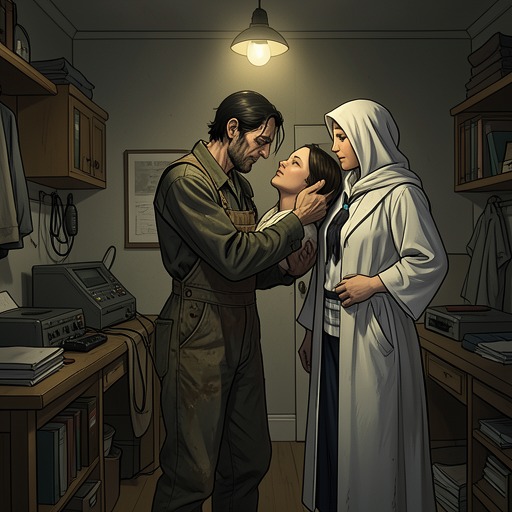
“I’m a surgeon now, and that’s the all of it”
The North Water“I’m a surgeon now, and that’s the all of it” is Patrick Sumner’s concise claim to a professional identity. Across two exchanges, the declaration moves from a practical answer during a medical emergency to a quiet boundary around the personal mystery others perceive in him: he identifies what he is now without supplying a fuller account of what came before.
First Use in the Medical Emergency
When the priest is suffering from an abscessed or possibly ulcerated cecum, Sumner explains that, with no opium available, an incision in the abdomen would let the diseased matter drain. Asked how he knows this, he answers, “Because I’m a surgeon.” The words serve an immediate purpose: they establish the source of his medical judgment as he proposes a serious intervention. The priest is in too much pain to comment or show surprise; after briefly closing his eyes, he asks whether Sumner has done it before. The declaration establishes Sumner’s stated profession, but this exchange alone does not provide an answer about his prior experience.
A Narrow Account of the Self
Later, Sumner tells the priest, “I never lied to you. Not once.” The priest nevertheless describes him as strange and mysterious to those who know him. Sumner replies quietly, “I’m a surgeon,” then adds, “A surgeon now, and that’s the all of it.” The qualifying “now” makes the claim present-focused, while the closing phrase refuses to turn that claim into a broader personal explanation. In context, the expression answers the priest’s characterization without disclosing the history behind Sumner’s identity.
Repetition and Significance
The repeated word “surgeon” links the two moments, but its function changes with the situation. In the first, it grounds Sumner’s proposed treatment in a professional capacity; in the later exchange, the fuller formulation presents that capacity as the limit of what he is willing to say about himself. The expression therefore joins practical authority to reticence: Sumner gives the priest enough to understand why he can act, while insisting that the role he occupies now is, for the purpose of their conversation, the whole account.