Angakoq
The North WaterAngakoq is a spiritual title associated with the bear’s power, and in the novel it becomes a way for the hunters to interpret Patrick Sumner’s extraordinary survival and possible influence on their luck. The term carries competing meanings: the hunters regard it as a source of healing, divination, and aid in the hunt; the priest rejects it as superstition; and Sumner alternately inhabits and disclaims the role. Its importance lies less in resolving which belief is true than in showing how different people make meaning from the same uncertain events—and how the title can become useful even to someone who says he believes in nothing.
The Hunters’ Understanding
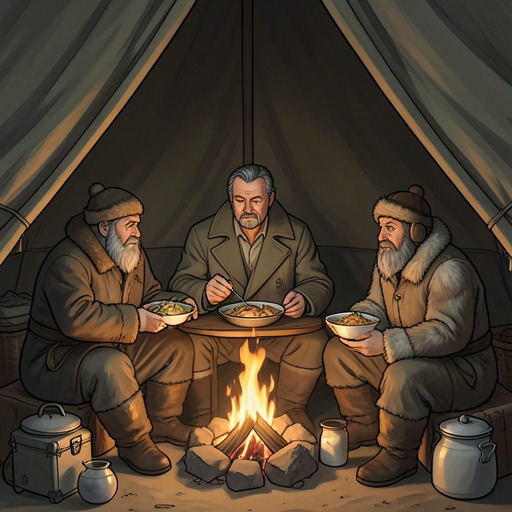
When hunters find Sumner blood-covered, drenched, and half-frozen, they debate whether to kill him or take him back to camp. They decide he deserves another chance because he seems lucky. That first practical judgment develops into a spiritual explanation: some people at the winter camp believe he is an Angakoq sent by Sedna to help with hunting, while others fear he is an evil spirit whose presence brings sickness. The shaman advises that Sumner will not recover until he is returned to his own people and directs the hunters to take him south to the mission at Coutts Inlet. The hunters also ask whether his luck might pass to them. The shaman confirms that Sumner is lucky, but describes his luck as alien rather than simply transferable.
The priest later explains the title to Sumner as a kind of wizard, a person believed to have the bear as a spiritual counterpart or source of power. In the belief he describes, animals besides the bear—including deer, walrus, seals, and seabirds—can also be associated with such figures, but the bear holds the highest place. The supposed powers include healing and divination. This account links the title directly to the hunters’ understanding of animals: an Angakoq does not merely possess an individual distinction but may stand in a special relation to the creatures on which the community depends.
The Mission’s Rejection of the Title
The priest presents the hunters’ interpretation only to dismiss it. He says that the Angakoqs he has seen are conjurers and charlatans, and describes their costumes and ceremonies as empty performance. He places this judgment within his missionary work: he has brought gifts, provided practical assistance, and is translating the Bible, which he hopes will reshape the community’s spiritual understanding. His explanation therefore reveals not only what the title means to the hunters but also the limits of his own account. He treats their beliefs as an error to be corrected, while the hunters’ account remains grounded in their experience of animals, luck, and survival.
That difference becomes especially clear when Sumner is asked to help a sick child. He tells Anna to discard the pills and asks her to tell the woman that he is an Angakoq and knows more than the priest. Anna refuses to deliver the claim. Later, when the priest is gravely ill, she confronts Sumner with the contradiction between his claimed power and his inability to save him. Sumner says that there is nothing he can do, citing their distance from a hospital and his lack of medicines. The title offers no guaranteed remedy: neither his assertion nor the hunters’ belief supplies the practical means he says are absent.
Sumner’s Use of the Role
Sumner does not simply accept the identity the hunters assign him. When Urgang and Merok invite him on a hunt, the priest tells him that they want him present because they suspect his powers will draw animals. Sumner does not correct that expectation. At the winter camp, he remains silent and reasons that, if the hunters believe him to be magical, he has no obligation to set them right. Yet his conduct is not wholly detached. At first he refuses the shared serving of heated seal blood and a piece of raw seal liver, then recognizes that his refusal has caused sadness and confusion. He accepts the blood, drinks, and passes the pan along. The moment makes participation a choice with immediate social consequences, even as he privately denies that it makes him one of the group.
The hunt gives the title a more concrete foothold. After a large seal is killed, the children gather around Sumner, tugging at his clothing and touching him as if seeking a share of the luck he has brought. The size of the animal appears to confirm their belief that he can draw prey from the depths. Sumner understands himself not as a god but as a lesser, assisting figure, and compares the role to the image of Saint Gertrude he remembers from William Harper’s house. He recognizes that the hunters’ interpretation is not his own, yet he does not consider it more absurd than the religious images he has encountered elsewhere. His comparison unsettles the boundary between one community’s sacred explanation and another’s: the beliefs differ, but each gives form to powers that exceed ordinary control.
Meaning and Limits
For Sumner, Angakoq is an identity he can claim without accepting it as the truth about himself. When speaking to Anna, he uses the title to assert knowledge and authority against the priest; at the camp, he allows others to interpret his presence as a source of luck. At the same time, he thinks of himself as neither Christian, Irishman, doctor, nor member of the hunters’ community. He calls himself nothing, and regards that absence of a settled identity as a privilege he does not want to surrender. His shifting relation to the title thus reflects a broader refusal to be fixed by other people’s categories, even when those categories offer a practical advantage or a place within a community.
The novel leaves the Angakoq’s powers unresolved. The successful seal hunt strengthens the hunters’ confidence, but the priest’s skepticism and Sumner’s own lack of certainty remain beside it. When Anna asks why he survived while everyone else died, Sumner answers that there is no reason. His response refuses the providential explanation that the title might suggest: survival does not, for him, prove that he was chosen or given a purpose. Angakoq consequently names not a settled supernatural fact but a contested relation among survival, animal life, communal belief, and the human desire to explain fortune.