Arctic
The North WaterThe Arctic in the novel is both a commercial frontier and an environment that resists control. Its shifting ice, severe weather, and changing distribution of whales determine the pace and risks of the sealing and whaling voyages, while the labor needed to exploit its animals exposes the dependence of shipboard profit on crews’ bodies and skills.
Setting and Route
The expedition moves north from Lerwick through fog, sleet, and strong winds. After eleven days, the weather moderates enough for the crew to see sea ice and, in the distance, Jan Mayen Island. The men prepare for sealing by distributing rifles and ammunition, then lower their boats when they reach the seal pack. The Arctic route is not a simple passage into open hunting grounds: weather and ice repeatedly make progress uncertain.
Three weeks after leaving Jan Mayen Island, the ships are near Cape Farewell. Later, the crew cross into the North Water, where the prospect of whales draws them farther into waters that are both productive and perilous. Brownlee explains that whales have moved north from waters where they were more common two decades earlier, toward ice that offers them greater protection from harpoons but makes pursuit more dangerous for ships. The route thus reflects both a commercial search for dwindling prey and the animals’ changing distribution.
Hunting and Shipboard Labor
The Arctic’s resources are rendered as work and market value. During the sealing, Henry Drax works alone across the ice, killing seals and preparing their skins while the five whaleboats collect their loads. Brownlee counts the skins and estimates that four hundred could yield nine tons of oil, with each ton potentially bringing about forty pounds. The hunt takes place amid competition: Dutch, Norwegian, Scottish, and English ships are spread along the floe edge, seeking portions of the same seal pack.
The first whale hunt in the North Water shows the coordination and danger involved in whaling. Black strikes the whale, and Otto’s boat approaches to drive in another harpoon; the other boats, including those carrying Cavendish and Drax, join the pursuit. Once the whale is secured alongside, Brownlee estimates its value at close to nine hundred pounds, based on an expected ten tons of oil and more than half a ton of whalebone. Otto and Black help process the catch, and the work takes four hours. Brownlee rewards the crew with an extra ration of rum, linking collective exertion to the voyage’s commercial return.
The surgeon Patrick Sumner is also drawn into this labor. After two more whales are killed, he is assigned to move heavy blocks of blubber from the foredeck to the men storing them below. He slips and nearly falls into the hold, but Otto saves him. The task leaves Sumner sore and exhausted; it also gives him an unusual satisfaction in physical work, and he sleeps without laudanum that night. The episode makes the expedition’s hierarchy visible while showing that its productive labor depends on practical cooperation across roles.
Ice, Weather, and Risk
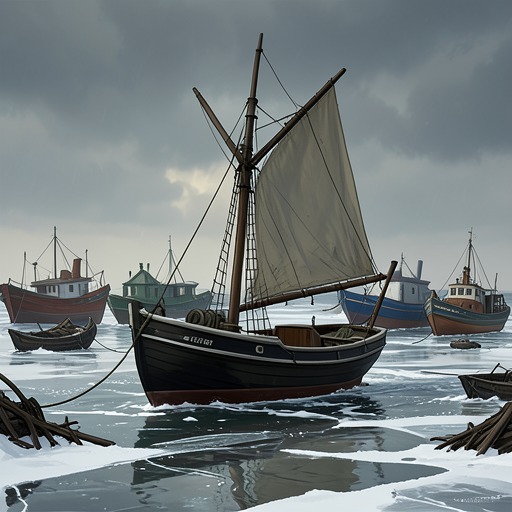
The Arctic does not remain a passive setting for the hunt. Foul weather and thick fog prevent the ships from fishing for several days as they move south through loose ice. When the weather clears, the fleet is near the entrance to Pond’s Bay, but unusually dense sea ice forces a further delay. The Hastings and three other ships moor alongside the Volunteer, and their captains wait together for conditions to change. Ice determines not only where the ships can hunt but also when they must stop.
A sudden wind shift later turns drifting ice into an immediate threat. Cavendish orders the crew to cut an ice dock for protection. Working with saws and pulleys, they cut through ice six feet thick, making sides two hundred feet long before dividing the floe into sections. The labor is urgent and physically demanding; meanwhile, the approaching pack closes its gaps and becomes a continuous field moving toward the ships. The Arctic’s danger comes not only from cold or storms but from the movement of the ice itself, which can transform a previously manageable situation into an approaching hazard.
Human Limits and Significance
The environment also shapes the expedition’s human encounters. In the priest’s cabin, Sumner initially attributes the older man’s illness to the Arctic diet, which lacks plants, vegetables, and fruit. After the priest worsens, Sumner steps outside into a landscape of sea ice, cold, and semilight. At noon, stars are visible above the distant horizon; the stillness makes him feel as though he may be the only person left alive. He then returns indoors and prepares medical instruments. The contrast between the immense, apparently empty surroundings and the immediate demands of care gives the Arctic a role in the novel’s treatment of isolation and responsibility.
The Arctic voyage also marks a turning point in Sumner’s public fortunes. When he later appears at Jacob Baxter’s home in London, Baxter says he had believed Sumner drowned or frozen with the other lost men. Sumner’s unexpected return makes the Arctic not merely a place of presumed death, but a setting from which he survives and re-enters the world he had left. Across these episodes, the region’s significance lies in its double character: it promises valuable animal resources, yet its weather, ice, and remoteness repeatedly expose the limits of the ships’ plans and the vulnerability of the people who serve them.