Bears, Animal Nature, and Survival
The North WaterBears, Animal Nature, and Survival is a recurring tension in the novel’s Arctic narrative: animals are captured, handled, and valued for human purposes, yet their actions repeatedly exceed human control. The bear cub kept aboard the Volunteer moves from shipboard curiosity to danger, while a later encounter with a polar bear culminates in Sumner relying on the animal’s body to survive. These episodes place human vulnerability beside animal agency, unsettling any simple division between civilized observer and wild creature.
Captivity and Shipboard Spectacle
After the crew captures a bear cub, Sumner takes responsibility for feeding it. In Lancaster Sound, his routine involves carrying galley scraps to the cask, pushing food through its grille with a metal spoon, and giving the animal water. The repeated care makes the bear dependent on the ship’s stores, but does not turn it into a tame companion: it bites down on the spoon, and Sumner must twist the utensil free. Its confinement remains visible even in these ordinary acts of feeding.
The cub’s presence also becomes entertainment for the crew. For weeks, the ship’s dog, Katie, and the bear circle between approach and retreat while the men shout encouragement and prod them with boots and boat hooks. The scene gives the animals a pattern of interaction that is not simply the crew’s planned spectacle: Katie advances and wheels away, while the bear follows cautiously. Their contrasting movement and temperament hold the sailors’ attention, but the men’s intervention turns their wary encounter into a performance staged for human amusement.
That uneasy arrangement breaks when the bear strikes Katie as she comes close. Sumner has a rope around the bear’s neck while cleaning its cask, but restraint does not prevent the attack. The episode marks the limit of the sailors’ control: the same animal they have fed and displayed remains capable of sudden violence. Sumner sees it still straining against the rope, its behavior no longer a spectacle for the crew but a danger requiring distance.
Release and the Limits of Possession
Later, at the winter camp, Sumner and Otto move the cask away from the camp’s edge and open its grille. The bear has grown considerably since its capture, and its coat is now clean and bright after Sumner’s regular feedings. Once free, it ambles around the cask, sniffing and nudging it. The changed animal is evidence of time spent under human care, but its first movements outside confinement are its own; it is no longer contained by the routine that governed its life aboard ship.
Sumner takes aim when the released bear turns toward him, then lowers the rifle and passes it to Otto. The hesitation does not erase the violence and control involved in capturing the cub, but it interrupts the expected progression from possession to killing. Sumner’s attention shifts from the weapon and the opportunity to consider, briefly, what the bear might be thinking. The moment leaves the animal outside his understanding rather than reducing it to a target or a symbol he can fully interpret.
Encounter on the Ice
A later episode places Sumner face to face with a bear on shore. In falling snow, he watches it approach, pause, and rear up before him. The bear is not presented as a trained creature or a predictable antagonist; its movements are observed without an explanation of its purpose. Sumner’s stillness, and the bear’s apparent unconcern, suspend the usual relation between hunter and prey. The encounter is powerful precisely because the human observer cannot confidently read the animal.
The bear later appears near the bodies of two people, and Sumner watches it approach them without eagerness or urgency. He follows the animal as it moves across the landscape and disappears through a narrow opening in the cliffs. Beyond that threshold lies an ice-choked fjord, a place Sumner experiences as strangely familiar. The bear’s movement thus shapes his route through the Arctic: it is not merely an object in his field of vision but an animal whose path draws him toward a consequential place.
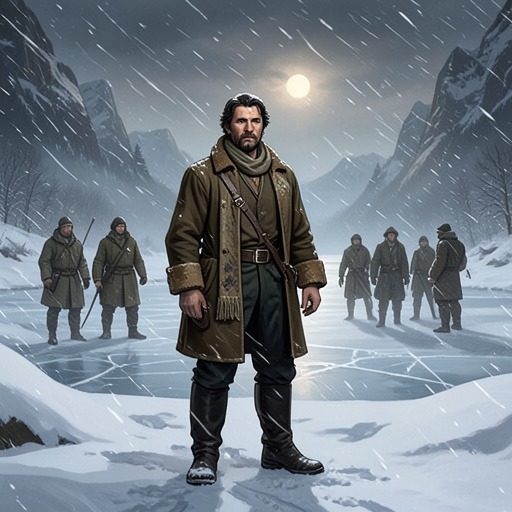
During a blizzard, the bear appears again through the snow, and Sumner raises his rifle and kills it. The encounter ends with a human act of lethal force, but the animal’s death becomes the condition for Sumner’s continued survival. He uses the bear’s warmth and body as shelter against the cold, converting the animal’s death into a means of enduring the storm. The episode refuses a clean opposition between the bear as menace and the bear as resource: it has been a presence Sumner cannot master or fully interpret, and it becomes the material that allows him to live.
Animals, Commerce, and Survival
The bear episodes sit within a story shaped by the commercial treatment of animals. Baxter describes the whale fishery as a trade transformed by overhunting, new technology, and changing energy markets: he says the whales have been killed off and that petroleum and coal gas have displaced whale oil. He also recalls the steam engines and harpoon guns now needed to make a profitable voyage. Whales, in this account, are both living animals and the dwindling basis of an industry. The bear cub’s capture and display aboard a whaling ship belong to the same world of human use, although its later release and Sumner’s dependence on a bear’s body complicate any purely commercial valuation.
The novel’s Arctic setting gives animals more than a background function. The crew’s wish to hunt whales, the spectacle made of the cub and Katie, and the perilous encounters on the ice show different forms of human contact with animal life: extraction, entertainment, fear, and dependence. In the final survival episode, the human body cannot stand apart from the animal world it has hunted. Sumner survives by taking warmth from the bear’s remains, and his rescue by hunters follows this period of exposure. The sequence makes survival a relation to other living beings, not a triumph of human independence.
Narrative Significance
The bear’s changing place in the narrative—captive, spectacle, released animal, encounter, and source of shelter—resists a single stable meaning. Human characters attempt to control animals through cages, ropes, weapons, and commercial calculations, but each method has limits. The bear’s attack on Katie makes confinement feel precarious; its release exposes the incompleteness of domestication; its passage through the landscape redirects Sumner; and its death enables his survival.
The account also preserves a difference between what humans need from animals and what animals are shown doing. Sumner observes the bear’s movements, but cannot know its thoughts or intentions; even his brief wondering does not resolve that gap. The animal therefore has a measure of narrative presence beyond its usefulness to him. At the same time, the plot does not turn that presence into a simple celebration of wilderness: the bear can threaten, be hunted, and become shelter. Survival emerges from this uneasy proximity, in which human and animal lives intersect without becoming interchangeable.