Black
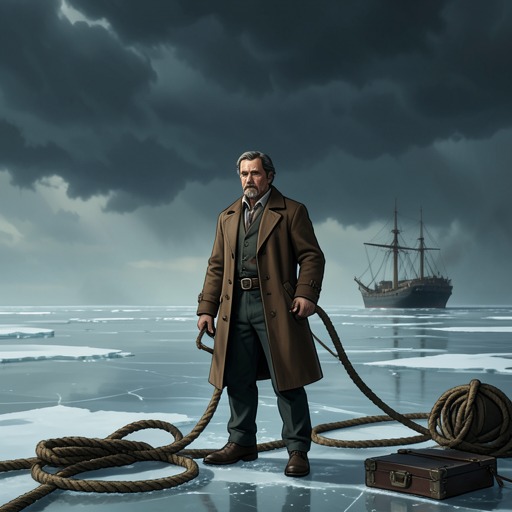
The North WaterBlack is the Volunteer’s young second mate, introduced as a cool, self-possessed officer whose ambition is matched by practical competence. During a voyage shaped by dwindling commercial prospects, a covert insurance scheme, and mounting danger in the ice, he moves from the margins of the officers’ company into consequential roles: he helps save Sumner, stops Drax’s attack, and leads a group across the ice to the Hastings. His character is defined less by speeches than by the moments when he assesses a risk and acts.
Identity and Introduction
Black first appears in Lerwick, where Cavendish invites him to join a party going ashore to test the local distillery. Cavendish describes him as a cool customer who claims to drink only ginger beer or milk; the boast is reported but never verified. The introduction places Black among the ship’s officers and establishes the contrast between his reserve and Cavendish’s continual talk.
Sumner regards Black as young and eager, but also somewhat arrogant. He is not openly rude or disdainful; rather, Sumner senses in him a confidence greater than his position might warrant. That impression is complicated by Black’s explanation of why he joined the Volunteer. He says he has no living family or important friends, and that he must take risks to advance. Brownlee’s reputation for recklessness offers the prospect of substantial earnings if the voyage succeeds, while failure, Black reasons, would leave him time to try again without attaching blame to him. His ambition is therefore both candid and calculated: he sees the voyage as an opportunity, but not as a cause to stake his future without reservation.
Work and Judgment at Sea
The broader economics of the expedition sharpen the context for Black’s choice. Baxter tells Brownlee that older methods of whaling no longer promise the returns they once did: modern equipment is costly, and a ship may still come back without a catch. Against that history, the Volunteer’s commercial aims include not only whales but the value of its insurance. Black’s own stated calculation is narrower and personal, yet it places him aboard a venture where profit, risk, and judgment are closely bound together.
During the northward passage from Lerwick, the crew crosses fog, sleet, and gales before reaching sea ice near Jan Mayen Island. Sealing begins, and the crew’s early success raises morale. By the time the expedition continues toward Cape Farewell, Brownlee considers Black an ambitious and unusually shrewd understudy. This assessment marks a change in how the captain regards him: Black’s ambition is not merely a youthful mannerism but a quality that can be put to use in the work of the voyage.
Black also takes part in the processing of a whale. After the carcass is brought alongside and Brownlee estimates its market value at nearly nine hundred pounds, Black and Otto climb onto it to cut out blubber and remove baleen and jaws. The work is a collective, physically demanding stage of the catch, connecting the crew’s labor directly to the commercial value on which the expedition depends. Black’s participation shows him not only as an officer evaluating risks but as a working member of the whaling crew.
Rescue and Intervention
Black’s clearest act of rescue comes when he finds Sumner trapped in a narrow crack between two ice floes, with most of his body beneath the water. Unable to tell whether the surgeon is breathing, Black secures a sealing rope around his chest and tries to haul him free. He dislodges Sumner, pulls him onto the ice, and strikes his face until an eyelid moves. Once Sumner shows signs of life, Black fires his rifle twice to summon help. Otto and two other members of the search party arrive, and the four carry Sumner back to the ship, where he is lifted aboard with a block and tackle.
The scene gives physical form to qualities earlier presented as temperament. Black’s composure does not make him passive: he acts despite uncertainty about whether Sumner can be saved, then signals for assistance rather than treating the rescue as a solitary feat. His judgment is practical and collective, and Sumner’s survival follows from the rope, the rifle signal, and the arrival of the search party.
Later, when Drax threatens Sumner in a cabin, Black intervenes at the moment of imminent violence. After a shotgun blast brings the others’ attention to the scene, Black stands in the doorway with the second barrel aimed at Drax and orders him to surrender the whalebone he is holding. Cavendish subsequently tells the crew that Drax is chained in the hold and will take no further part in the voyage. Black’s intervention has changed the immediate balance of power: Drax is restrained, and Brownlee’s authority can no longer be treated as the only protection against him.
Leadership in Lancaster Sound
After Brownlee is incapacitated, Cavendish takes command of the Volunteer. Black openly opposes the decision to enter Lancaster Sound so late in the season. He argues that no man has caught a whale that far north in August and warns that continuing into the sound will waste time and expose the ship to danger. Cavendish answers that profit requires risk; Black distinguishes risk from what he considers foolishness. His objection is grounded in the season and the ship’s safety, not simply in reluctance to follow a new commander.
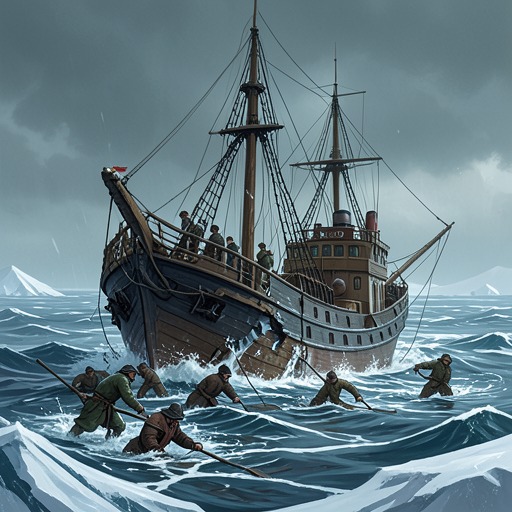
When the drift ice begins moving toward the ship, Black is given a concrete leadership task. The crew cuts an ice dock to shelter the Volunteer, and Black measures its length and breadth, marking its corners and midpoints with boarding pikes before the men begin sawing. Later he places charges in a diagonal cut and lights the fuse, breaking up the large sections of ice so they can be hauled clear. The dock is finished and the ship warped into it, though the moving pack eventually fractures the dock and crushes the vessel. The effort demonstrates Black’s ability to organize exact, dangerous work; it cannot overcome the pressure of the ice.
Evacuation and Narrative Role
Once the Volunteer is wrecked in the ice, the Hastings lies four miles away and offers a possible refuge. Cavendish walks across to seek help and returns with word that Campbell will receive the men. He assigns the crew to three parties of twelve, using whaleboats as sledges. Black leads the first party, which is to leave immediately, while Jones-the-whale leads the second and a third group remains with the wreck until they return.
Black’s trajectory thus joins personal ambition to repeated service under pressure. He boards the Volunteer hoping to improve his prospects, but the voyage’s decisive tests are not simply commercial: they require rescuing a nearly drowned surgeon, confronting Drax, challenging an unsafe course, organizing work against the ice, and helping move the crew toward refuge. The episodes distinguish confidence from judgment. Where Black initially sees Brownlee’s recklessness as an opportunity, he later argues against a danger he believes needless; when the ship is threatened, he does not merely object but helps carry out the labor required to protect and then evacuate it. His role in the available account ends with his departure at the head of a relief party, a practical leader whose competence has become essential to the crew’s survival.