British field hospital policy of treating British soldiers
The North WaterThe British field hospital policy of treating British soldiers makes military affiliation a condition of access to care. In Patrick Sumner’s recollection of a crowded wartime hospital, staff apply that boundary to a wounded child identified as the offspring of the enemy, bringing institutional authority into conflict with the needs of an individual patient.
Scope and Enforcement
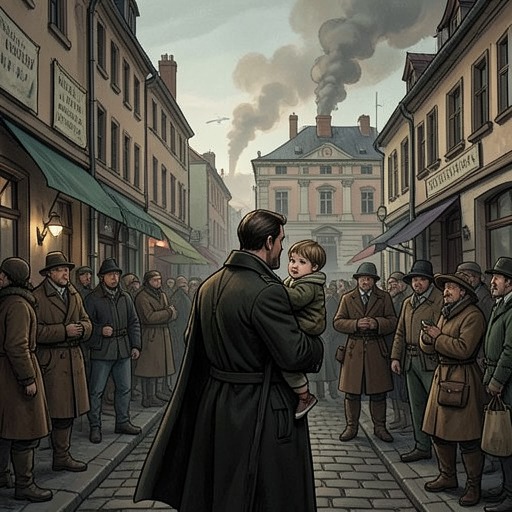
The policy is stated plainly when Corbyn tells a man that the hospital cannot help him; Wilkie specifies that its patients must be British soldiers. When Sumner asks about the child, Corbyn classifies him as a casualty of war but says the staff are not ordered to assist an enemy’s offspring. The man rejects the designation of enemy, but his objection does not change the decision. The exchange shows the rule operating not as a judgment about the child’s condition, but as a limit imposed by the hospital’s military remit.
The Hospital and the Child
The refusal takes place amid an overwhelming flow of wounded men. Sumner remembers the hospital as a place of continuous emergency work, where surgeons and attendants process casualties and staff must make decisions under severe pressure. Against that background, the child’s exclusion is not presented as a lack of medical need: the disagreement turns on who is eligible for treatment. The rule thus gives military categories priority over the immediate claim made by a civilian child and the man accompanying him.
Corbyn’s subsequent instructions complicate the scene without establishing that the policy has been waived. He orders three men and Price to accompany the child’s companion in pursuit of treasure, tells them to arm themselves, and says he will remain with the boy. He also proposes dividing the proceeds among the party. The episode places the hospital’s stated duty alongside a private, profit-seeking plan, but the evidence does not say that Corbyn treats the child or formally changes the eligibility rule.
Contrast with Sumner’s Later Practice
Later, away from the military hospital, Sumner examines and treats Joseph, washing and dressing the boy’s injuries. In another crisis, he prepares to operate on a priest suffering from an abdominal abscess, using the limited equipment available to him. These episodes occur in different circumstances and do not demonstrate a formal revision of the hospital policy. They do, however, contrast with the earlier refusal: Sumner’s medical work is shown extending to patients whose eligibility is not defined by the British military hospital’s stated boundary.
Narrative Significance
The policy makes the limits of institutional care visible through a concrete disagreement between staff, a father, and a child in need. The episode also places Sumner’s medical identity within competing demands: the hospital defines whom its staff are ordered to help, while later scenes present him responding to particular patients beyond that wartime setting. The contrast does not erase the force of the rule; it clarifies how sharply its administrative boundary differs from the individual acts of care that follow.