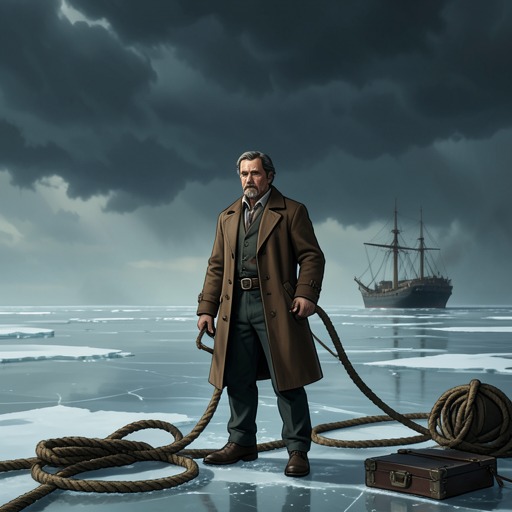
Brownlee’s prohibition on sending a sixth sealing boat
The North WaterArthur Brownlee’s prohibition on sending a sixth sealing boat is a safety order issued after Patrick Sumner nearly dies in the Arctic water. It places a limit on the ship’s sealing operation at a moment when the expedition’s commercial hopes depend on successful hunting, and exposes the tension between Brownlee’s responsibility for his men and the demand to bring back a profitable catch.
Origin and Immediate Circumstances
The order follows Sumner’s recovery from his near-fatal dunking. At supper, Brownlee hears the surgeon is improving and announces that there will be no more sixth boat: he does not want another man’s death on his conscience. Cavendish dismisses Sumner’s survival as luck, while Henry Drax treats it as astonishing; Brownlee ends the dispute by holding to the prohibition rather than debating how narrowly Sumner escaped.
The context is a hazardous sealing voyage. After sailing north from Lerwick through fog, sleet, wind, and gales, the crew encounter sea ice and prepare for the hunt with rifles, ammunition, and sharpened knives. When the seal pack appears, the boats are lowered at dawn. The account describes five whaleboats working the ice, placing Brownlee’s later reference to a sixth boat within an operation already demanding coordinated labor in dangerous conditions.
Commercial Pressure and Risk
Brownlee’s caution stands against the economic pressures surrounding the voyage. He has acknowledged that the older, less technologically demanding whaling trade has changed: a boat and harpoon once offered a chance of great returns, whereas modern hunting calls for powerful steam engines, harpoon guns, and luck, with no guarantee of a catch. The expedition’s successful sealing initially lifts morale, but its optimism depends on continuing to find and harvest animals while rival ships compete for the same grounds.
The order does not amount to abandoning the hunt. Brownlee’s stated limit is specifically on sending a sixth sealing boat, while the crew continue their work at sea. Later, after entering the North Water, they pursue a whale; the first strike is made by Black, and the hunt involves several boats. The evidence therefore presents the prohibition as a restriction on one dangerous deployment, not as a general ban on whaling or boat use.
Authority and Crew Conflict
Brownlee makes the rule explicit in front of the officers and crew: the surgeon has his role, and Cavendish has his. His insistence protects Sumner from being sent out with the hunters while also asserting the captain’s authority over how labor is assigned. The exchange reveals that the order is contested. Cavendish responds with visible irritation, and Drax’s remarks cast Sumner’s survival as undeserved rather than as a reason to change the crew’s practices.
The prohibition thus operates both as a practical limit and as a command about responsibility. Brownlee does not accept the suggestion that Sumner’s near-drowning was merely bad luck and therefore irrelevant to the ship’s conduct. He ties the danger to his own conscience and closes discussion, making the rule a direct expression of his duty as captain amid pressure to keep hunting.
Significance and Limits
The order captures a conflict that recurs across the voyage: commercial ambition demands sustained labor in ice and open water, but the work exposes the crew to serious danger. Brownlee has urged confidence in the expedition’s prospects, yet here he refuses to treat a near-fatal accident as an acceptable cost of pursuit. The ban is a concrete boundary placed on that pursuit, even as the ship continues sealing and later hunts whales.
The available account establishes Brownlee’s declaration and the crew’s reaction, but does not show a later decision to rescind it or establish that it governs every subsequent boat operation. Its clearest significance is therefore local and immediate: after Sumner’s accident, Brownlee forbids another sealing boat and makes the surgeon’s safety, at least in this respect, a matter of command.