Cavendish
The North WaterCavendish is the first mate aboard the Volunteer: a sociable, coarse-tongued officer who can organize difficult work and take command in a crisis, yet also uses intimidation against vulnerable crewmen and participates in a scheme to sink the ship. His trajectory turns on the widening gap between his practical authority and his judgment. He helps lead a dangerous Arctic voyage, assumes command after Brownlee is incapacitated, and is ultimately killed by Henry Drax during the winter crisis.
Identity and Introduction
Cavendish first comes into view in Lerwick, where he invites Sumner to join a party of seamen intent on sampling the local distillery. He presents the group by contrasting its members: Drax as a habitual drinker, Black as a supposedly restrained man, and Jones-the-whale as an inscrutable Welshman. The introduction establishes Cavendish’s taste for talk and performance. Rowed ashore by Drax and Jones-the-whale, he fills the journey with stories of knife fights and sexual exploits, treating conversation as a way to command attention.
His sociability does not make him a peacemaker. During the evening, Drax provokes a man and punches him; when the man’s crewmates retaliate, Cavendish goes to help and is knocked down in the ensuing fight. Sumner initially prefers to stay out of the brawl, but recognizes that the odds are against Cavendish and intervenes. The episode presents Cavendish as loyal to a fellow officer, though his response brings him into a confrontation he cannot control.
Work and Authority at Sea
On the northward passage, the crew endure gales before reaching the ice near Jan Mayen Island and preparing to hunt seals. Cavendish is among the officers whose work contributes to the voyage’s early momentum. Brownlee later judges him irritating but competent, while the success of the sealing raises morale aboard the Volunteer. In the North Water, Cavendish is among the men gathered around the first whale struck by Black, joining the dangerous work as the boats close in and the crew use lances to kill it. The carcass is then measured for its possible yield of oil and whalebone, and the crew flense it for the ship’s cargo.
Cavendish also treats shipboard labor as a test of character. When Sumner is assigned the physically demanding work of carrying blocks of blubber from the foredeck and pitching them into the hold, Cavendish later teases him that some surgeons would be too delicate for the task, but that Sumner has taken to it well. The remark is joking, yet it reflects the voyage’s labor hierarchy: a surgeon can be drawn into production work when the ship needs hands, and competence is measured in the body as well as in professional skill.
His authority has a harsher side in his dealings with Joseph Hannah. When Hannah is suspected of having suffered abuse, Cavendish is asked to bring him aft to answer questions. Later, as the crew prepare to render blubber, Cavendish notices Hannah’s absence, demands to know where he has gone, and speaks of punishing him when he is found. His language treats the cabin boy as an object of discipline rather than as a vulnerable crew member. After Hannah’s death, Cavendish tells Brownlee that questioning the men has produced a name: McKendrick. That accusation spreads through the ship and is followed by McKendrick’s confinement and isolation. Cavendish’s account initiates a consequential identification, but the crew’s certainty does not itself establish that the accusation is true.
Complicity and Command
While the Volunteer is delayed by dense ice near Pond’s Bay, Brownlee and Campbell discuss the planned loss of the vessel. Campbell stresses that the sinking must appear convincing and must not provoke the underwriters’ suspicion. Cavendish’s later exchange with Drax makes his own role plain: he considers whether the ship might be sunk later if it does not go down at once, while Drax objects that doing so would make the carefully built ice dock look pointless. The conversation links Cavendish’s practical work in the ice to a concealed commercial design. The dock is not simply protection from moving pack ice; its construction also helps create the appearance needed for the scheme.
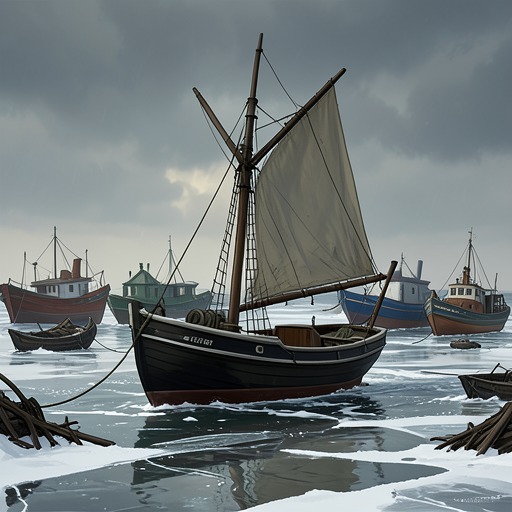
When the wind changes and drifting ice begins moving toward the ship, Cavendish directs the crew to cut an ice dock for protection. The operation demands coordinated labor: the men mark out the dock, rig pulleys and long steel saws, and work in teams to cut through ice six feet thick. Its sides extend two hundred feet, and the crew divide the floe into sections so the cut pieces can be moved. Cavendish’s ability to set this work in motion demonstrates genuine seamanship and command. It also sharpens the irony of his complicity: the same technical competence that serves the crew’s immediate survival is implicated in the effort to make the Volunteer’s destruction appear plausible.
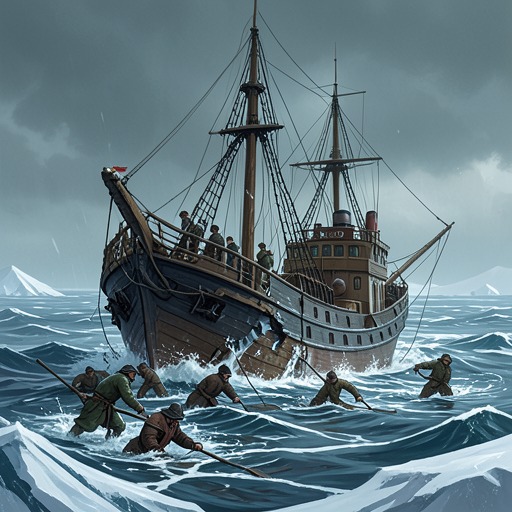
After Brownlee is gravely injured, Cavendish assumes command of the ship. Despite a broken nose and lost front teeth, he recovers sufficiently to resume his duties and address the men on deck. He tells them that Drax is chained in the hold and will take no further part in the voyage, describing Drax as exceptionally dangerous and presenting his confinement as a safeguard. The crew, however, increasingly regard the voyage as cursed, recalling the Percival and fearing that the Volunteer will also be lost beneath the Baffin ice. Cavendish now bears responsibility for command, but the men’s loss of confidence limits what authority can accomplish.
Conflict, Death, and Narrative Role
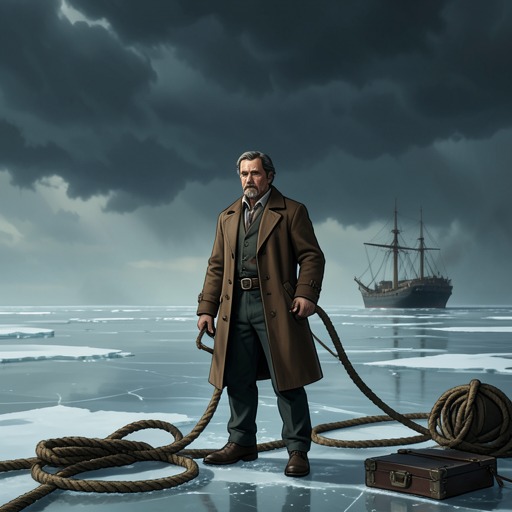
Cavendish’s relationship with Drax shifts from shared service to lethal conflict. When the two are stranded amid the winter camp’s breakdown, Drax draws Cavendish’s attention to a sleeping bag and asks him to look inside. As Cavendish bends to inspect it, Drax kills him with a knife and searches the pockets of Brownlee’s greatcoat. The killing removes the officer who had taken charge after Brownlee’s injury, leaving the camp still more exposed to Drax’s violence. Drax’s subsequent remark that the idea was Cavendish’s alone also preserves the implication that Cavendish had been involved in the plan against the ship, even as Drax distances himself from responsibility for it.
Cavendish’s significance lies in this uneasy combination of capability and complicity. He can organize a party, contribute to a successful hunt, supervise demanding work in the ice, and take over command when Brownlee cannot serve. Those capacities do not make him a reliable protector: his treatment of Hannah reveals how readily authority becomes threat, while his participation in the sinking scheme turns maritime skill toward deception. His death at Drax’s hands ends that contradiction without resolving it. Cavendish is neither merely an incompetent officer nor simply a victim of the crisis; he helps sustain the systems of labor and concealment that leave the crew in danger, then becomes one of the people those systems cannot save.