Cavendish deliberately scuttles Volunteer for insurance
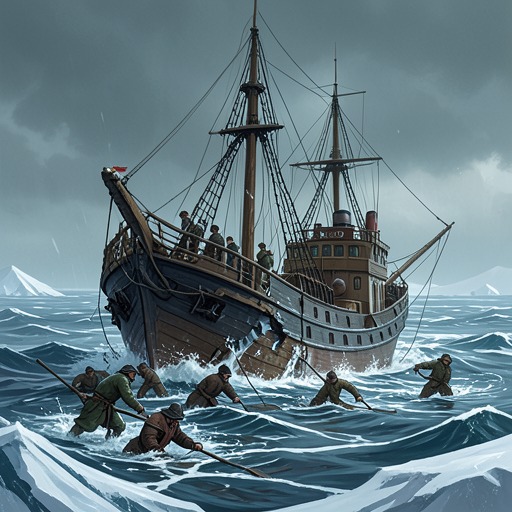
The North WaterCavendish’s deliberate scuttling of Volunteer converts an apparent Arctic maritime emergency into a planned act of insurance fraud. When the ice fails to destroy the ship, Cavendish and Drax discover that its hull remains largely intact; Cavendish then takes an axe to the timbers himself. The ship sinks, but the sequence makes clear that the decisive damage comes not from the ice but from the captain’s choice to complete the wreck by hand.
Commercial Scheme and Whaling’s Decline
The plan develops against a business that Brownlee and Baxter describe as losing its former profitability. Baxter recalls that whaling once allowed a modestly equipped ship to return with valuable cargo, but says that the industry now requires expensive steam power, harpoon guns, and luck, with no assurance of a successful catch. He argues that demand for whale oil has fallen as petroleum and coal gas take its place. Brownlee resists this account: he believes whales remain available farther north and insists that a capable captain and crew can still fill the hold. Their disagreement sets the commercial pressure behind the voyage: Brownlee wants to prove that whaling can still pay, while Baxter presents the old trade as an opportunity that should be abandoned for another source of profit.
Baxter makes the alternative concrete by showing Brownlee two parchment sheets and emphasizing a proposed £12,000 divided three ways, far beyond what Brownlee could expect to earn from killing whales. The papers connect the voyage to a profit scheme rather than an ordinary commercial expedition. Brownlee accepts the importance of the arrangement, but warns that Campbell must be present when needed or he will turn the ship around and sail home. Baxter describes money as something that finds new routes regardless of what the men prefer. The scheme thus treats the ship and its voyage as instruments whose purpose can change when the expected return from whaling no longer seems sufficient.
Arrangements for a Credible Loss
Campbell’s conversation with Brownlee clarifies that the ship’s destruction must be managed to look like a plausible accident. Campbell says the whales are a small part of the larger undertaking and warns that the timing matters: the ship must be sunk in a way that will not invite questions from the underwriters. Ice gives the conspirators a possible cover, but also creates risk for the people arranging the loss. Campbell says that delaying could leave him trapped as well. The scheme depends, therefore, not simply on destroying Volunteer, but on making the destruction appear consistent with the conditions of the voyage and arranging an escape before the ice closes around those involved.
The later circumstances supply that cover. After foul weather and heavy ice obstruct the ships’ progress, the crew has to respond to moving floes as a genuine threat. When the drift ice begins advancing, Cavendish orders the men to cut an ice dock for protection. The operation is laborious and carefully organized: men mark out the dock, work in teams with long ice saws, and divide the floe into large sections. This practical defense against the pack provides a credible setting for the ship’s apparent loss, while also placing the hull under pressure. Yet the same scene exposes the limits of the supposed accident: ice and danger alone do not produce the sinking that the plot requires.
The Deliberate Scuttling
Cavendish initially believes that Volunteer will not survive the pressure of the ice. Drax counters that the ship could remain afloat if left alone and suggests a direct way to ensure its destruction: he asks for only ten minutes with an axe to damage the hull. Cavendish distrusts him and refuses to hand over the tool, particularly because Drax has already attacked Brownlee. Their exchange reveals the tension between the two men even as both understand the purpose of the operation. Drax recognizes that the ship may need to be sabotaged; Cavendish wants to control the act himself.
When they inspect the forehold together, they find that water is entering through separated timbers and failed caulking, but the leak is only a dribble and the damage is not serious. Drax points out that the ship has bent without breaking. Cavendish sees that the ice has not done enough to sink her. He then takes the axe and strikes the dampened timbers repeatedly until the doubled planking begins to splinter inward. The reversal is decisive: the scene first makes the ship’s resistance visible, then shows Cavendish deliberately overcoming it. The sinking is not simply the outcome of a perilous passage. The captain makes it happen.
Abandonment and the Plan’s Exposure
Within two hours, Volunteer pitches forward so far that the bowsprit rests against the ice and the foremast breaks. Cavendish orders Black and a team of men back aboard to salvage spars, booms, and rigging and to cut down the remaining masts before they break away. The ship, stripped of its masts and largely hidden by the surrounding ice, no longer offers shelter or a means of escape. Sumner reflects on how fragile the construction seems beside the confidence he had once placed in it. The physical loss is also the operational consequence of Cavendish’s sabotage: the vessel is no longer a working whaler but a wreck to be abandoned.
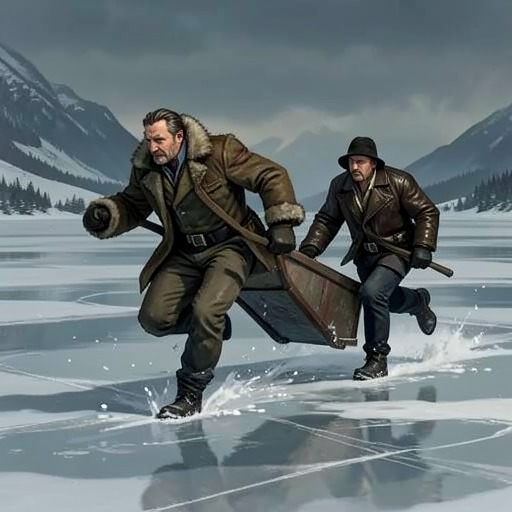
A route away from the wreck has already been arranged. Hastings lies four miles to the east, and Cavendish makes the journey across the ice. He returns with news that Campbell has offered refuge and hospitality, then organizes the transfer of men and supplies in three gangs, using whaleboats as sledges. This orderly evacuation stands in contrast to the ship’s destruction. The group has a destination and a method of moving its people and equipment, even as Volunteer is left behind. The planned refuge supports the inference that the sinking belongs to a wider arrangement rather than being an unforeseen disaster, although the text does not establish that an insurance payment is ever collected.
Revelation and Narrative Significance
Later, Sumner states his reconstruction of the plot to Baxter: he says Baxter had Cavendish sink Volunteer, and that the plan depended on Drax and Sumner being eliminated so that no one could expose it. In Sumner’s account, Drax was meant to shoot him and Stevens was expected to shoot Drax, leaving the matter apparently settled. Baxter challenges Sumner’s explanation and turns the conversation toward the two men dead in the timber yard, including the man Sumner has killed. Sumner’s accusation therefore makes the proposed insurance scheme explicit, while Baxter’s response keeps the exchange adversarial rather than supplying an unqualified confession.
The episode links the decline of whale-oil commerce to a more direct form of violence against labor and property. The ship is first valued as a tool for hunting, then as an asset whose destruction might yield a greater return. The ice is real, the work of protecting the vessel is real, and the danger to the crew is real; the fraud depends on folding deliberate damage into those genuine conditions. Cavendish’s axe reveals the distinction on which the scheme rests: the wreck must look like the work of the Arctic, even though its final cause is human action.