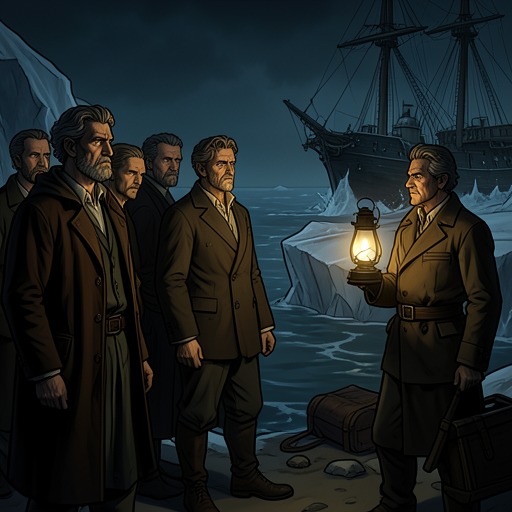
Cavendish kills Bannon during the camp mutiny
The North WaterCavendish kills Bannon during the camp mutiny after a day of fruitless searching for the missing Hastings has left the stranded crew exhausted, cold, and increasingly hostile. A quarrel over drink becomes a fight; when Bannon charges Cavendish with a barrel stave, Cavendish shoots him. The killing abruptly silences the camp and makes the struggle over command unmistakable: with Brownlee gone, Cavendish can hold authority only by showing that he is prepared to use lethal force.
Background and mounting pressure
The confrontation occurs after the Volunteer’s crew has been driven from the ship and forced to live in a makeshift camp on the ice. The men have spent the day rowing east along the land ice and north across broken drift ice, searching for the Hastings. They find neither the ship nor any indication of what has happened to it. Sumner, recently promoted to steersman, hopes that sighting the vessel might ease his fear, but the search ends in uncertainty. Among the crew, anxiety has hardened into bitterness and anger, and Cavendish’s disputed promotion to captain makes him an obvious target for their resentment.
Their hardship belongs to a voyage already shaped by commercial pressure and concealed plans. Before sailing, Brownlee insisted he could still fill the hold, while Baxter reminded him that twelve thousand pounds divided three ways would exceed what Brownlee could expect to earn from whaling. The exchange frames the expedition as both a hunt for whales and a venture in which money could redirect the ship’s purpose. Later, Campbell warns Brownlee that the Volunteer must be sunk in a way that will not prompt questions from the underwriters. These plans do not establish a direct cause for the camp fight, but they place its failing command structure inside a voyage where private financial interests and the crew’s exposure to danger are sharply at odds.
The work itself has offered intermittent success, not security. North of Lerwick, Drax kills seals across the ice, and Brownlee calculates the possible value of the skins. Later, Black strikes the crew’s first whale in the North Water; its carcass is estimated to yield ten tons of oil and more than half a ton of whalebone, worth close to nine hundred pounds at market. Such figures make the voyage’s commercial promise tangible, but they do not protect the men once the ship is lost and the crew is stranded. At the camp, the immediate facts are simpler: no work can be done, the Hastings remains absent, and the men must wait.
From disorder to gunfire
That evening, the cook prepares a meal from salt beef and old turnips. Cavendish taps a cask of brandy and has a ration distributed. The men take more without waiting for permission until the cask is empty. The gathering grows unstable; after a spell of drunken argument, a fight breaks out and someone draws a knife. McKendrick, who is watching rather than fighting, is cut deeply in the forearm, and the blacksmith is knocked unconscious. The violence is already spreading beyond a contest between the men who began the quarrel.
Cavendish tries to intervene but is struck on the head with a belaying pin. Sumner and Otto pull him outside to keep him from being beaten further. Otto returns to calm the men, but they abuse him and threaten him with the knife. Cavendish gets back to his feet, takes two loaded rifles from the whaleboats, and gives a third to Otto. He enters the tent again, fires into the ice to draw the men’s attention, and declares that he remains captain in Brownlee’s absence. His threat is not an attempt to settle the dispute by persuasion; it announces that any further challenge may be answered with a bullet.
Bannon, a Shetlander wearing silver hoops in his ears, picks up a barrel stave and rushes Cavendish. Cavendish shoots him. The other men respond with a roar of dismay, then fall silent. Cavendish drops the empty rifle and takes a loaded one from Otto. He warns the crew that the confrontation has cost a man his life and that he may shoot again if crossed. The killing thus follows a clear escalation: intoxication and argument give way to a general fight; attempts at intervention fail; Cavendish returns armed; Bannon’s charge is met with lethal force.
Consequences and significance
The immediate consequence is both Bannon’s death and the end of the open confrontation. The scene does not present a restored, consensual order. Instead, Cavendish secures a pause through a show of armed power, while the men are left to reckon with the fact that challenging him can be fatal. Otto’s presence on both sides of the intervention is also significant: he first tries to calm the camp, then supplies Cavendish with a loaded rifle, placing him within the desperate effort to control the violence.
The episode makes the instability of Cavendish’s captaincy concrete. His authority is already described as unearned and tainted by violence; here, in Brownlee’s absence and with the crew stranded, he enforces it himself. The episode’s value turns sharply from the possibility of holding the camp together to death and fear. That turn does not resolve the crew’s larger predicament—the Hastings is still missing, and the men remain on the ice—but it changes the terms on which they must endure it. Command has become inseparable from the threat of further violence.