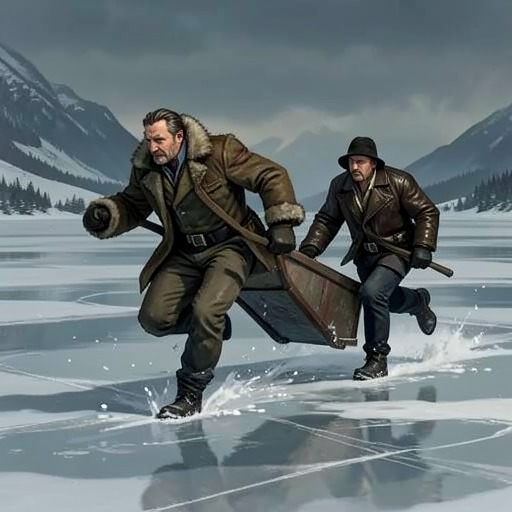
Cavendish shoots Bannon dead
The North WaterCavendish shoots Bannon dead during a breakdown of discipline at the winter camp, where a search for the missing Hastings has yielded no answers and the men’s frustration has turned inward. The killing is both a sudden death and a public assertion of authority: with Brownlee gone, Cavendish declares himself captain and demonstrates what resistance to his command will cost.
Setting and Pressures
The confrontation follows a voyage shaped by commercial desperation and mounting danger. Baxter has reminded Brownlee that the old returns from whaling are no longer dependable: modern equipment is expensive, and even a well-prepared ship may return without a catch. At the same time, Baxter has shown him papers promising twelve thousand pounds divided three ways, a sum he presents as beyond what Brownlee could expect to earn from whales. He describes money as a force that cannot be controlled, while Brownlee warns that there must be enough ice ahead. Their exchange establishes the profit-driven scheme surrounding the voyage, though the evidence does not make that scheme the direct cause of Bannon’s death.
The work at sea offers a measure of success but not security. After sailing north from Lerwick through fog, sleet, and gales, the crew reaches the seal pack near Jan Mayen Island. Five boats return laden with skins; Brownlee estimates that four hundred skins could yield nine tons of oil. Later, after the ship enters the North Water, Black strikes a whale, and the crew kills and flenses it. Brownlee estimates its products at close to nine hundred pounds at market and orders an extra ration of rum. These episodes show the labor and uncertain rewards sustaining the expedition: crews hunt and process animals through exhausting physical work, while the captain measures the result in cargo and market value.
The enterprise remains entangled with a plan to scuttle the Volunteer for insurance. When the Volunteer and the Hastings are waiting among other ships near Pond’s Bay, Campbell tells Brownlee that whales are secondary to finding an opportunity to sink the ship without making the loss look suspicious to underwriters. Later, drifting ice forces the men to cut a protective dock from a six-foot-thick floe, using long saws and coordinated teams. By the time the camp confrontation occurs, the crew has endured dangerous work, an unstable ice environment, and the disappearance of the Hastings. Earlier that day, Cavendish and Otto led boats searching for it; the men returned without seeing the ship or learning what had happened.
The Camp Mutiny
That evening, the crew gathers in a ramshackle, burned-over camp. The cook makes stew from salt beef and old turnips, and Cavendish serves each man brandy. The allotted portions do not end the drinking: the men take more until the cask is empty. In the resulting atmosphere of drunken argument, a fight breaks out and a knife is drawn. McKendrick, who is only watching, is cut in the forearm, and the blacksmith is knocked unconscious. These injuries are part of the disorder that Cavendish tries to stop, but his intervention does not restore calm.
When Cavendish moves to intervene, someone strikes him with a belaying pin. Sumner and Otto pull him outside to protect him from further blows. Otto then goes back in and is abused and threatened with the knife. Cavendish, back on his feet, arms himself with two loaded rifles from the whaleboats and gives a third to Otto. He re-enters the tent and fires once into the ice to command attention. He states that, with Brownlee gone, he remains captain and is prepared to kill anyone who challenges him. His claim rests not on an orderly transfer of authority, but on the immediate threat of armed violence.
The Shooting
After a pause, Bannon picks up a barrel stave and rushes at Cavendish. Cavendish fires from the rifle held at his hip. Bannon is killed, and the other men answer with a roar of dismay before falling silent. Cavendish drops the empty rifle and takes the loaded one from Otto. He tells the survivors to take heed: the disorder has cost a man his life. The sequence is starkly public. The warning, the pause, Bannon’s charge, and the shot make the death a turning point within the confrontation rather than an unseen consequence of the earlier brawl.
Cavendish continues to present himself as dangerous and unpredictable, telling the men that they should remember he does whatever takes his fancy if they cross him. His bloodied appearance and the disorder in the tent register the violence that preceded the shot, but the killing itself changes the balance of the scene: the crew’s collective anger gives way to silence, while Cavendish remains armed and in command. Otto’s role is also sharply divided. He first helps remove Cavendish from danger, then returns with a rifle and stands beside him as the confrontation resumes.
Consequences and Significance
The immediate consequence is Bannon’s death and the suppression of the camp’s challenge to Cavendish. The episode does not resolve the crew’s broader grievances or the uncertainty surrounding the Hastings; it establishes only that, in this moment, Cavendish can enforce his authority through lethal force. His title of captain is asserted alongside the threat, not separated from it. The men’s silence marks the immediate shift from open disorder to submission under arms.
The scene also brings the voyage’s competing forms of violence into close proximity. Before this night, the narrative has shown the organized killing of seals and whales as labor measured in skins, oil, and market value. Here, a human death occurs within a struggle over command, after a search in dangerous ice and a night of drunken conflict. The contrast does not make the events identical, but it places the crew’s commercial work and their own precarious lives within the same harsh expedition. Bannon’s death is the point at which a dispute among shipmates becomes an unmistakable demonstration of who can impose order—and by what means.