Corbyn
The North WaterCorbyn is the staff surgeon at the field hospital in Delhi, where he must make decisions amid a relentless influx of casualties and scarce time. His authority is both clinical and disciplinary: he determines which patients require immediate intervention, permits an armed expedition during a lull in the fighting, and later insists that Patrick Sumner’s departure from his post is a serious matter. The novel presents him as a capable practitioner whose judgment can preserve lives, but whose decisions also expose the compromises and unequal priorities built into wartime medicine.
Identity and Professional Background
Corbyn serves as a staff surgeon at the Delhi field hospital behind the racquet court. He has earlier experience with the Coldstream Guards at Inkerman, where, according to the account of his service, he worked amid two thousand dead in ten hours. The compressed description of a rifle in one hand and a scalpel in the other links his medical work to the violence surrounding it: he is not a civilian observer of battle but a practitioner formed within military conflict.
At Delhi, his work takes place in a hospital overwhelmed by the wounded. He and the assistant surgeons, including Sumner, Wilkie, and O’Dowd, operate through the morning, while Corbyn decides which limbs must be amputated at once and which may be saved. His authority depends on making distinctions quickly, in circumstances where delay itself has consequences. The scene establishes him not through a private history or a lengthy account of his character, but through the responsibilities he assumes and the decisions others must follow.
Medical Judgment in Delhi
The hospital’s work is repetitive and exhausting: one operation follows another, and the surgeons labor until the fighting slows and the flow of casualties stops. Corbyn’s role is to direct this work as well as participate in it. His earlier experience at Inkerman gives his assessment of the current crisis a grim measure; he treats the scale of the suffering as something he has encountered before, without suggesting that familiarity makes it easy.
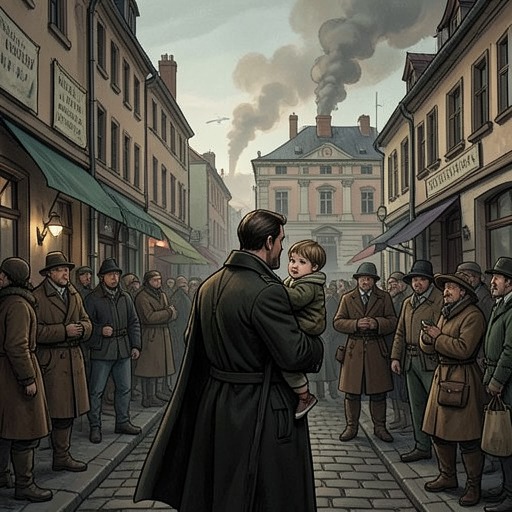
When a turbaned man brings a wounded child to the hospital, Corbyn examines the boy and judges that the injury is too severe for him to live long. The child’s companion insists that an operation may still be possible. Corbyn then orders Sumner, Wilkie, and O’Dowd to accompany the man, with the orderly Price, and tells them to arm themselves and return if the situation appears unsafe. He remains at the hospital with the child. The decision combines medical uncertainty with a calculated risk: Corbyn does not promise that the boy can be saved, but he allows the possibility of treatment to be pursued beyond the hospital’s immediate protection.
The arrangement is also explicitly tied to a share of the treasure sought by the party. Corbyn specifies equal shares for the four participants and an additional tithe for Price, while observing that prize agents cannot claim what they never learn about. His willingness to authorize the expedition therefore does not arise from medical duty alone. He is prepared to bend official rules and involve hospital personnel in a secret venture, even as he stays behind to care for the child. The juxtaposition leaves his judgment ethically mixed: he accepts danger and secrecy, but does not simply abandon the patient who prompted the decision.
Corbyn and Patrick Sumner
After Sumner is carried back through the damaged city, Corbyn recognizes him among the wounded and has him moved to a private side room. Sumner receives food, water, and laudanum, and an adjunct is sent to attend to his injured leg. Corbyn visits later that evening. His attention to Sumner is practical and immediate, and the private room distinguishes the surgeon’s response from the impersonal crush of the hospital below.
That care does not prevent Corbyn from treating Sumner’s conduct as a military offense. He tells him that a surgeon leaving his post is a serious matter, and makes clear that charges are likely. When Sumner asks what Corbyn intends to do, Corbyn says that he will be moved to the regimental hospital and receive the official charges shortly; he expects to see him again at the hearing. The exchange sets compassionate attention beside institutional accountability. Corbyn can be glad that Sumner survived and still regard the circumstances of his survival as grounds for prosecution.
The evidence does not make Corbyn’s judgment a simple act of personal hostility. He states the seriousness of leaving one’s post and describes the process Sumner will face, while Sumner experiences the warning as a threat to his career. Sumner believes he has no case and that appearing before the general will end his military life. Their unequal positions sharpen the exchange: Corbyn can explain the charges and anticipate the hearing, while Sumner can only ask why this is being done to him.
Memory and the Mistaken Attack
Later, in London, Sumner encounters an officer who resembles Corbyn only in age and height. Before recognizing the mistake, he remembers Corbyn at the court-martial as casual and unconcerned, and recalls him as seeming to possess the power to make or unmake the truth. That description belongs to Sumner’s recollection of the hearing, not to an independent account of Corbyn’s motives. Its importance lies in the force Corbyn’s remembered bearing has acquired for the disgraced surgeon.
As the officer approaches, Sumner’s anger rises; he steps out and strikes the man across the face. Only afterward does he realize that the officer is not Corbyn. He identifies the person he meant to attack as Corbyn, a regimental surgeon, but the stranger does not know the name. The mistaken assault turns Sumner’s unresolved grievance into a physical act directed at the wrong person. Corbyn is absent from the encounter itself, yet his remembered role in Sumner’s court-martial is powerful enough to shape it.
Narrative Role and Limits
Corbyn links the novel’s account of military medicine to its account of military justice. At Delhi he makes rapid clinical decisions under pressure, offers Sumner care after his return, and later invokes the obligation of a surgeon to remain at his post. These actions are not presented as mutually exclusive: the same officer who tends to a wounded man also participates in the system that may punish him.
His characterization remains bounded by the scenes in which he appears. The narrative shows his hospital work, his decision about the child and the proposed expedition, his response to Sumner’s return, and the way Sumner remembers him later. It does not establish what Corbyn thinks privately about the hearing or disclose what becomes of him after the mistaken attack. His narrative significance therefore rests less on a fully narrated personal arc than on the authority he exercises and the enduring place that authority occupies in Sumner’s memory.